
Synonyms for Journey: 25+ Better Words and Examples
Last updated: October 6, 2026
Thank you for reading this post, don't forget to subscribe!Everyone talks about their “journey” — the journey to better health, the journey of building a business, the journey across a new country. The word has become so popular that it can start to sound vague. The good news is that English offers sharper alternatives for every kind of journey, from the plain trip to the dramatic odyssey. According to the Merriam-Webster Thesaurus, a synonym is a word that means the same or nearly the same thing — so the right choice depends on how far, how hard, and how meaningful the travel is.
Table of Contents
- Quick Answer
- What Does “Journey” Mean?
- The Closest Alternatives to “Journey”
- “Journey” Synonyms at a Glance
- Synonyms for “Journey” by Context
- Grammar and Sentence Structure
- When Not to Use a Synonym for “Journey”
- Frequently Asked Questions
Quick Answer
- Trip — a short, casual journey there and back
- Voyage — a long journey, often by sea or air
- Expedition — a planned journey with a clear purpose
- Trek — a long, difficult journey on foot
- Passage — movement through time, space, or a life stage
- Odyssey — a long, eventful journey full of experiences
- Pilgrimage — a journey with spiritual or deep personal meaning
- Quest — a journey driven by a specific goal
- Route — the path a journey follows
- Course — the direction or progression of a journey over time
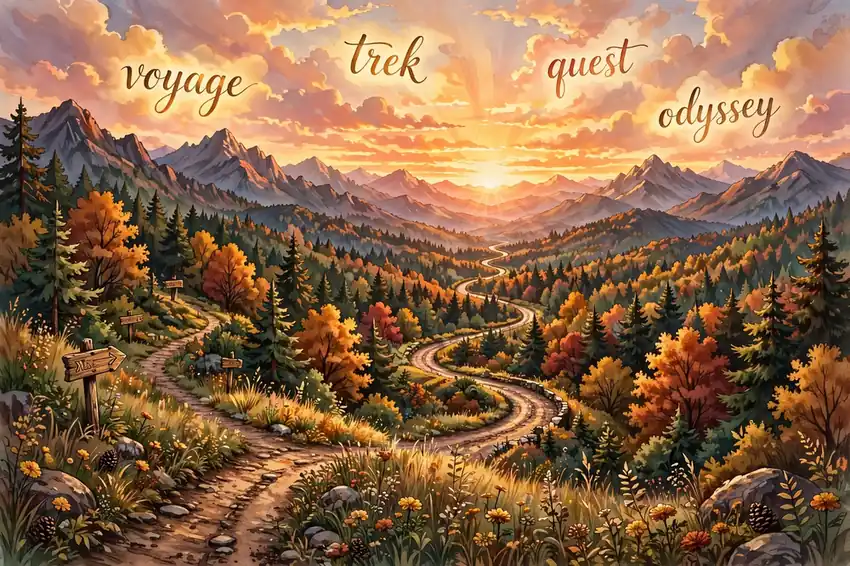
What Does “Journey” Mean?
A journey is an act of traveling from one place to another, usually over a long distance or an extended period. The word also works figuratively: it can describe any process of change, such as learning a skill, recovering from illness, or growing a career. That flexibility is why it shows up in everything from travel blogs to graduation speeches.
Examples: The journey to the northern mountains took nine hours by bus. Becoming a doctor was a ten-year journey for her.
The Closest Alternatives to “Journey”
Trip
Meaning: A relatively short journey with a defined start and return.
Difference: More casual and bounded than “journey”; rarely carries deep meaning.
Tone: Neutral, everyday.
Best Use: Vacations, errands, weekend getaways.
Example: Our trip to the coast lasted just three days.
Voyage
Meaning: A long journey, traditionally by ship but now also by plane or space.
Difference: Stresses distance and duration; sounds more grand than “journey”.
Tone: Slightly formal, literary.
Best Use: Ocean crossings, space travel, historical writing.
Example: Their voyage across the Pacific took nearly a month.
Expedition
Meaning: A journey organized for a specific purpose, such as research or exploration.
Difference: Implies a team, equipment, and planning that “journey” does not require.
Tone: Professional, adventurous.
Best Use: Scientific fieldwork, mountaineering, exploration stories.
Example: The expedition reached the glacier after six days of climbing.
Trek
Meaning: A long, difficult journey, usually on foot over rough terrain.
Difference: Emphasizes physical effort more than “journey” does.
Tone: Rugged, informal.
Best Use: Hiking, backpacking, adventure narratives.
Example: The trek through the highlands tested everyone’s stamina.
Passage
Meaning: The act of moving through a space, a period of time, or a stage of life.
Difference: Broader and less physical than “journey”; often abstract.
Tone: Neutral to formal.
Best Use: Life transitions, aging, long time spans.
Example: His passage into retirement was smoother than expected.
Odyssey
Meaning: A long journey marked by many adventures, setbacks, and lessons.
Difference: Far more dramatic and story-like than the plain word “journey”.
Tone: Literary, epic.
Best Use: Memoirs, personal stories of hardship and growth.
Example: Her search for a diagnosis became a medical odyssey.
Pilgrimage
Meaning: A journey made to a sacred place or for deep personal reasons.
Difference: Adds spiritual or emotional purpose beyond mere travel.
Tone: Serious, reverent.
Best Use: Religious travel, visits to meaningful places.
Example: They made a pilgrimage to the village where their grandparents were born.
Quest
Meaning: A journey undertaken to find or achieve something specific.
Difference: Goal-focused; a quest ends when the target is reached.
Tone: Motivated, narrative.
Best Use: Self-improvement projects, research goals, stories of pursuit.
Example: His quest for the perfect recipe took him through twelve countries.
Route
Meaning: The specific path taken during a journey.
Difference: Concrete and navigational; describes the way, not the experience.
Tone: Practical, neutral.
Best Use: Directions, logistics, delivery planning.
Example: We changed our route to avoid the flooded road.
Course
Meaning: The direction something takes, or its progression through stages.
Difference: More abstract than “journey”; suits processes rather than trips.
Tone: Neutral, analytical.
Best Use: Career paths, studies, developments over time.
Example: The course of his career changed after the scholarship.
“Journey” Synonyms at a Glance
| Alternative | Main Meaning | Tone | Best Use |
|---|---|---|---|
| Trip | Short casual travel | Neutral | Vacations, errands |
| Voyage | Long-distance travel | Formal | Sea or air travel |
| Expedition | Purposeful journey | Professional | Exploration, research |
| Trek | Hard walk or hike | Rugged | Outdoor adventures |
| Passage | Movement through time or space | Neutral | Life stages |
| Odyssey | Epic, eventful journey | Literary | Personal stories |
| Quest | Goal-driven journey | Motivated | Projects, pursuits |
| Route | Path taken | Practical | Directions, logistics |
| Course | Progression over time | Neutral | Careers, studies |
Synonyms for “Journey” by Context
Formal Writing and Essays
- Voyage — for historical or long-distance travel
- Expedition — for scientific or organized efforts
- Passage — for abstract movement through time
- Odyssey — for narrative essays with drama
Casual Speech
- Trip — your default everyday word
- Trek — when it was hard or long
- Route — when you’re talking directions
Business and Careers
- Course — for career or project progression
- Quest — for mission-driven goals
- Journey itself — still fine for brand storytelling
Personal Growth and Reflection
- Pilgrimage — when the travel carries deep meaning
- Odyssey — when it was long and transformative
- Passage — when describing a life transition
Grammar and Sentence Structure
“Journey” is a countable noun: one journey, two journeys. It pairs with verbs such as take, begin, embark on, continue, and complete. Note that we say “embark on a journey” but “take a trip” — mixing those verb pairings sounds awkward. Descriptive adjectives usually come before the noun: a long journey, a solo journey, an unforgettable journey.
Examples: We embarked on the journey at sunrise. It was a difficult but rewarding journey for the whole team.
When Not to Use a Synonym for “Journey”
1. Short, ordinary distances: Using a grand word for a tiny errand sounds silly.
Wrong: It was a long odyssey to the grocery store.
Corrected: It was a quick trip to the grocery store.
2. Trips with no deeper meaning: “Pilgrimage” implies reverence, so don’t use it casually.
Wrong: Our daily pilgrimage to the coffee shop.
Corrected: Our daily trip to the coffee shop.
3. Talking about the path, not the experience: When you mean the road itself, pick the concrete word.
Wrong: We started our odyssey on Highway 9.
Corrected: We started our route on Highway 9.
Frequently Asked Questions
Q: Can “journey” describe something that isn’t travel?
A: Yes. It often describes processes like healing, learning, or building a career — anything with stages and progress.
Q: What is the difference between a trip and a journey?
A: A trip is usually short and casual, while a journey suggests more distance, time, or significance. A weekend away is a trip; a year of study abroad is a journey.
Q: Is “odyssey” too dramatic for an essay?
A: It works if your essay covers many events or real struggles. For ordinary topics, “journey” or “trip” is safer.
Q: What is the plural of “journey”?
A: “Journeys.” The y changes to i only after a consonant plus y with certain endings, which doesn’t apply here.
For an overview of many more word lists, see synonyms for 200 common words. You may also enjoy the earlier lists for synonyms for sad and synonyms for but.
Faizi is a content writer at AllAboutFacts (hotteamnames.com), covering vocabulary, language tips, and everyday explainers.


