
Synonyms for This Shows: 25+ Better Words and Examples
Last updated: October 6, 2026
Thank you for reading this post, don't forget to subscribe!“This shows” is one of the most overused phrases in school essays and academic writing. If you have caught yourself typing it in every paragraph, you are not alone — and the good news is that there are plenty of sharper ways to say the same thing. Below you will find 25+ alternatives, from formal research terms to casual everyday swaps, so your writing sounds varied and confident. For even more word choices, browse the Merriam-Webster Thesaurus whenever you revise a draft.
Table of Contents
- Quick Answer
- What Does “This Shows” Mean?
- The Closest Alternatives to “This Shows”
- “This Shows” Synonyms at a Glance
- Synonyms for “This Shows” by Context
- Grammar and Sentence Structure
- When Not to Use a Synonym for “This Shows”
- Frequently Asked Questions
Quick Answer
Here are the best substitutes for “this shows,” each with a note on when it fits:
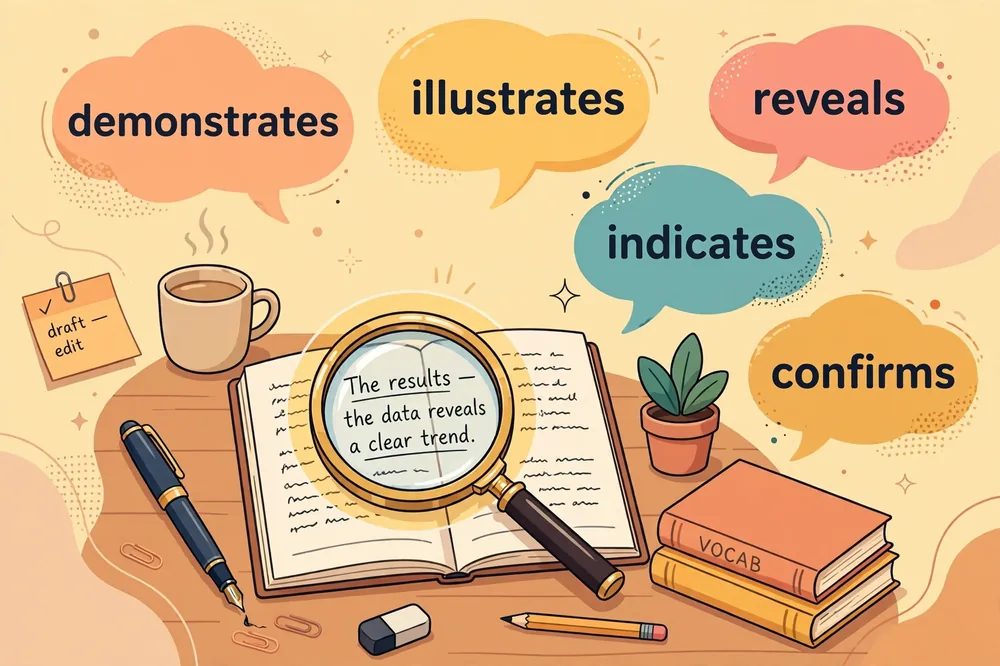
- This demonstrates — the closest formal upgrade; safe for almost any essay
- This indicates — suggests the evidence points to a conclusion without proving it
- This illustrates — perfect when you are pointing to a concrete example
- This reveals — works when the evidence uncovers something hidden or surprising
- This suggests — softer; use when the evidence hints rather than proves
- This confirms — strong; use only when the evidence actually settles the question
- This highlights — draws the reader’s attention to an important point
- This proves — the strongest option; reserve for cases with airtight evidence
- This implies — says the conclusion follows logically from the evidence
- This underscores — emphasizes something the paragraph already established
What Does “This Shows” Mean?
“This shows” is a demonstrative phrase that writers use to connect evidence to a claim. The word “this” points back to whatever was just stated — a statistic, a quote, an experiment result — and “shows” says that it makes your point visible or clear. Teachers often circle it because it is vague: it tells the reader that something is being shown but never says how the evidence does the showing.
Consider the difference: “The survey found that 80% of students study at night. This shows that night study is popular.” The sentence works, but swapping in a more precise verb — “this indicates,” “this suggests” — would tell the reader exactly what relationship the writer sees between the survey and the claim. That precision is what separates plain writing from polished academic writing.
The Closest Alternatives to “This Shows”
This demonstrates
Meaning: clearly displays or proves something through evidence or examples.
Difference: stronger and more formal than “shows”; carries the sense of a display for the reader’s benefit.
Tone: formal, academic, authoritative.
Best Use: the default upgrade for almost any school essay or report.
Example: “This demonstrates that regular sleep improves test scores.”
This indicates
Meaning: points to a conclusion as a sign or signal.
Difference: slightly cautious — the evidence points toward a conclusion rather than proving it outright.
Tone: formal, measured, scientific.
Best Use: lab reports, data analysis, and any writing where you want to sound careful.
Example: “This indicates that demand for remote work is still rising.”
This illustrates
Meaning: makes something clearer by giving an example.
Difference: the best choice when your evidence is a specific case, story, or picture rather than data.
Tone: formal but accessible.
Best Use: literature essays, case studies, and explanations that use examples.
Example: “This illustrates how quickly rumors spread on social media.”
This reveals
Meaning: makes something visible that was previously hidden.
Difference: implies a discovery — the evidence brings something new to light.
Tone: slightly dramatic, confident.
Best Use: when the finding is surprising or contradicts expectations.
Example: “This reveals a pattern of bias in the hiring data.”
This suggests
Meaning: hints at or proposes a conclusion based on evidence.
Difference: the softest of the strong options; it hedges, which is sometimes exactly what you need.
Tone: cautious, tentative, academic.
Best Use: when the evidence is limited or you are proposing an interpretation.
Example: “This suggests that smaller classes benefit struggling students.”
This confirms
Meaning: verifies or backs up an existing claim.
Difference: only works when the claim was already made and the evidence supports it.
Tone: confident, decisive.
Best Use: research writing where new data matches an earlier hypothesis.
Example: “This confirms the theory that exercise improves mood.”
This highlights
Meaning: calls attention to an important point.
Difference: focuses on emphasis rather than proof — you are spotlighting, not arguing.
Tone: neutral to positive.
Best Use: essays and presentations where you want to flag a key takeaway.
Example: “This highlights the need for better public transport.”
This proves
Meaning: establishes something as true beyond reasonable doubt.
Difference: the strongest claim on this list; overuse can make writing sound arrogant or sloppy.
Tone: absolute, forceful.
Best Use: mathematics, logic, and cases where the evidence is genuinely conclusive.
Example: “This proves that the company violated its own policy.”
This implies
Meaning: indicates something indirectly, through logical consequence.
Difference: the evidence does not state the conclusion outright — the reader must follow the logic.
Tone: formal, analytical.
Best Use: philosophy, literary analysis, and arguments built on reasoning.
Example: “This implies that the author distrusted the new government.”
This underscores
Meaning: emphasizes or stresses the importance of something.
Difference: best used for conclusions the reader should not miss, especially near the end of an essay.
Tone: formal, emphatic.
Best Use: conclusions and topic sentences that restate a main point.
Example: “This underscores why recycling programs deserve more funding.”
“This Shows” Synonyms at a Glance
| Alternative | Main Meaning | Tone | Best Use |
|---|---|---|---|
| This demonstrates | clearly displays through evidence | formal | general academic essays |
| This indicates | points to as a sign | measured, scientific | data and lab reports |
| This illustrates | clarifies with an example | formal, accessible | literature, case studies |
| This reveals | uncovers something hidden | confident | surprising findings |
| This suggests | hints at a conclusion | cautious | tentative interpretations |
| This confirms | verifies an existing claim | decisive | supporting a hypothesis |
| This highlights | calls attention to | neutral | key takeaways |
| This proves | establishes as true | absolute | conclusive evidence only |
| This implies | indicates indirectly | analytical | logic-based arguments |
| This underscores | stresses importance | emphatic | conclusions |
| This reflects | mirrors a wider trend | neutral | linking detail to the big picture |
| This supports | backs up an argument | neutral, academic | building an evidence chain |
Synonyms for “This Shows” by Context
Formal academic writing
- This demonstrates — the all-purpose academic upgrade.
- This indicates — for data that points to a trend.
- This evidences — rare but very formal; best in dissertations.
- This substantiates — when the evidence backs up a claim with weight.
- This corroborates — when one source agrees with another.
Essays and school assignments
- This illustrates — great when you quote or summarize an example.
- This highlights — draws the teacher’s eye to your key point.
- This means that — a simple, natural way to restate a point plainly.
- From this, we can see that — a longer, readable transition.
- This leads to the conclusion that — useful when you are wrapping up an argument.
Business and professional writing
- This confirms — tells stakeholders the data backs the plan.
- This underscores — emphasizes a strategic point in a report.
- The data tells us that — plain, direct, confident.
- This reinforces — when findings strengthen an earlier point.
Casual speech and everyday writing
- This just goes to show — conversational, slightly opinionated.
- That says a lot — informal way to point out what evidence implies.
- Which means — short, natural bridge between evidence and point.
- You can tell from this — friendly and direct for blogs or messages.
Grammar and Sentence Structure
“This shows” follows a simple pattern: a demonstrative subject (“this”) plus a verb (“shows”), usually followed by a “that” clause or a noun phrase. Its replacements follow the same pattern, so swapping them in is straightforward: “This demonstrates that…”, “This reveals a pattern of…”.
A few grammar notes will keep your sentences clean. First, make sure “this” has a clear antecedent — the reader should know exactly what “this” refers to. Vague demonstratives are one reason teachers dislike the phrase. Second, after “this suggests” or “this implies,” prefer a “that” clause (“this suggests that prices will rise”) rather than a bare noun, since hedging verbs read more naturally with clauses. Third, match the verb to your evidence: singular data “indicates,” plural studies “demonstrate.” These small choices make your writing sound precise rather than mechanical.
When Not to Use a Synonym for “This Shows”
Mistake 1: Using “this proves” for weak evidence.
Wrong: “One survey of 20 people proves that teenagers never read books.”
Corrected: “One survey of 20 people suggests that teenagers read fewer books than before.”
Mistake 2: Using “this reveals” when nothing new is revealed.
Wrong: “This reveals that water is wet.”
Corrected: “This illustrates how obvious the problem had become.”
Mistake 3: Swapping the phrase but keeping the vagueness.
Wrong: “This demonstrates stuff about the economy.”
Corrected: “This demonstrates that unemployment fell for the third straight month.” Even the best synonym cannot rescue a sentence with nothing concrete after it — always name the point your evidence supports.
Frequently Asked Questions
What is the best formal synonym for “this shows” in an essay?
“This demonstrates” is the safest formal choice — it is accepted in every academic context and carries no extra baggage. “This indicates” works better when you are being cautious about data.
What can I say instead of “this shows” in a conclusion?
Try “this underscores,” “this confirms,” or “this leads to the conclusion that.” These signal that you are wrapping up rather than introducing new evidence.
Is “this proves” too strong for most essays?
Usually, yes. “Proves” claims there is no room for doubt, and most school evidence does not meet that bar. Save it for airtight cases; otherwise use “suggests,” “indicates,” or “supports.”
How do I stop repeating “this shows” in every paragraph?
Rotate through 3–4 alternatives from this article and match each one to what your evidence actually does — illustrate, suggest, confirm, reveal. Building your broader vocabulary also helps; for instance, our guide to synonyms for so tackles another phrase students overuse, and the pillar article on synonyms for 200+ common words to expand your vocabulary collects the full series.
Faizi is a content writer at AllAboutFacts (hotteamnames.com), covering vocabulary, language tips, and everyday explainers.


