
Synonyms for Which: 25+ Better Words and Examples
Last updated: October 6, 2026
Thank you for reading this post, don't forget to subscribe!We use “which” in almost every paragraph we write — to ask questions, to describe things, and to add extra detail to sentences. But repeating it again and again makes writing feel flat and mechanical. Learning the best synonyms for which gives you sharper, more natural ways to connect ideas, and the Merriam-Webster Thesaurus is a handy place to double-check any replacement.
- Quick Answer
- What Does “Which” Mean?
- The Closest Alternatives to “Which”
- “Which” Synonyms at a Glance
- Synonyms for “Which” by Context
- How to Use “Which” Correctly
- When Not to Use a Synonym for “Which”
- Frequently Asked Questions
Quick Answer
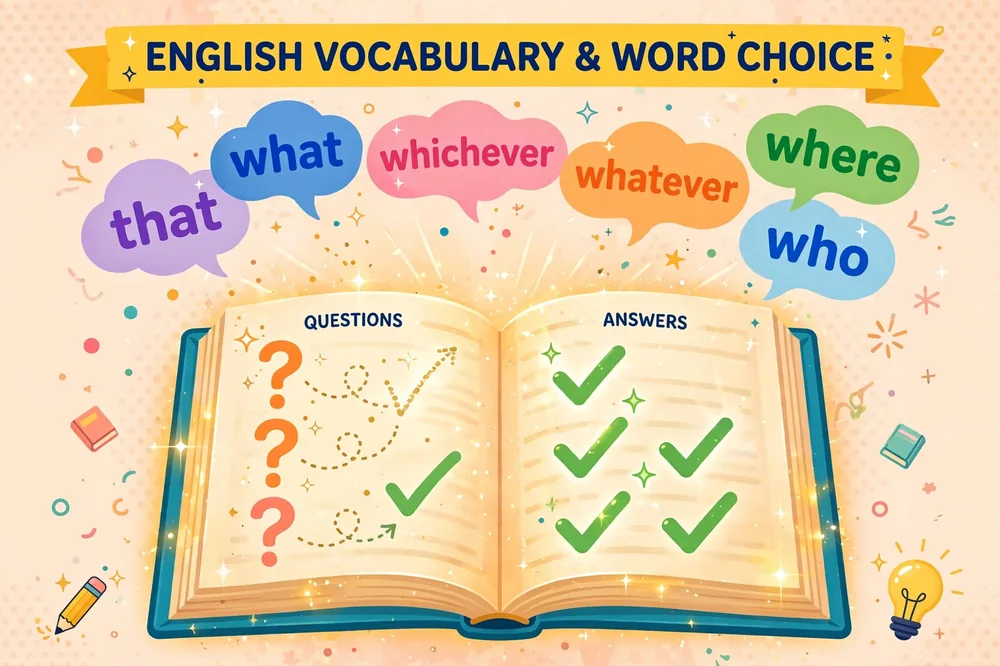
Here are the best synonyms for “which” to keep in your toolkit:
- That — for essential, defining clauses (“the book that changed my life”)
- What — for direct questions and noun clauses (“what did you say?”)
- Whatever — for open-ended choices (“take whatever you like”)
- Whichever — for picking from options (“whichever is cheapest”)
- Who — when the thing being described is a person
- Where — when you’re really talking about a place or situation
- When — when you’re really talking about a time
- As — in comparisons and certain descriptive clauses (“such as”)
- Including — to introduce examples (“…including the blue one”)
- Such as — to name examples instead of listing (“fruits such as mango”)
- Out of which — for selections from a known group (“three out of which”)
- Of which — formal writing (“a topic of which little is known”)
What Does “Which” Mean?
“Which” is a question word and a connecting word, not a describing word like “happy” or “fast.” Its job is to point at a thing, a choice, or an idea:
- Asking: “Which color do you prefer?” — it asks someone to pick from options.
- Connecting: “The car, which was brand new, broke down.” — it links extra information to the noun before it.
- Choosing: “You can take which route you like.” — it presents alternatives.
Example: “The movie, which lasted three hours, felt too long.” Here “which” ties the extra detail (its length) back to “the movie.” Because “which” works differently in questions, choices, and descriptions, its synonyms depend on the job it’s doing — and that’s what we’ll explore below.
The Closest Alternatives to “Which”
That
Meaning: introduces essential information that defines the noun.
Difference: “That” signals the clause is necessary — removing it changes the meaning. “Which” (with commas) usually adds optional detail.
Tone: neutral, direct, slightly more American in style.
Best Use: defining clauses in everyday and business writing.
Example: “Bring the folder that has the reports.” (not the other folder)
What
Meaning: asks for or names an unspecified thing.
Difference: “What” works when there’s no set list of options; “which” usually implies a known set.
Tone: neutral, conversational.
Best Use: questions and noun clauses.
Example: “I don’t know what you’re talking about.”
Whatever
Meaning: “any thing at all” — no restrictions.
Difference: “Which” narrows; “whatever” opens wide.
Tone: casual, sometimes dismissive.
Best Use: open offers and informal speech.
Example: “Pick whatever toppings you want.”
Whichever
Meaning: “any one of these options.”
Difference: stronger and more decisive than “which”; it stresses that any choice is fine.
Tone: confident, flexible.
Best Use: instructions and offers where the choice doesn’t matter.
Example: “Take whichever seat is free.”
Who
Meaning: refers back to a person.
Difference: “Which” is for things; “who” is for people — using “which” for people sounds cold.
Tone: natural, correct in all registers.
Best Use: describing people (“the teacher who helped me”).
Example: “She’s the doctor who treated my father.”
Where
Meaning: points to a place or situation.
Difference: “Which” points at a thing; “where” points at a location or state of affairs.
Tone: neutral.
Best Use: clauses about places and situations.
Example: “We reached a point where we had to decide.” (Better than “…a point which we had to decide at.”)
When
Meaning: points to a time or moment.
Difference: “Which” identifies the thing; “when” identifies the time.
Tone: neutral.
Best Use: clauses about time.
Example: “There are days when nothing goes right.”
Such as
Meaning: introduces examples.
Difference: “Which” links a description; “such as” names illustrations.
Tone: formal to neutral.
Best Use: academic and business writing.
Example: “Many fruits, such as mango and guava, grow here.” (instead of “…fruits, which include mango…”)
Including
Meaning: adds items to a group being mentioned.
Difference: “Which” describes; “including” lists.
Tone: neutral, business-friendly.
Best Use: reports, lists, and presentations.
Example: “The package contains everything, including the charger.”
Of which
Meaning: “belonging to which” — formal phrasing for a known group.
Difference: “Which” is plain; “of which” is elevated and precise.
Tone: formal, academic.
Best Use: essays, legal, and academic writing.
Example: “He owns three farms, one of which dates back a century.”
“Which” Synonyms at a Glance
| Alternative | Main Meaning | Tone | Best Use |
|---|---|---|---|
| That | essential describing clause | neutral | defining descriptions |
| What | unspecified thing or question | neutral | questions, open noun clauses |
| Whatever | anything at all | casual | open offers |
| Whichever | any one of the options | confident | choices that don’t matter |
| Who | refers to a person | neutral | describing people |
| Where | place or situation | neutral | location-based clauses |
| When | time or moment | neutral | time-based clauses |
| Such as | introduces examples | formal-neutral | academic and business writing |
| Including | adds items to a group | neutral | lists and reports |
| Of which | belonging to the group | formal | academic writing |
Synonyms for “Which” by Context
In Formal Writing
- Of which — “the policy, one clause of which was disputed…”
- Such as — “issues such as inflation and debt…”
- That — for precise defining clauses: “the method that works best”
In Casual Speech
- What — “I forgot what you said.”
- Whatever — “wear whatever feels comfortable.”
- Whichever — “pick whichever movie you want.”
In Business Writing
- Including — “all departments, including sales and HR”
- That — “the plan that we approved in May”
- Such as — “services such as delivery and support”
How to Use “Which” Correctly
Most confusion around “which” comes from one rule: use “which” with commas for extra, removable information, and “that” without commas for essential information.
- Extra detail: “My laptop, which is five years old, still works fine.” (The sentence survives without the middle part.)
- Essential detail: “Bring the laptop that has the charger.” (Without “that has the charger,” we don’t know which laptop.)
- Questions: Use “which” when choosing from a known set — “Which of these jackets is yours?” Use “what” when the options are open — “What is your favorite food?”
- After prepositions: Only “which” works after a preposition, never “that”: “the house in which I grew up” is correct; “the house in that I grew up” is not.
Like other small connecting words, mastering “which” sharpens whole sentences. Readers building strong foundations often pair this with our guides on synonyms for but and synonyms for so, and our hub of synonyms for 200 common words to expand your vocabulary.
When Not to Use a Synonym for “Which”
Mistake 1: Swapping “which” for “that” after a preposition.
Wrong: “the company in that I worked.”
Right: “the company in which I worked.” (Only “which” follows a preposition.)
Mistake 2: Using “which” for people.
Wrong: “the manager which hired me.”
Right: “the manager who hired me.” (“Which” is for things; “who” is for people.)
Mistake 3: Dropping the commas around a non-essential “which” clause.
Wrong: “The report which took two weeks is finally done.”
Right: “The report, which took two weeks, is finally done.” (The detail is extra, so it needs commas.)
Frequently Asked Questions
Q: Are “which” and “that” interchangeable?
A: Not always. “That” is for essential clauses without commas; “which” is for extra clauses with commas. Swapping them changes the rhythm and sometimes the meaning of the sentence.
Q: Can “which” refer to a whole sentence?
A: Yes — “He arrived late, which annoyed everyone.” Here “which” refers to the whole idea of arriving late. This works, but overusing it makes writing vague.
Q: Is “whichever” just a longer “which”?
A: Close, but “whichever” adds emphasis that the choice doesn’t matter: “Take whichever” sounds more generous and decisive than “Take which.”
Q: What’s the quickest way to reduce “which” in my writing?
A: Turn clauses into phrases: “the book which was written by her” becomes “the book written by her.” Reaching for alternatives like “that,” “including,” or “such as” also breaks the repetition.
Faizi is a content writer at AllAboutFacts (hotteamnames.com), covering vocabulary, language tips, and everyday explainers.


