Synonyms for New: 25+ Better Words and Examples
Last updated: October 6, 2026
Thank you for reading this post, don't forget to subscribe!“New” is one of the most overused adjectives in English. We say new phone, new idea, new friend — and after a while, the word loses its spark. The good news is that English has dozens of sharper alternatives that capture exactly what kind of “new” you mean. This guide gives you 25+ synonyms for “new” with examples, so your writing sounds precise instead of repetitive. When you need even more choices, the Merriam-Webster Thesaurus is a reliable place to look.
Table of Contents
- Quick Answer
- What Does “New” Mean?
- The Closest Alternatives to “New”
- “New” Synonyms at a Glance
- Synonyms for “New” by Context
- Grammar and Sentence Structure
- When Not to Use a Synonym for “New”
- Frequently Asked Questions
Quick Answer
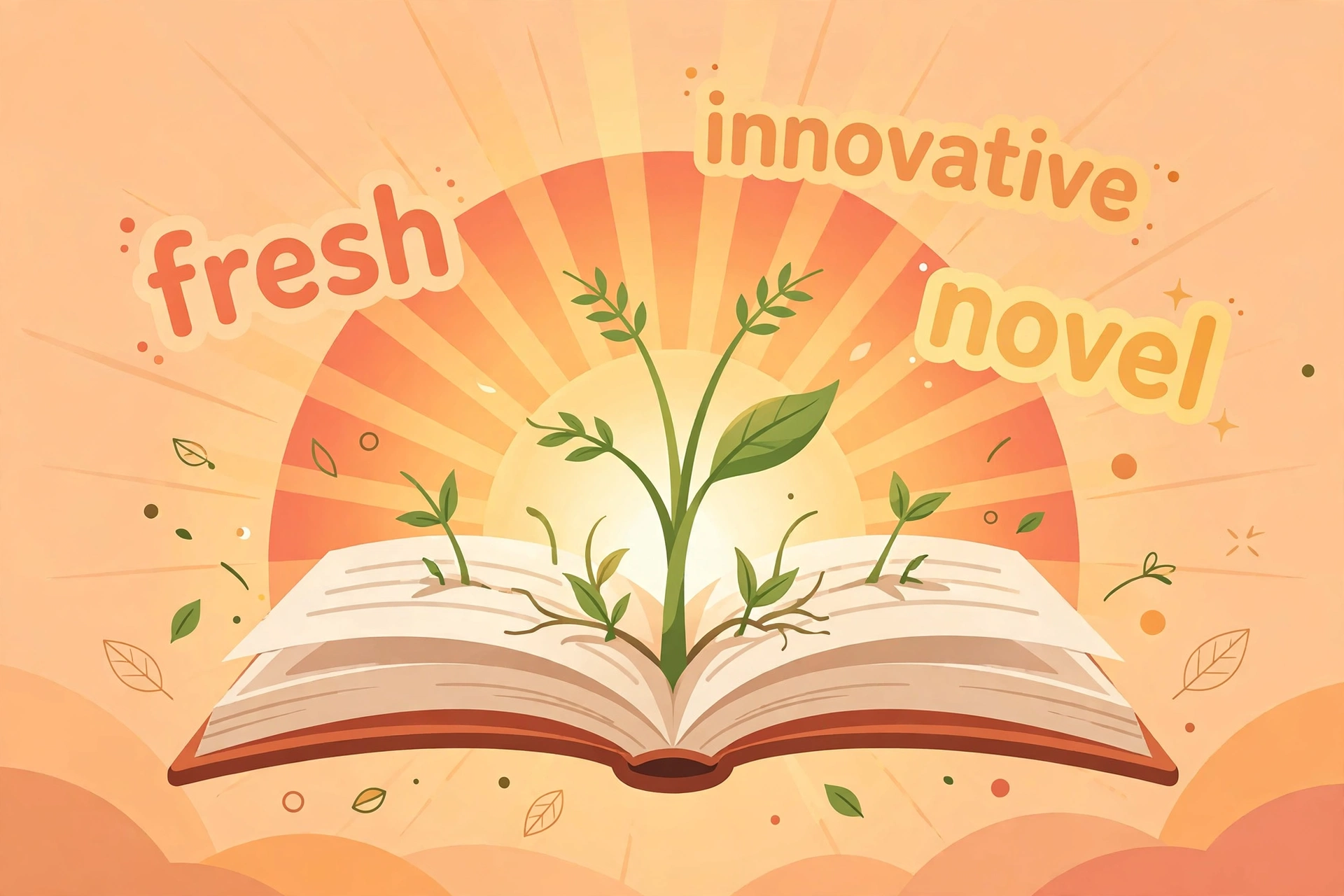
- Fresh — crisp and lively; ideal for ideas, starts, and produce
- Novel — original and unusual; often used for ideas and approaches
- Innovative — creative and forward-thinking; great for products and solutions
- Original — first of its kind; emphasizes authenticity
- Modern — current and up to date; contrasts with the old-fashioned
- Recent — happened or made not long ago; neutral and factual
- Latest — the most recent version; common in news and tech
- Brand-new — completely unused; emphatic and informal
- Cutting-edge — at the forefront of development; tech-savvy tone
- Groundbreaking — pioneering and revolutionary; for big advances
- Unprecedented — never seen before; dramatic and formal
- Up-to-date — current with the latest information; practical tone
What Does “New” Mean?
“New” describes something that has recently come into existence, been discovered, or been introduced for the first time. It can apply to objects (a new car), ideas (a new theory), people (a new neighbor), or experiences (a new hobby). It also covers things that are simply unfamiliar to the speaker, as in “this is new to me.”
Because the word is so broad, it often hides useful meaning. Saying “we need a new approach” is vague; saying “we need a fresh approach” or “an innovative approach” tells the listener what kind of change you want. For example: “The company launched a new line of headphones.” That tells you the headphones exist; it doesn’t tell you whether they’re redesigned, cheaper, or technologically advanced.
And if you’re writing about the thrill of something new, you may also like our guide to synonyms for excited — it covers the feelings that usually come with fresh starts.
The Closest Alternatives to “New”
Fresh
Meaning: Recently made or arrived; full of energy and life.
Difference: While “new” only means recent, “fresh” adds a sense of vitality and crispness.
Tone: Positive and lively.
Best Use: Ideas, perspectives, starts, and food.
Example: “The team brought a fresh perspective to the project.”
Novel
Meaning: New and original in a way that is different from anything before.
Difference: Stresses originality, not just recency — a novel idea may be years old but still unmatched.
Tone: Intellectual and formal.
Best Use: Academic writing, research, and creative problem-solving.
Example: “The study proposed a novel method for testing water quality.”
Innovative
Meaning: Introducing new ideas or methods; creative and forward-looking.
Difference: Implies deliberate creativity and improvement, not just novelty.
Tone: Professional and positive.
Best Use: Business writing, product descriptions, and resumes.
Example: “The startup is known for its innovative payment solutions.”
Original
Meaning: Not copied or imitated; the first of its kind.
Difference: Emphasizes authenticity and authorship rather than recency.
Tone: Neutral to admiring.
Best Use: Art, writing, ideas, and design.
Example: “Her original screenplay won three awards.”
Modern
Meaning: Relating to the present time; current in style or technology.
Difference: Focuses on being current rather than freshly created — a modern building can be decades old.
Tone: Neutral.
Best Use: Design, architecture, and lifestyle writing.
Example: “They remodeled the kitchen in a clean, modern style.”
Recent
Meaning: Having happened or been made not long ago.
Difference: A neutral time marker — it doesn’t praise or promise anything.
Tone: Factual and plain.
Best Use: News, reports, and everyday descriptions.
Example: “A recent study found that walking improves focus.”
Latest
Meaning: The most recent version, model, or development.
Difference: Implies a series with updates — the latest phone replaces last year’s.
Tone: Neutral; slightly promotional in ads.
Best Use: Technology, news, and product announcements.
Example: “Have you downloaded the latest update?”
Brand-new
Meaning: Completely new; never used before.
Difference: A stronger, more emphatic “new” — nothing secondhand about it.
Tone: Informal and enthusiastic.
Best Use: Conversation, shopping, and casual writing.
Example: “He showed up in a brand-new suit for the interview.”
Cutting-edge
Meaning: At the most advanced stage of development.
Difference: Suggests leadership and technology, not just novelty.
Tone: Confident and modern.
Best Use: Tech, medicine, and research writing.
Example: “The hospital uses cutting-edge imaging equipment.”
Groundbreaking
Meaning: Pioneering; bringing major new discoveries or changes.
Difference: Reserved for advances that shift a field — stronger than “new.”
Tone: Admiring and dramatic.
Best Use: Science, history, and journalism.
Example: “Her groundbreaking research changed how we treat the disease.”
“New” Synonyms at a Glance
| Alternative | Main Meaning | Tone | Best Use |
|---|---|---|---|
| Fresh | Crisp and full of life | Positive, lively | Ideas, starts, food |
| Novel | Original and unlike anything before | Intellectual, formal | Research, creative thinking |
| Innovative | Creatively forward-thinking | Professional, positive | Business, products, resumes |
| Original | First of its kind, not copied | Neutral to admiring | Art, writing, design |
| Modern | Current in style or time | Neutral | Design, lifestyle |
| Recent | Not long ago | Factual, plain | News, reports |
| Latest | Most recent version | Neutral | Tech, news, products |
| Brand-new | Completely unused | Informal, enthusiastic | Everyday speech |
| Cutting-edge | Most advanced available | Confident, modern | Technology, research |
| Groundbreaking | Pioneering, revolutionary | Admiring, dramatic | Science, journalism |
| Unprecedented | Never seen before | Formal, dramatic | History, serious reporting |
| Up-to-date | Current with latest information | Practical, neutral | Guides, documentation |
Synonyms for “New” by Context
Formal and Academic Writing
- Novel — “a novel approach to data analysis”
- Innovative — “innovative teaching methods”
- Unprecedented — “unprecedented climate patterns”
- Groundbreaking — “groundbreaking findings in genetics”
Everyday Conversation
- Fresh — “Let’s take a fresh look at the plan.”
- Brand-new — “I got a brand-new bike.”
- Latest — “Did you see the latest episode?”
- Recent — “any recent news from her?”
Business and Marketing
- Innovative — “our innovative software platform”
- Cutting-edge — “cutting-edge security features”
- Revolutionary — “a revolutionary customer experience”
- State-of-the-art — “state-of-the-art facilities”
For a wider vocabulary upgrade beyond this one word, browse our pillar guide to synonyms for 200 common words to expand your vocabulary — it links out to the full series.
Grammar and Sentence Structure
“New” is an adjective, so it usually sits before the noun: a new book, new shoes, the new policy. It forms comparatives and superlatives regularly — newer, newest — and pairs with “to” for unfamiliarity (“new to the city”) or “at” for activities (“new at chess” sounds awkward; prefer “a beginner at chess”).
Watch out for three common traps. First, “news” is a different word — uncountable and plural-looking (“the news is good”), not a plural of “new.” Second, “new” and “knew” are homophones, so double-check spelling. Third, “brand new” is idiomatic and correct despite sounding redundant; “new-new” is not.
When Not to Use a Synonym for “New”
Mistake 1: Using “innovative” for something merely recently bought.
Wrong: “I bought an innovative sofa yesterday.”
Corrected: “I bought a new sofa yesterday.” (Innovative should describe creativity or design, not a shopping trip.)
Mistake 2: Using “novel” for people.
Wrong: “She is a novel teacher.”
Corrected: “She is a new teacher.” (People are new to a place or role; “novel” describes ideas, methods, and things.)
Mistake 3: Using “latest” when there is no series.
Wrong: “This is my latest painting of a sunset.” (Said of your first painting.)
Corrected: “This is my newest painting of a sunset.” (“Latest” implies earlier versions exist.)
Frequently Asked Questions
What is the difference between “new” and “fresh”?
“New” means recently made or introduced; “fresh” adds a sense of energy and crispness. A new car is one you just bought; a fresh start is one full of energy and possibility.
What is a fancy word for “new”?
“Novel” and “innovative” are the most elegant choices. For dramatic effect, try “groundbreaking” or “unprecedented” — but save them for genuinely remarkable things.
Is “brand new” redundant?
Technically yes, but it is a standard idiom that adds emphasis. It means completely unused, and native speakers use it constantly in casual speech and writing.
What is the opposite of “new”?
The most common antonym is “old.” Depending on context, “used,” “outdated,” “vintage,” or “antique” may fit better.
Faizi is a content writer at AllAboutFacts (hotteamnames.com), covering vocabulary, language tips, and everyday explainers.


