
Synonyms for Boring: 25+ Better Words and Examples
Last updated: October 6, 2026
Thank you for reading this post, don't forget to subscribe!Calling everything “boring” makes your writing sound flat — and slightly bored itself. Whether you are reviewing a movie, writing an essay, or just chatting, sharper alternatives like dull, tedious, or monotonous will say exactly what you mean. For quick checks, the Merriam-Webster Thesaurus is a handy companion, and this guide gives you 25+ better words with examples.
Table of Contents
- Quick Answer
- What Does “Boring” Mean?
- The Closest Alternatives to “Boring”
- “Boring” Synonyms at a Glance
- Synonyms for “Boring” by Context
- Grammar and Sentence Structure
- When Not to Use a Synonym for “Boring”
- Frequently Asked Questions
Quick Answer
- Dull — the safest all-purpose swap for boring.
- Tedious — boring because it drags on too long.
- Monotonous — boring because it never changes.
- Tiresome — boring because it wears you out.
- Dreary — boring with a gloomy, grey feeling.
- Humdrum — boring in an everyday, routine way.
- Bland — boring because it lacks flavor or character.
- Uninteresting — the polite, neutral way to say boring.
- Lifeless — boring because nothing moves or excites.
- Prosaic — boring in a plain, unimaginative way.
- Vapid — boring because it is empty of thought.
- Mundane — boring because it is ordinary and everyday.
What Does “Boring” Mean?
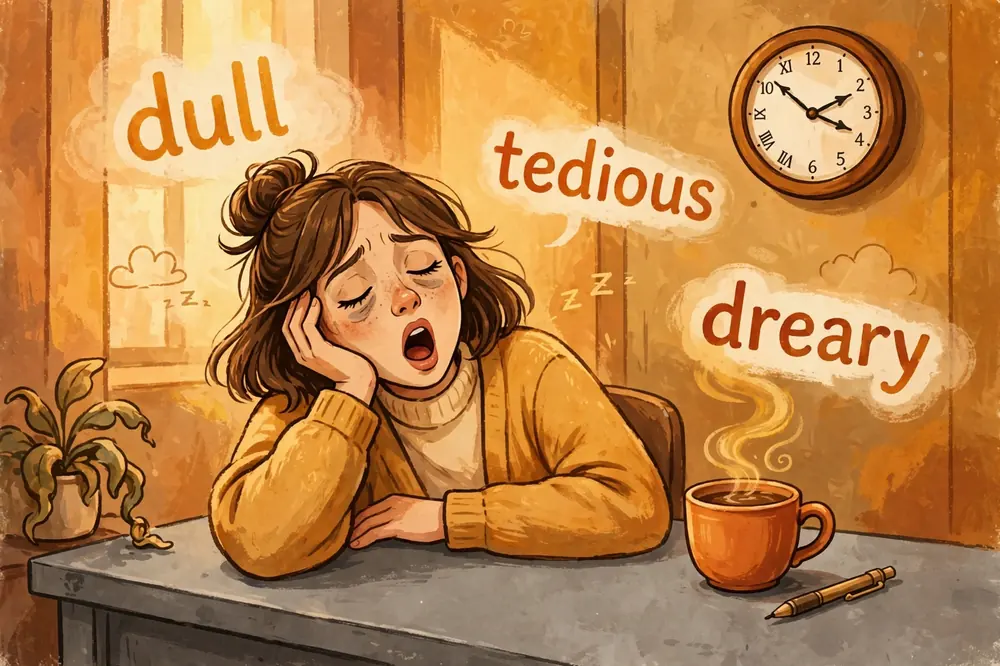
“Boring” describes something that fails to hold your interest or attention. A boring lecture makes you check the clock; a boring conversation makes your mind wander.
Examples:
- The presentation was so boring that half the audience started scrolling their phones.
- Weekends at home felt boring until she picked up gardening.
The Closest Alternatives to “Boring”
Dull
Meaning: Not interesting, exciting, or sharp.
Difference: The closest and most versatile substitute; works for people, things, and events.
Tone: Neutral to slightly blunt.
Best Use: Everyday speech and writing when you need a safe swap.
Example: The meeting was a dull repetition of last week’s update.
Tedious
Meaning: Too long, slow, or detailed to hold attention.
Difference: Stresses the pain of duration — it is boring because it never ends.
Tone: Mildly complaining.
Best Use: Long tasks, lectures, paperwork, journeys.
Example: Filling out the visa forms was a tedious process.
Monotonous
Meaning: Lacking variety; the same all the time.
Difference: Points at sameness as the cause — a flat tone, a repeated task.
Tone: Formal, descriptive.
Best Use: Academic writing, work routines, sound and speech.
Example: The speaker’s monotonous voice put the whole hall to sleep.
Tiresome
Meaning: Causing fatigue through repetition or effort.
Difference: Adds exhaustion — boring in a way that drains you.
Tone: Slightly formal, a touch dramatic.
Best Use: Repeated questions, complaints, chores.
Example: His constant excuses became tiresome after a while.
Dreary
Meaning: Dull and gloomy; depressingly boring.
Difference: Mixes boredom with sadness — weather, places, moods.
Tone: Literary, gloomy.
Best Use: Describing weather, towns, days, atmospheres.
Example: A dreary afternoon of rain kept everyone indoors.
Humdrum
Meaning: Lacking excitement; ordinary routine.
Difference: Focuses on dull routine rather than a single boring moment.
Tone: Playful and old-fashioned.
Best Use: Daily life, jobs, schedules.
Example: She traded her humdrum office job for freelance work.
Bland
Meaning: Lacking strong features or flavor.
Difference: Suggests blandness — no punch in taste, style, or personality.
Tone: Casual, critical.
Best Use: Food, writing, personalities, design.
Example: The soup was bland and badly needed some spice.
Uninteresting
Meaning: Not engaging or attracting attention.
Difference: The most neutral option — boredom stated without emotion.
Tone: Polite and diplomatic.
Best Use: Reviews, feedback, formal writing where “boring” sounds rude.
Example: The first chapter was uninteresting, but the book improved later.
Lifeless
Meaning: Lacking energy, movement, or spirit.
Difference: Implies something that should feel alive but does not — a party, a performance.
Tone: Strong and critical.
Best Use: Events, art, performances, writing.
Example: The sequel felt lifeless compared to the original film.
Prosaic
Meaning: Plain, ordinary, and unimaginative.
Difference: Literally “like prose” — no poetry, no imagination.
Tone: Formal, literary.
Best Use: Essays, criticism, describing ideas or writing style.
Example: His prosaic report listed facts but told no story.
Vapid
Meaning: Offering nothing of substance or thought.
Difference: Boring because it is empty-headed, not just slow.
Tone: Sharp and disapproving.
Best Use: Speeches, articles, conversations that lack depth.
Example: The interview was full of vapid, rehearsed answers.
Mundane
Meaning: Ordinary, everyday, lacking excitement.
Difference: Boredom of the ordinary — chores, errands, small talk.
Tone: Neutral, slightly philosophical.
Best Use: Daily routines and everyday topics.
Example: He found beauty even in mundane chores like doing the dishes.
“Boring” Synonyms at a Glance
| Alternative | Main Meaning | Tone | Best Use |
|---|---|---|---|
| Dull | Not interesting or sharp | Neutral | All-purpose everyday swap |
| Tedious | Drags on too long | Mildly complaining | Long tasks and lectures |
| Monotonous | Never changes | Formal | Routines, voices, sounds |
| Tiresome | Wears you out | Slightly formal | Repeated complaints or chores |
| Dreary | Gloomy and dull | Literary | Weather, places, moods |
| Humdrum | Ordinary routine | Playful | Daily life and jobs |
| Bland | Lacks flavor or character | Casual | Food, style, personality |
| Uninteresting | Fails to engage | Polite | Formal feedback and reviews |
| Lifeless | No energy or spirit | Strong | Events and performances |
| Prosaic | Plain and unimaginative | Literary | Essays and criticism |
| Vapid | Empty of thought | Sharp | Shallow speeches and articles |
| Mundane | Ordinary and everyday | Neutral | Routines and small talk |
Synonyms for “Boring” by Context
Formal Writing and Essays
- Monotonous — the speaker’s monotonous delivery.
- Prosaic — a prosaic account of the events.
- Uninspiring — an uninspiring set of proposals.
- Tedious — a tedious list of figures.
Casual Speech
- Dull — that party was so dull.
- Dreary — what a dreary day.
- Bland — the food was pretty bland.
- Humdrum — just my usual humdrum routine.
Business and Professional Feedback
- Uninteresting — the opening section felt uninteresting to readers.
- Flat — the presentation fell flat in the second half.
- Lackluster — a lackluster response from the audience.
- Formulaic — the pitch sounded formulaic.
Grammar and Sentence Structure
“Boring” is an adjective that can describe things, people, and experiences. It also works in the common pattern “bored with” vs “boring to”: She was bored with the lecture (her feeling) vs The lecture was boring (the lecture’s quality). Its synonyms follow the same grammar: most take a subject directly — a tedious wait, a dreary town, vapid comments. A few, like “soporific” or “jejune,” are rare and best reserved for writing. If you are building your vocabulary beyond this word, explore our synonyms for 200 common words to expand your vocabulary hub, plus guides like synonyms for sad and synonyms for easy.
When Not to Use a Synonym for “Boring”
Mistake 1: Using “dull” for a sharp object.
Wrong: The knife is boring, so it can’t cut.
Corrected: The knife is dull, so it can’t cut. — “Dull” can mean both uninteresting and not sharp; pick the synonym whose double meaning fits.
Mistake 2: Confusing “bored” and “boring.”
Wrong: I am boring in this class. (This says you are boring!)
Corrected: I am bored in this class. — People feel bored; things are boring.
Mistake 3: Using strong words for mild situations.
Wrong: The small talk at dinner was vapid.
Corrected: The small talk at dinner was mundane. — “Vapid” is harsh and insulting; match the strength of the word to the situation.
Frequently Asked Questions
What is the best single synonym for boring?
“Dull” is the closest all-purpose synonym. It fits people, events, food, weather, and writing without sounding odd.
What is a polite way to say boring?
Use “uninteresting” or “not very engaging.” For example: “The first part was a bit uninteresting” sounds much softer than “boring.”
What is the difference between boring and tedious?
All tedious things are boring, but not all boring things are tedious. “Tedious” specifically means boring because something drags on too long.
What is a formal synonym for boring in an essay?
“Monotonous,” “prosaic,” and “uninspiring” all work well in academic writing. Example: “The argument, though sound, was presented in a monotonous style.”
Faizi is a content writer at AllAboutFacts (hotteamnames.com), covering vocabulary, language tips, and everyday explainers.


