
Synonyms for Food: 25+ Better Words and Examples
Last updated: October 6, 2026
Thank you for reading this post, don't forget to subscribe!Food is one of the most common words in English — we say it dozens of times a week without thinking twice. The trouble is that this everyday word is also remarkably vague: it covers everything from a home-cooked meal to a late-night snack to a chef’s elaborate cuisine. Learning better synonyms for food helps you say exactly what you mean, whether you are writing a restaurant review or a nutrition article. If your descriptions lean sweet, our guide to synonyms for sweet pairs nicely with this one. According to the Merriam-Webster Thesaurus, the right substitute depends on whether you mean a full meal, a quick bite, or food in general — and this guide covers all of them.
Table of Contents
- Quick Answer
- What Does “Food” Mean?
- The Closest Alternatives to “Food”
- “Food” Synonyms at a Glance
- Synonyms for “Food” by Context
- Grammar and Sentence Structure
- When Not to Use a Synonym for “Food”
- Frequently Asked Questions
Quick Answer
- Meal — a full sitting of food: breakfast, lunch, or dinner
- Cuisine — a style or tradition of cooking, often national
- Dish — one prepared item of food, like a curry or salad
- Fare — the food provided, common in travel and restaurant writing
- Snack — a small, quick bite between meals
- Groceries — food bought from a store, always plural
- Refreshments — light food and drink served at events
- Nourishment — food thought of as sustenance, formal tone
- Sustenance — what keeps you alive and going, formal
- Provisions — food stored for a trip, event, or emergency
- Edibles — anything fit to be eaten, slightly technical
- Comestibles — a fancy, old-fashioned word for edible items
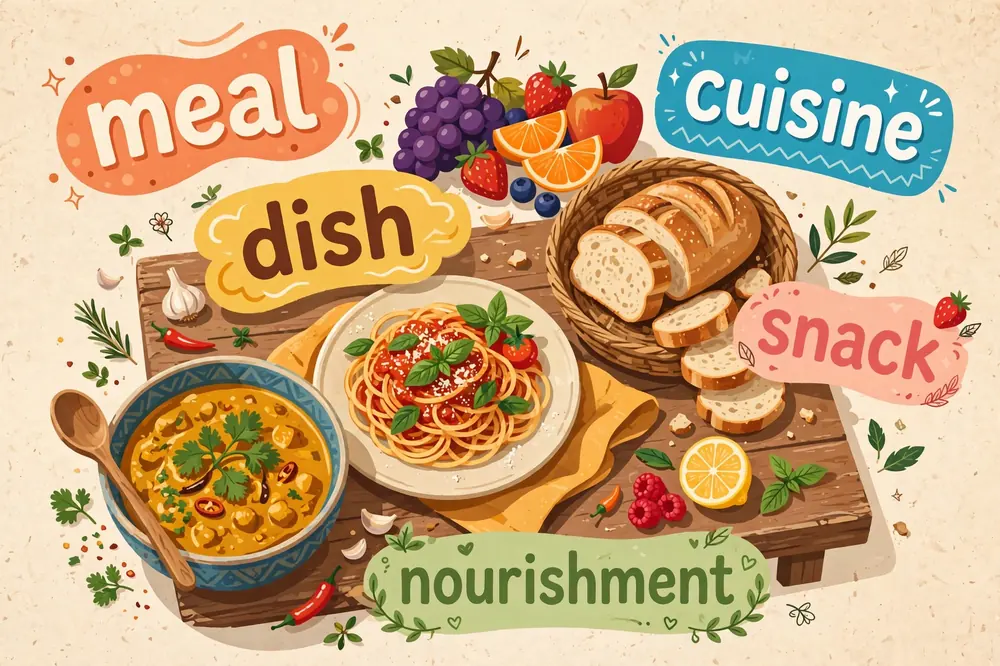
What Does “Food” Mean?
Food is any solid or semi-solid substance that living things eat to get energy and nutrients. It is the broadest possible word in its family: a single apple, a five-course dinner, and a bowl of rice all count as food. We also use it figuratively, as in “food for thought,” meaning something that feeds the mind rather than the body.
Because it is so general, food works in almost any sentence — “What’s your favorite food?” is perfectly natural. But in writing, especially reviews, menus, and health content, a more specific word usually paints a clearer picture. Swapping in meal, cuisine, or snack tells the reader exactly which slice of “food” you mean.
Examples: The street food in Karachi is famous for its bold spices. We packed enough food for the whole camping trip.
The Closest Alternatives to “Food”
Meal
Meaning: An occasion of eating, usually breakfast, lunch, or dinner.
Difference: Refers to the eating event and everything served, not a single item.
Tone: Neutral, everyday.
Best Use: Daily routines, restaurant plans, and health writing (“three meals a day”).
Example: We had a wonderful meal at the new Italian place downtown.
Cuisine
Meaning: A characteristic style of cooking, often tied to a country or region.
Difference: More elegant and specific than “food”; it implies a tradition or craft.
Tone: Formal, sophisticated.
Best Use: Restaurant reviews, travel writing, and food blogs.
Example: Turkish cuisine is famous for kebabs, mezes, and baklava.
Dish
Meaning: A single prepared food item, served as part of a meal.
Difference: Narrower than “food” — one recipe, not everything you eat.
Tone: Neutral, practical.
Best Use: Recipes, menus, and recommendations (“try this dish”).
Example: The signature dish is a slow-cooked lamb shank.
Fare
Meaning: The food and drink provided or available somewhere.
Difference: Slightly old-fashioned and literary; suggests what an establishment offers.
Tone: Refined, journalistic.
Best Use: Reviews, travel features, and event catering descriptions.
Example: The airline’s economy-class fare was surprisingly decent.
Snack
Meaning: A small amount of food eaten between regular meals.
Difference: Implies informality and small size; never a full dinner.
Tone: Casual, friendly.
Best Use: Everyday conversation, parenting, and office life.
Example: I grabbed a quick snack before the meeting started.
Nourishment
Meaning: Food regarded as providing what the body needs to stay healthy.
Difference: Emphasizes the health-giving function rather than the pleasure of eating.
Tone: Formal, caring.
Best Use: Health articles, charity writing, and formal essays.
Example: Warm soup gave the hikers much-needed nourishment.
Sustenance
Meaning: Food and drink that keep a person or animal alive.
Difference: More serious than “food”; it stresses survival and basic needs.
Tone: Formal, serious.
Best Use: Essays, reports, and descriptions of hardship or travel.
Example: For weeks, rice and beans were their only sustenance.
Provisions
Meaning: Supplies of food (and sometimes drink) stocked for future use.
Difference: Always plural; it means stored or packed food, not what is on the plate.
Tone: Neutral to formal.
Best Use: Travel, camping, events, and disaster preparedness.
Example: We loaded the boat with provisions for a week at sea.
Edibles
Meaning: Things that are suitable or safe to eat.
Difference: A technical term; in some regions it also means cannabis-infused products, so context matters.
Tone: Neutral, slightly technical.
Best Use: Food safety, foraging guides, and regulatory writing.
Example: The guide lists which wild berries are edibles.
Comestibles
Meaning: Articles of food; things one can eat.
Difference: A fancy, somewhat old-fashioned synonym — use it for flavor, not everyday speech.
Tone: Playful, upscale.
Best Use: Witty food writing, upscale menus, and lighthearted articles.
Example: The market stall overflowed with exotic comestibles.
“Food” Synonyms at a Glance
| Alternative | Main Meaning | Tone | Best Use |
|---|---|---|---|
| Meal | A full sitting of eating | Neutral | Daily routines, plans |
| Cuisine | A style of cooking | Formal | Reviews, travel writing |
| Dish | One prepared item | Neutral | Recipes, menus |
| Fare | Food provided somewhere | Refined | Reviews, events |
| Snack | Small bite between meals | Casual | Everyday talk |
| Nourishment | Health-giving food | Formal | Health writing |
| Sustenance | Food for survival | Serious | Essays, reports |
| Provisions | Stored supplies | Formal | Trips, emergencies |
| Edibles | Things safe to eat | Technical | Safety guides |
| Comestibles | Fancy word for food items | Playful | Witty writing |
Synonyms for “Food” by Context
Formal Writing
- Nourishment — ideal for essays and health topics
- Sustenance — best when food means survival
- Provisions — for stored or supplied food in reports
Casual Speech
- Meal — the safe, everyday default
- Snack — for small bites and cravings
- Dish — when recommending something specific
Business and Restaurants
- Cuisine — adds polish to menus and branding
- Fare — common in hospitality and travel copy
- Comestibles — a witty touch for marketing
Grammar and Sentence Structure
Food is usually an uncountable noun: “I love Italian food” is correct, while “I love Italian foods” sounds odd unless you mean distinct types of food (which is acceptable but formal). Most of its synonyms behave the same way: cuisine, fare, nourishment, and sustenance are uncountable. Meal, dish, and snack are countable (“three meals,” “two dishes”), and provisions, edibles, and comestibles are always plural.
Our pillar guide on synonyms for 200+ common words to expand your vocabulary covers more countability traps like this one. A quick test: if you can put “a” or “an” in front of it — “a meal,” “a dish,” “a snack” — the word is countable, and you can pluralize it freely.
When Not to Use a Synonym for “Food”
Mistake 1: Using “cuisine” for everyday eating.
Wrong: I bought some cuisine from the store.
Corrected: I bought some groceries from the store. (“Cuisine” means a style of cooking, not items in a bag.)
Mistake 2: Confusing “dish” with the whole meal.
Wrong: The wedding dish included five courses.
Corrected: The wedding meal included five courses. (“Dish” is one item; “meal” is the whole sitting.)
Mistake 3: Using “provisions” at a restaurant.
Wrong: The restaurant’s provisions were delicious.
Corrected: The restaurant’s dishes were delicious. (“Provisions” means stored supplies, not served plates.)
Frequently Asked Questions
What is the most common synonym for food?
Meal is the most widely used alternative in everyday English. It fits almost any casual sentence where “food” feels flat, such as “Let’s grab a meal” instead of “Let’s grab some food.”
What is a fancy word for food?
Cuisine is the standard upscale choice, while comestibles is a playful, old-fashioned option for witty writing. Fare also adds a refined tone to reviews and travel features.
Is “food” countable or uncountable?
“Food” is uncountable in normal use — say “some food,” not “two foods.” The plural “foods” is only acceptable when you mean distinct types, as in “fermented foods are good for digestion.”
What is the difference between food and meal?
“Food” is the broad substance you eat, while “meal” is a specific eating occasion — breakfast, lunch, or dinner — including everything served at it. A meal is made of food, not the other way around.
Faizi is a content writer at AllAboutFacts (hotteamnames.com), covering vocabulary, language tips, and everyday explainers.


