
Synonyms for Sweet: 25+ Better Words and Examples
Last updated: October 6, 2026
Thank you for reading this post, don't forget to subscribe!“Sweet” is one of those words we reach for constantly — the cake was sweet, the puppy was sweet, the gesture was sweet. But such a small word is doing a lot of heavy lifting, and a sharper synonym can say exactly what you mean: was it the taste, the kindness, or the charm that made it sweet? This guide gives you 25+ better words for “sweet,” explains the feeling behind each one, and shows you when to use them. Keep the Merriam-Webster Thesaurus handy too — no vocabulary shelf is complete without it.
Table of Contents
- Quick Answer
- What Does “Sweet” Mean?
- The Closest Alternatives to “Sweet”
- “Sweet” Synonyms at a Glance
- Synonyms for “Sweet” by Context
- Grammar and Sentence Structure
- When Not to Use a Synonym for “Sweet”
- Frequently Asked Questions
Quick Answer
- Sugary — use for taste; the direct, everyday swap for sweet food and drinks.
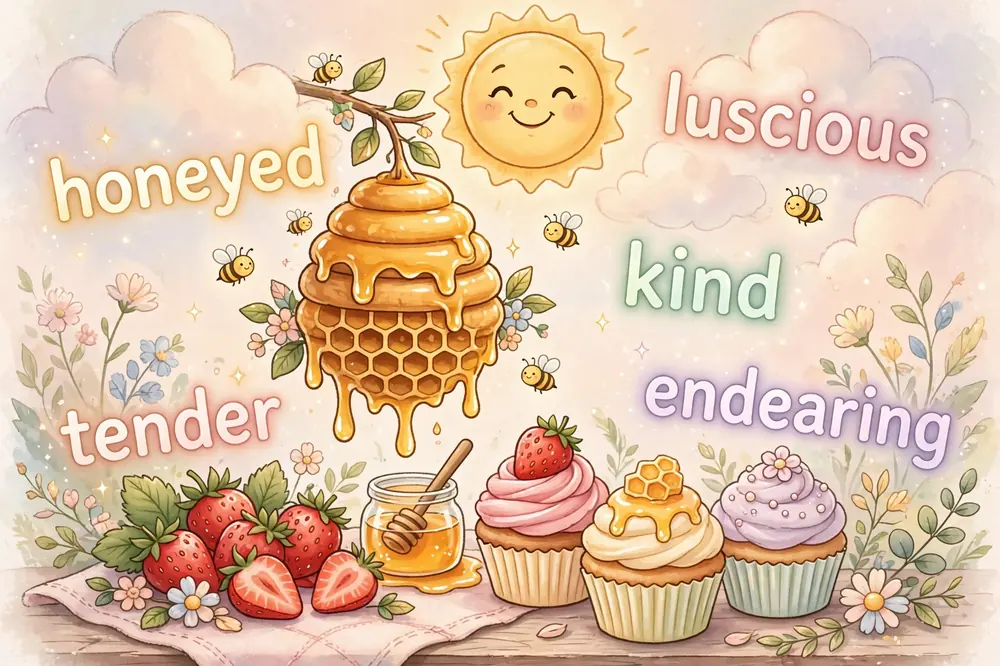
- Honeyed — use for a smooth, natural sweetness in taste or voice.
- Delectable — use for food that is deliciously sweet and worth savoring.
- Luscious — use for richly, juicily sweet flavors like ripe fruit.
- Saccharine — use for excessive, sickly sweetness (often figurative).
- Kind — use for a sweet person: warm, considerate, gentle.
- Endearing — use for behavior or traits that make you fond of someone.
- Charming — use for a sweet personality that wins people over.
- Lovely — use for something sweet that pleases the senses or heart.
- Dulcet — use for sweet-sounding voices or music.
- Pleasant — use as a mild, safe synonym for a sweet experience.
- Adorable — use for a sweet look: cute in a heart-melting way.
What Does “Sweet” Mean?
“Sweet” is a versatile adjective with two main lives. The first is taste: one of the five basic flavors, the taste of sugar, honey, ripe fruit, and dessert. The second is emotional: describing someone kind and thoughtful, something charming or pleasant, or even a deal that is very favorable (“a sweet deal”).
Because it covers so much ground, “sweet” can be vague. Naming the exact kind of sweetness sharpens your writing:
- The strawberries were sweet. (taste)
- The strawberries were luscious. (rich, juicy sweetness)
- She left a sweet note. (kind gesture)
- She left an endearing note. (a note that makes you fond of her)
Picking the right shade of sweet is one of the fastest ways to level up everyday writing. Our full list of synonyms for 200+ common words has more upgrades waiting when you are done here.
The Closest Alternatives to “Sweet”
1. Sugary
Meaning: Tasting of or containing sugar.
Difference: Nearly identical to “sweet” for food and drink, but more specific to sugar content.
Tone: Casual and everyday.
Best Use: Describing desserts, drinks, and snacks.
Example: The sugary frosting melted on my tongue.
2. Honeyed
Meaning: Sweet like honey; smooth and soothing.
Difference: Adds warmth and naturalness — not just sweet, but golden and gentle.
Tone: Literary, warm, elegant.
Best Use: Describing voices, words, or natural flavors.
Example: She thanked the audience in honeyed tones.
3. Delectable
Meaning: Deliciously sweet; highly enjoyable to taste.
Difference: Stronger than “sweet” — it promises real pleasure.
Tone: Refined, slightly formal.
Best Use: Food writing, restaurant reviews, menus.
Example: The bakery’s delectable pastries sold out by noon.
4. Luscious
Meaning: Richly sweet and juicy.
Difference: Implies abundance — sweetness you can almost feel.
Tone: Sensual, indulgent.
Best Use: Fruit, desserts, and luxurious flavors.
Example: We picked luscious mangoes straight from the tree.
5. Saccharine
Meaning: Excessively sweet, sickly so.
Difference: Carries a warning — too much sweetness, often fake or cloying.
Tone: Critical, slightly negative.
Best Use: Reviews and opinions where sweetness goes overboard.
Example: The movie’s saccharine ending felt forced.
6. Kind
Meaning: Gentle, caring, and considerate.
Difference: Captures the “sweet person” sense without any mention of taste.
Tone: Warm and sincere.
Best Use: Describing people, gestures, and character.
Example: It was kind of him to drive her home.
7. Endearing
Meaning: Inspiring affection or fondness.
Difference: Focuses on the effect: sweetness that makes you love someone.
Tone: Heartfelt and genuine.
Best Use: Habits, quirks, and small gestures.
Example: His endearing habit of naming his plants made everyone smile.
8. Charming
Meaning: Delightfully pleasant and attractive.
Difference: Suggests sweetness with a touch of charisma and social ease.
Tone: Positive, slightly admiring.
Best Use: People, manners, towns, and atmospheres.
Example: The charming waiter remembered every regular’s name.
9. Lovely
Meaning: Beautifully sweet; delightful to the senses.
Difference: Broader than “sweet” — covers looks, sounds, and feelings.
Tone: Gentle and agreeable.
Best Use: Everyday compliments, descriptions, invitations.
Example: We had a lovely evening on the terrace.
10. Dulcet
Meaning: Sweet-sounding; soft and pleasant to hear.
Difference: Strictly for sound — a voice or melody that soothes.
Tone: Poetic and refined.
Best Use: Music, singing, and gentle voices.
Example: The dulcet notes of the flute drifted across the lake.
“Sweet” Synonyms at a Glance
| Alternative | Main Meaning | Tone | Best Use |
|---|---|---|---|
| Sugary | Tasting of sugar | Casual | Desserts, drinks |
| Honeyed | Smooth, honey-like sweetness | Warm, elegant | Voices, flavors |
| Delectable | Deliciously enjoyable | Refined | Food writing, menus |
| Luscious | Richly sweet and juicy | Indulgent | Fruit, desserts |
| Saccharine | Excessively sweet | Critical | Reviews, opinions |
| Kind | Caring and considerate | Sincere | People, gestures |
| Endearing | Inspiring affection | Heartfelt | Quirks, small gestures |
| Charming | Delightfully pleasant | Admiring | People, atmospheres |
| Lovely | Delightful to the senses | Gentle | Compliments, descriptions |
| Dulcet | Sweet-sounding | Poetic | Music, voices |
| Pleasant | Mildly sweet or agreeable | Neutral | Experiences, weather |
| Adorable | Heart-meltingly cute | Affectionate | Looks, pets, babies |
Synonyms for “Sweet” by Context
Food and Drink
- Sugary — “a sugary glaze on the donuts.”
- Syrupy — for thick, heavy sweetness like pancakes in maple syrup.
- Candy-like — for playful, childlike sweetness.
- Toothsome — for desserts worth every calorie.
People and Personality
- Kind — the sincere choice: “a kind neighbor.”
- Thoughtful — for sweet actions that show care and planning.
- Gentle — for a soft, non-pushy sweetness.
- Warm-hearted — for someone whose sweetness comes from genuine feeling.
Romance and Affection
- Adorable — “an adorable photo of the two of them,” much like our synonyms for cute collection explores.
- Endearing — for quirks that deepen affection.
- Tender — for soft, caring romantic moments.
- Precious — for something sweet you treasure.
Sound and Music
- Dulcet — “her dulcet voice filled the hall.”
- Mellifluous — for voices and melodies that flow like honey.
- Melodious — for sweet, tuneful sound in general.
- Soothing — for sounds whose sweetness calms you.
Grammar and Sentence Structure
“Sweet” is an adjective, and its synonyms slot into the same positions: before nouns (“a delectable dessert”) or after linking verbs (“the tea was honeyed”). A few usage notes keep your sentences smooth:
- Comparatives: “sweet” becomes “sweeter” and “sweetest.” Most synonyms use “more” and “most”: “more luscious,” “the most endearing.” Avoid doubling them — “more sweeter” is wrong.
- Adverb forms: To modify actions, use the adverb: “she smiled sweetly,” “he spoke charmingly.” Not all synonyms convert neatly, so “kindly” works but “endearingly” sounds strained — prefer “in an endearing way.”
- Noun forms: “Sweetness,” “kindness,” “charm,” and “tenderness” let you rebuild sentences: “Her sweetness won them over” → “Her kindness won them over.”
- Watch the domain: Taste synonyms (“sugary,” “syrupy”) describe food; personality synonyms (“kind,” “charming”) describe people. Mixing domains — “a syrupy person” — reads as sarcasm unless you intend it.
When Not to Use a Synonym for “Sweet”
1. Don’t use taste words for people.
Wrong: “Our new teacher is so sugary.”
Corrected: “Our new teacher is so kind.” (“Sugary” describes flavor; applied to a person it sounds mocking or oddly literal.)
2. Don’t use “saccharine” as a compliment.
Wrong: “What a saccharine wedding speech — I loved it!”
Corrected: “What a heartfelt wedding speech — I loved it!” (“Saccharine” almost always criticizes over-the-top sweetness; use “heartfelt” or “tender” for genuine praise.)
3. Don’t reach for a fancy word when “sweet” is clearer.
Wrong: “The mellifluous cupcakes were a hit at the bake sale.”
Corrected: “The delectable cupcakes were a hit at the bake sale.” (“Mellifluous” is for sound, not taste — and in a recipe note, plain “sweet” often beats any synonym.)
Frequently Asked Questions
What is the best synonym for “sweet” when describing food?
“Sugary” is the closest everyday match, “delectable” suits food writing, and “luscious” fits rich fruit and desserts. Choose based on how strong the flavor feels.
What is a formal synonym for “sweet” for a person?
“Kind” and “thoughtful” are safe and professional; “gracious” works in formal thanks and invitations. Avoid “adorable” or “sugary” in professional contexts.
What is the difference between “sweet” and “saccharine”?
“Sweet” is neutral or positive, while “saccharine” means sweetness gone too far — sickly, forced, or insincere. Think of a loving birthday card versus a greeting card dripping with clichés.
Can “sweet” describe non-food things?
Absolutely. “Sweet” describes sounds (“a sweet melody”), smells (“a sweet fragrance”), people (“a sweet gesture”), and even bargains (“a sweet deal”). Each sense has its own best synonyms, which is why the context sections above matter — and if you are collecting kind words in general, our synonyms for hope article is a good next stop.
Faizi is a content writer at AllAboutFacts (hotteamnames.com), covering vocabulary, language tips, and everyday explainers.


