
Synonyms for Cute: 25+ Better Words and Examples
Last updated: October 6, 2026
Thank you for reading this post, don't forget to subscribe!Looking for better synonyms for “cute”? Whether you are describing a puppy, a design, or a kind gesture, choosing a more precise word can make your writing warmer and far more expressive. Below you will find over 25 alternatives with meanings, examples, and usage tips, based on careful research of the Merriam-Webster Thesaurus. If you want to keep building a stronger vocabulary, browse our pillar guide to synonyms for 200 common words next.
Table of Contents
- Quick Answer
- What Does “Cute” Mean?
- The Closest Alternatives to “Cute”
- Cute Synonyms at a Glance
- Synonyms for “Cute” by Context
- Grammar and Sentence Structure
- When Not to Use a Synonym for “Cute”
- Frequently Asked Questions
Quick Answer
The best all-purpose synonyms for “cute” include:
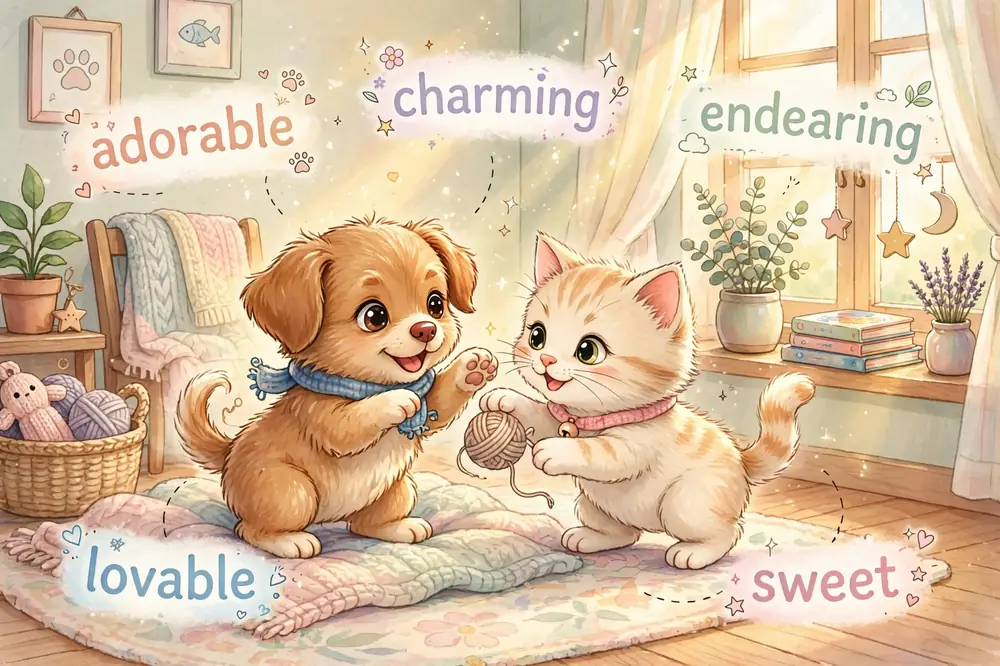
- Adorable — the closest all-round match; for anything that inspires instant fondness.
- Charming — for a person, place, or thing that wins you over with appeal.
- Endearing — for something that makes you feel warm affection.
- Darling — for something small, sweet, and precious, often with a touch of formality.
- Lovable — for a personality or character that is easy to love.
- Precious — for something delicate and treasured, often a baby or a keepsake.
- Sweet — for kind, gentle appeal in both people and gestures.
- Delightful — for something that gives joy and pleasure.
- Winsome — for an innocent, childlike charm that disarms you.
- Captivating — for a powerful charm that holds your attention.
What Does “Cute” Mean?
“Cute” is an adjective that describes something attractive and endearing, usually in a small, delicate, or youthful way. Babies, puppies, kittens, and miniature objects are classic examples — things that trigger a warm, protective feeling in us. The word also has a second meaning: it can describe something clever or shrewd, as in “a cute trick,” where the tone is more about craftiness than sweetness.
Example: “The kitten curled up in the blanket was incredibly cute.” — Here it means small and endearing. “It was a cute move, saving time by automating the boring parts.” — Here it means clever.
The Closest Alternatives to “Cute”
1. Adorable
Meaning: Inspiring great affection and fondness.
Difference: The closest one-to-one swap for “cute,” but slightly stronger and more emotional.
Tone: Warm, enthusiastic, affectionate.
Best Use: Describing babies, pets, and anything heart-melting.
Example: “Their newborn puppy is absolutely adorable.”
2. Charming
Meaning: Pleasing and attractive in a way that wins people over.
Difference: Broader than “cute” — it can apply to places, behavior, and ideas, not just appearance.
Tone: Elegant, complimentary.
Best Use: Travel writing, describing people, interiors, and small towns.
Example: “We stayed in a charming little cottage by the sea.”
3. Endearing
Meaning: Causing feelings of affection and fondness.
Difference: Focuses on the emotional effect on you rather than the thing’s looks.
Tone: Tender, heartfelt.
Best Use: Describing quirks, habits, and personalities.
Example: “His habit of naming every houseplant is endearing.”
4. Darling
Meaning: Dear, beloved, or sweetly small.
Difference: Slightly more formal and old-fashioned than “cute.”
Tone: Affectionate, sometimes a little vintage.
Best Use: Describing children, outfits, and small objects; wedding and lifestyle writing.
Example: “She wore a darling dress with tiny flowers.”
5. Lovable
Meaning: Easy to love; inspiring affection.
Difference: More about personality than appearance — a lovable character may not look “cute” at all.
Tone: Sincere, warm.
Best Use: Book and movie reviews, describing pets and people.
Example: “The grumpy old neighbor turned out to be surprisingly lovable.”
6. Precious
Meaning: Valued and cherished; also small and dear.
Tone: Tender, sometimes emotional.
Best Use: Describing babies, keepsakes, and once-in-a-lifetime moments.
Example: “Those first steps are such precious memories.”
7. Sweet
Meaning: Kind, gentle, and pleasant.
Difference: Leans toward behavior and kindness rather than looks.
Tone: Warm, sincere, everyday.
Best Use: Describing gestures, notes, and kind people.
Example: “It was sweet of her to bring soup when I was sick.”
8. Delightful
Meaning: Giving great pleasure and joy.
Difference: Wider in meaning — a place, event, or meal can be delightful without being cute.
Tone: Cheerful, refined.
Best Use: Reviews, recommendations, describing experiences.
Example: “The café had a delightful garden terrace.”
9. Winsome
Meaning: Attractive in an innocent, childlike way.
Difference: More literary and specific than “cute” — it suggests purity and simplicity.
Tone: Elegant, literary.
Best Use: Creative writing, describing smiles and personalities.
Example: “She gave a winsome smile and the whole room softened.”
10. Captivating
Meaning: Holding your attention with strong charm.
Difference: More intense — it suggests you cannot look away, not just that something is sweet.
Tone: Vivid, expressive.
Best Use: Describing performances, eyes, stories, and striking beauty.
Example: “The documentary’s opening scene was truly captivating.”
Cute Synonyms at a Glance
| Alternative | Main Meaning | Tone | Best Use |
|---|---|---|---|
| Adorable | Inspires instant fondness | Warm, enthusiastic | Babies, pets, heart-melting things |
| Charming | Pleasing and attractive | Elegant, complimentary | Places, people, interiors |
| Endearing | Creates warm affection | Tender, heartfelt | Quirks, habits, personalities |
| Darling | Sweet and beloved | Affectionate, vintage | Children, outfits, small objects |
| Lovable | Easy to love | Sincere, warm | Characters, pets, people |
| Precious | Treasured and delicate | Tender, emotional | Babies, keepsakes, memories |
| Sweet | Kind and gentle | Warm, everyday | Gestures, notes, kind people |
| Delightful | Gives joy and pleasure | Cheerful, refined | Experiences, reviews, recommendations |
| Winsome | Innocent, childlike charm | Literary, elegant | Creative writing, smiles |
| Captivating | Holds your attention | Vivid, expressive | Performances, stories, striking beauty |
| Fetching | Attractively charming | Stylish, lively | Looks, outfits, smiles |
| Irresistible | Too appealing to resist | Strong, enthusiastic | Food, offers, baby animals |
Synonyms for “Cute” by Context
Describing People and Pets
When the appeal is personal, pick words that carry warmth toward a living being.
- Adorable — babies, toddlers, puppies, kittens.
- Lovable — personalities and characters you grow fond of.
- Precious — newborns and deeply treasured children.
- Cherubic — babies with round, angelic faces.
Describing Style and Design
For fashion, interiors, and art, choose words that sound polished rather than childish.
- Charming — cottages, streets, boutiques, cafés.
- Darling — outfits, accessories, small décor pieces.
- Fetching — a look or style that turns heads.
- Dainty — small, delicate, finely made objects.
Describing Clever Ideas and Tricks
When “cute” means clever rather than sweet, swap it for a sharper word.
- Clever — a smart solution or witty remark.
- Ingenious — an inventive, well-designed idea.
- Witty — a clever line or playful comeback.
- Shrewd — a smart move, with a hint of craftiness.
Grammar and Sentence Structure
“Cute” is a regular descriptive adjective: it usually comes before the noun (“a cute puppy”) or after a linking verb (“the puppy is cute”). Its comparative and superlative forms are regular too — “cuter” and “cutest.” One common pattern is the “too cute to” construction: “The video is too cute to skip.” You can also soften it with adverbs: “kind of cute,” “incredibly cute,” “ridiculously cute.”
When you swap in a synonym, watch the grammar. “Endearing” and “charming” work the same way (“an endearing habit”), but nouns like “charm” need restructuring (“the charm of the place”). Also note that “darling” can act as a noun of address (“Hello, darling”), which “cute” never does.
When Not to Use a Synonym for “Cute”
Mistake 1: Using “cute” for serious or formal subjects. Light words can make heavy topics feel dismissed.
Wrong: “The funeral had such a cute photo display.”
Corrected: “The funeral had such a touching photo display.”
Mistake 2: Calling a colleague “cute” at work. In professional settings it can sound condescending.
Wrong: “Our new manager is so cute when she gets excited about the project.”
Corrected: “Our new manager is so passionate about the project.”
Mistake 3: Using “cute” when the real feeling is sadness. A sorrowful scene needs an emotional word, not an affectionate one.
Wrong: “The lost puppy looked so cute in the rain.”
Corrected: “The lost puppy looked so pitiful in the rain.” If you need more emotional vocabulary, see our guide to synonyms for sad.
Frequently Asked Questions
What is the best synonym for “cute”?
“Adorable” is the closest all-purpose replacement. It covers babies, pets, and anything heart-melting, and it works in both casual and slightly formal writing.
Is “cute” always a compliment?
Usually, yes — it expresses fondness. But it can feel patronizing when applied to adults in professional settings, or dismissive when used for serious topics. Read the room before you use it.
What is the difference between “cute” and “pretty”?
“Pretty” focuses on beauty and looks, while “cute” adds smallness, youth, and a protective tenderness. A mountain can be pretty but is rarely called cute; a kitten is more often cute than pretty.
What is the opposite of “cute”?
Common antonyms include “repellent,” “unappealing,” and “grotesque.” For milder contrast, “unattractive” or “plain” work well.
Faizi is a content writer at AllAboutFacts (hotteamnames.com), covering vocabulary, language tips, and everyday explainers.


