
Synonyms for House: 25+ Better Words and Examples
Last updated: October 6, 2026
Thank you for reading this post, don't forget to subscribe!House is a word we say almost every day — but repeating it in writing makes your sentences sound flat. Whether you are describing a building, a family, or a cozy place to live, learning better synonyms for house gives your words more color and precision. A quick look at the Merriam-Webster Thesaurus confirms just how many options you have, and this guide collects the best ones.
Below you will find 25+ alternatives for “house” with real examples, so you always choose the right word. If you are building everyday vocabulary, our hub article on synonyms for 200 common words is a great companion read.
- Quick Answer
- What Does “House” Mean?
- The Closest Alternatives to “House”
- “House” Synonyms at a Glance
- Synonyms for “House” by Context
- Grammar and Sentence Structure
- When Not to Use a Synonym for “House”
- Frequently Asked Questions
Quick Answer
- Home — the warmest swap; use it when you mean the place someone lives, not just the building.
- Residence — formal and neutral; best for official or legal writing.
- Dwelling — a general term for any place people live; slightly formal.
- Abode — a literary, old-fashioned word for a home.
- Domicile — a legal term for one’s official home.
- Household — the people living together in a house, not the building itself.
- Shelter — emphasizes protection from weather or danger.
- Cottage — a small, cozy house, often in the countryside.
- Villa — a large, elegant house, often with a garden or view.
- Mansion — a very large, impressive house.
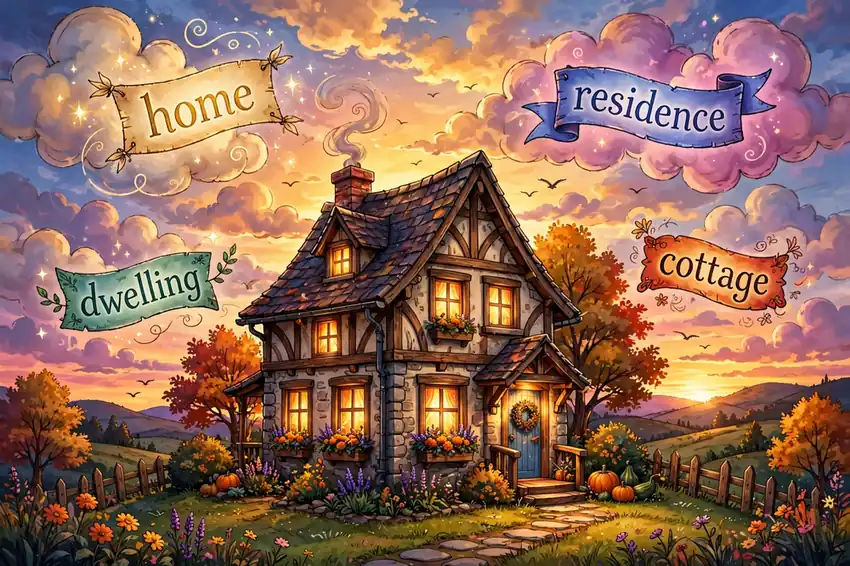
What Does “House” Mean?
As a noun, house (pronounced “hows”) means a building designed for people to live in: “They bought a house near the park.” It can also mean a family or lineage (“the house of kings”) or, in business, a company or establishment (“a publishing house“).
As a verb, house (pronounced “howz”) means to provide someone with a place to live or to store something: “The hotel houses 200 guests.” Most of the time, though, you need the noun — and the noun has far better alternatives than repeating it.
The Closest Alternatives to “House”
Home
Meaning: The place where someone lives and feels comfortable.
Difference: Carries feeling and belonging; a house is a building, but a home is personal.
Tone: Warm, emotional, universal.
Best Use: Everyday speech, personal writing, advertising.
Example: “After a long trip, it felt good to be home.”
Residence
Meaning: A person’s home, especially in formal contexts.
Difference: Neutral and official — it describes the fact of living somewhere, not the feeling.
Tone: Formal, polite.
Best Use: Legal documents, biographies, news articles.
Example: “The mayor’s residence sits on a quiet street.”
Dwelling
Meaning: Any place where people live.
Difference: A broad, technical word that covers houses, apartments, and cabins alike.
Tone: Formal, slightly academic.
Best Use: Real estate, urban planning, research.
Example: “The census counted every dwelling in the district.”
Abode
Meaning: A person’s home.
Difference: Literary and old-fashioned; sounds poetic or playful.
Tone: Poetic, slightly humorous in modern use.
Best Use: Creative writing, invitations, light humor.
Example: “Welcome to my humble abode!”
Domicile
Meaning: A person’s legal or official home.
Difference: Purely legal — it is about where you are registered, not where you feel at home.
Tone: Legal, technical.
Best Use: Tax forms, contracts, court documents.
Example: “He listed Texas as his domicile for tax purposes.”
Household
Meaning: The people living together in one house.
Difference: Means the people, never the building itself.
Tone: Neutral, practical.
Best Use: Surveys, economics, social writing.
Example: “The average household in this city has three members.”
Shelter
Meaning: A place that protects you from danger or bad weather.
Difference: Focuses on protection, not comfort or ownership.
Tone: Serious, compassionate.
Best Use: Charity work, emergency services, animal rescue.
Example: “The volunteers built a shelter for families after the flood.”
Cottage
Meaning: A small house, usually in the countryside.
Difference: Implies charm, smallness, and a rural setting.
Tone: Cozy, charming.
Best Use: Travel writing, real estate, fiction.
Example: “They rented a cottage by the lake for the summer.”
Villa
Meaning: A large, elegant house, often with a garden.
Difference: Suggests luxury and a pleasant climate or view.
Tone: Upscale, stylish.
Best Use: Travel, luxury real estate, holiday rentals.
Example: “The villa overlooks the sea and has its own pool.”
Mansion
Meaning: A very large, impressive house.
Difference: The biggest and grandest of all house words.
Tone: Grand, formal.
Best Use: News, real estate, history.
Example: “The old mansion was turned into a museum.”
“House” Synonyms at a Glance
| Alternative | Main Meaning | Tone | Best Use |
|---|---|---|---|
| Home | Place where you live | Warm, personal | Everyday speech |
| Residence | Formal home | Formal | Official writing |
| Dwelling | Any place people live | Technical | Research, census |
| Abode | Home (literary) | Poetic | Creative writing |
| Domicile | Legal home | Legal | Contracts, taxes |
| Household | The people in a house | Neutral | Surveys, economics |
| Shelter | Protective place | Serious | Charity, emergencies |
| Cottage | Small country house | Cozy | Travel, fiction |
| Villa | Elegant large house | Upscale | Luxury listings |
| Mansion | Very large grand house | Grand | Real estate, news |
Synonyms for “House” by Context
Formal and Official Writing
- Residence — “The ambassador’s residence is under renovation.”
- Dwelling — “The fire damaged three dwellings.”
- Domicile — “Her domicile is in New York.”
- Premises — “The company owns the premises outright.”
Casual Speech and Everyday Writing
- Home — “Let’s go home; it’s getting late.”
- Place — “Come over to my place tonight.”
- Pad — “His new pad is really nice.” (very informal)
- Crib — “We finally moved into our own crib.” (very informal, US)
Real Estate and Property Listings
- Cottage — “A charming two-bedroom cottage near the river.”
- Villa — “A modern villa with panoramic views.”
- Bungalow — “A cozy single-story bungalow with a garden.”
- Townhouse — “A three-floor townhouse in the city center.”
- Farmhouse — “A restored farmhouse on five acres.”
Historic or Grand Settings
- Mansion — “The mansion dates back to 1890.”
- Manor — “The old manor sits on a hill above the village.”
- Estate — “They manage a large country estate.”
- Homestead — “His grandparents built the homestead by hand.”
Grammar and Sentence Structure
House is both a noun and a verb, and the pronunciation changes: the noun rhymes with “mouse” (“I bought a house“), while the verb rhymes with “cows” (“The school houses 500 students”). This trips up learners, so pronounce carefully.
As a noun, it pairs with in, at, and of: “live in a house,” “the house of my dreams.” The plural is houses (rhymes with “cows-es”): “Three houses on the street are for sale.”
Note that home works differently — it needs no preposition with verbs of motion: “go home,” not “go to home.” And household never means the building: “a quiet household” describes the family, so don’t swap it in when you mean bricks and walls.
When Not to Use a Synonym for “House”
Mistake 1: Using “household” for the building.
Wrong: “They painted their household blue.”
Corrected: “They painted their house blue.” — Household means the people inside.
Mistake 2: Using “domicile” in casual writing.
Wrong: “Let’s go back to our domicile.” (texting a friend)
Corrected: “Let’s go back home.” — Domicile is only for legal contexts.
Mistake 3: Calling every building a “mansion.”
Wrong: “He lives in a small mansion.”
Corrected: “He lives in a small cottage.” — Mansion means grand and large; the words contradict each other.
Frequently Asked Questions
What is the best synonym for “house”?
Home is the best all-purpose choice. It works in almost every sentence where “house” fits and adds a warmer, more personal feeling.
What is the difference between “house” and “home”?
A house is the physical building; a home is where you live and belong. You can buy a house, but you make it a home. That is why “home” feels warmer and more personal.
Is “residence” too formal for everyday writing?
Usually, yes. “Residence” sounds natural in news, biographies, and official forms, but in conversation or friendly writing it can sound stiff — use home or house instead.
What do you call a very small house?
A cottage is the classic word, or cabin if it is rustic and made of wood. For extremely small modern homes, tiny house is the popular term.
Faizi is a content writer at AllAboutFacts (hotteamnames.com), covering vocabulary, language tips, and everyday explainers.


