
Synonyms for Very: 25+ Better Words and Examples
Last updated: October 6, 2026
Thank you for reading this post, don't forget to subscribe!If you have ever been told that your writing uses the word “very” too much, you are not alone. Very is one of the most common words in English, but stronger synonyms can make your sentences clearer, more vivid, and more convincing. According to the Merriam-Webster Thesaurus, a well-chosen synonym carries the exact shade of meaning you want. This guide gives you 25+ better words for “very” with examples so you can upgrade your writing today.
Table of Contents
- Quick Answer
- What Does “Very” Mean?
- The Closest Alternatives to “Very”
- Synonyms for “Very” at a Glance
- Synonyms for “Very” by Context
- Grammar and Sentence Structure
- When Not to Use a Synonym for “Very”
- Frequently Asked Questions
Quick Answer
- Extremely — a direct, stronger replacement for “very” in most formal and informal writing
- Incredibly — adds emphasis with a touch of amazement or surprise
- Remarkably — best when the degree is unusual or worth noticing
- Exceptionally — ideal for praise and formal descriptions of high quality
- Highly — works well before adjectives and past participles, especially in professional writing
- Deeply — suits emotions, commitment, and serious feelings
- Tremendously — strong and confident, good for spoken emphasis
- Exceedingly — formal and literary, for elegant emphasis
- Absolutely — casual and emphatic, common in everyday speech
- Utterly — best for complete or total states, like “utterly exhausted”
- Truly — adds sincerity as well as intensity
- Particularly — highlights something special or notable among others
What Does “Very” Mean?
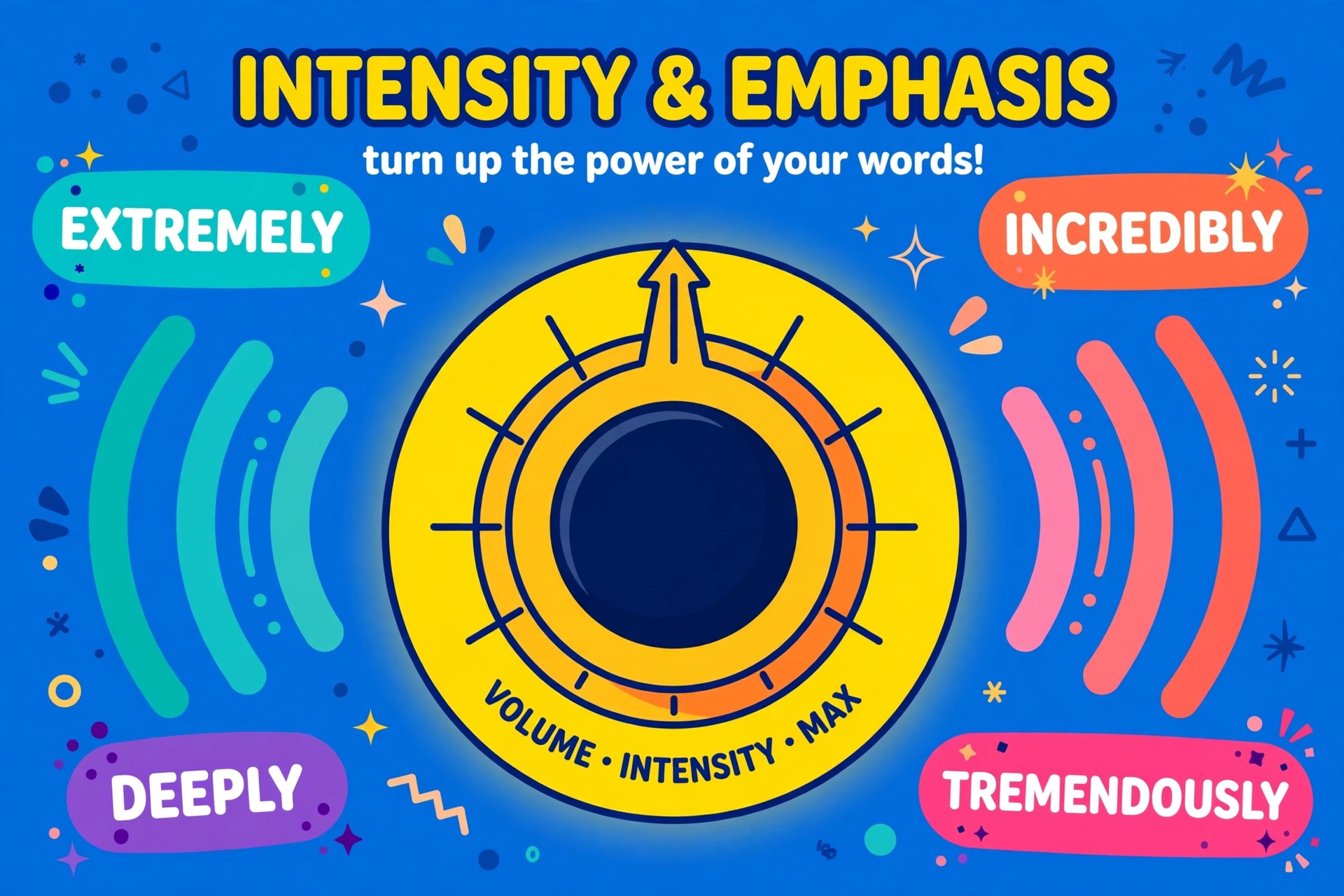
Very is an adverb whose job is to intensify — it takes the adjective or adverb next to it and turns up its volume. It does not describe a thing itself; it tells you how much of a quality exists. Grammatically, it almost always sits right before the word it modifies, as in “very tall,” “very quickly,” or “very much.”
Because it is so generic, it works everywhere — and that is also its weakness. Stronger synonyms do the same intensifying job while adding color and precision. Compare:
- She was very tired after the marathon. (plain)
- She was utterly exhausted after the marathon. (vivid and specific)
Both sentences intensify “tired,” but the second one paints a sharper picture. That is the whole point of this guide: swap a flat “very” for a word that does more work.
The Closest Alternatives to “Very”
Extremely
Meaning: To a very high degree; more than usual.
Difference: Stronger and more serious than “very.” It signals a notable extreme.
Tone: Neutral to formal.
Best Use: Academic writing, reports, and serious descriptions.
Example: The exam was extremely difficult this year.
Incredibly
Meaning: To an amazing or surprising degree.
Difference: Carries a sense of wonder — the degree is hard to believe.
Tone: Casual to neutral.
Best Use: Storytelling, reviews, and everyday speech.
Example: The concert was incredibly loud, in the best way.
Remarkably
Meaning: In a way worth noticing; unusually.
Difference: Suggests the degree is surprising or noteworthy, not just large.
Tone: Neutral to formal.
Best Use: Journalism, essays, and thoughtful commentary.
Example: He stayed remarkably calm during the crisis.
Exceptionally
Meaning: To an unusually high degree.
Difference: Almost always positive — it implies rarity and quality.
Tone: Formal and polished.
Best Use: Recommendations, reviews, and praise.
Example: She is an exceptionally talented designer.
Highly
Meaning: To a great degree.
Difference: Pairs naturally with past participles (“highly respected”) and adjectives in professional contexts.
Tone: Professional and formal.
Best Use: Business writing, resumes, and official communication.
Example: This is a highly recommended restaurant.
Deeply
Meaning: Profoundly; with strong feeling.
Difference: Works best with emotions, beliefs, and commitments rather than physical things.
Tone: Serious and sincere.
Best Use: Personal writing, apologies, and emotional topics.
Example: I am deeply grateful for your help.
Tremendously
Meaning: To an enormous extent.
Difference: Big, confident, and slightly dramatic — great for spoken emphasis.
Tone: Enthusiastic and conversational.
Best Use: Speeches, interviews, and casual conversation.
Example: We are tremendously proud of the team.
Exceedingly
Meaning: More than ordinary; to an extreme degree.
Difference: Slightly old-fashioned and elegant; adds a literary feel.
Tone: Formal and literary.
Best Use: Creative writing, essays, and refined prose.
Example: The view from the terrace was exceedingly beautiful.
Absolutely
Meaning: Completely; totally.
Difference: Very casual and emphatic — more at home in speech than in formal reports.
Tone: Casual and energetic.
Best Use: Everyday conversation, texts, and informal writing.
Example: That idea is absolutely brilliant.
Utterly
Meaning: Completely; without exception.
Difference: Best for total states — things that cannot be partial, like exhaustion or silence.
Tone: Dramatic and emphatic.
Best Use: Strong statements and vivid descriptions.
Example: After the hike, we were utterly exhausted.
Synonyms for “Very” at a Glance
| Alternative | Main Meaning | Tone | Best Use |
|---|---|---|---|
| Extremely | To a very high degree | Neutral/formal | Serious writing and reports |
| Incredibly | Amazingly; hard to believe | Casual | Stories and everyday speech |
| Remarkably | Unusually; worth noticing | Neutral/formal | Essays and commentary |
| Exceptionally | Unusually well | Formal | Praise and recommendations |
| Highly | To a great degree | Professional | Business and official writing |
| Deeply | Profoundly; with feeling | Serious | Emotions and apologies |
| Tremendously | Enormously | Enthusiastic | Speeches and conversation |
| Exceedingly | Beyond the ordinary | Literary | Creative and refined prose |
| Absolutely | Completely | Casual | Informal emphasis |
| Utterly | Totally; without exception | Dramatic | Total states and strong claims |
| Truly | Genuinely; really | Sincere | Heartfelt statements |
| Particularly | Especially; notably | Neutral | Highlighting something special |
Synonyms for “Very” by Context
In Formal Writing
- Extremely — the safest all-purpose formal swap
- Highly — especially before past participles (“highly efficient”)
- Exceptionally — for praise and standout quality
- Considerably — for measurable differences (“considerably faster”)
- Substantially — for amounts and impact in reports
In Casual Speech
- Really — the everyday default everyone understands
- Absolutely — energetic and emphatic
- Super — friendly and upbeat (“super excited”)
- Incredibly — adds amazement to casual praise
- So — natural and conversational (“so happy”)
In Business and Professional Writing
- Highly — “highly recommended,” “highly skilled”
- Significantly — for data-driven improvements
- Substantially — for budgets, growth, and impact
- Greatly — “greatly appreciated,” “greatly improved”
In Creative Writing
- Exceedingly — elegant, slightly old-fashioned emphasis
- Profoundly — for thoughts, feelings, and meaning
- Immensely — big and sweeping (“immensely relieved”)
- Vastly — for differences and scale (“vastly different”)
Grammar and Sentence Structure
“Very” is a simple intensifier, but its replacements come with small grammar rules worth knowing:
- Position: Most intensifiers sit directly before the adjective or adverb: “extremely fast,” “incredibly quickly.” Do not separate them from the word they modify.
- Gradable vs. absolute adjectives: Words like “tired,” “big,” and “happy” are gradable — they accept “very” and most synonyms. Absolute adjectives like “perfect,” “unique,” and “dead” describe a total state, so “very perfect” sounds wrong; use “absolutely perfect” or “utterly unique” instead.
- Past participles: “Highly,” “greatly,” and “deeply” pair naturally with past participles: “highly respected,” “greatly improved,” “deeply moved.”
- Negative forms: “Not very” becomes “not particularly,” “not especially,” or “barely”: “The movie was not particularly good.”
- Comparisons: After “than,” use “much” or “far” rather than “very”: “much better than,” “far more interesting than.”
When Not to Use a Synonym for “Very”
- Don’t stack intensifiers. Two strong words fight each other instead of adding up.
❌ Wrong: “The test was extremely incredibly hard.”
✅ Corrected: “The test was extremely hard.” - Don’t pair a synonym with a word it can’t modify. “Deeply” suits feelings, not sizes; “highly” suits qualities, not emotions.
❌ Wrong: “The building was deeply tall.”
✅ Corrected: “The building was remarkably tall.” - Don’t use “very” with absolute adjectives at all. Replace the whole pair, not just the intensifier.
❌ Wrong: “Her answer was very perfect.”
✅ Corrected: “Her answer was absolutely perfect.”
Frequently Asked Questions
What is the best single replacement for “very”?
“Extremely” is the most versatile one-to-one replacement — it works in nearly every sentence where “very” fits. “Really” is the best choice for casual conversation.
Why do teachers say to avoid “very”?
Because “very” is vague. It tells the reader something is intense without saying what kind of intensity. Specific synonyms like “deeply,” “remarkably,” or “utterly” carry more information in the same space.
Can “very” be used in formal writing?
Yes, but sparingly. One or two uses are harmless; the problem is repetition. In formal writing, prefer “extremely,” “highly,” or “significantly” depending on what you are intensifying.
Is “really” the same as “very”?
Almost. “Really” is the informal twin of “very” and means the same thing. Use “really” in speech and casual writing, and pick a stronger synonym when you want impact.
For more ways to strengthen your vocabulary, explore our synonyms for 200 common words to expand your vocabulary hub, or see our guides to synonyms for but and synonyms for also.
Faizi is a content writer at AllAboutFacts (hotteamnames.com), covering vocabulary, language tips, and everyday explainers.


