Synonyms for Learn: 25+ Better Words and Examples
Last updated: October 6, 2026
Thank you for reading this post, don't forget to subscribe!We say learn for almost everything — new languages, new recipes, new jobs. It is one of the most overused verbs in English, and repeating it flattens even interesting writing. This guide collects 25+ stronger alternatives, cross-checked against references like the Merriam-Webster Thesaurus, with examples showing exactly when to use each one.
Table of Contents
- Quick Answer
- What Does “Learn” Mean?
- The Closest Alternatives to “Learn”
- “Learn” Synonyms at a Glance
- Synonyms for “Learn” by Context
- Grammar and Sentence Structure
- When Not to Use a Synonym for “Learn”
- Frequently Asked Questions
Quick Answer
The 10 strongest replacements for learn:
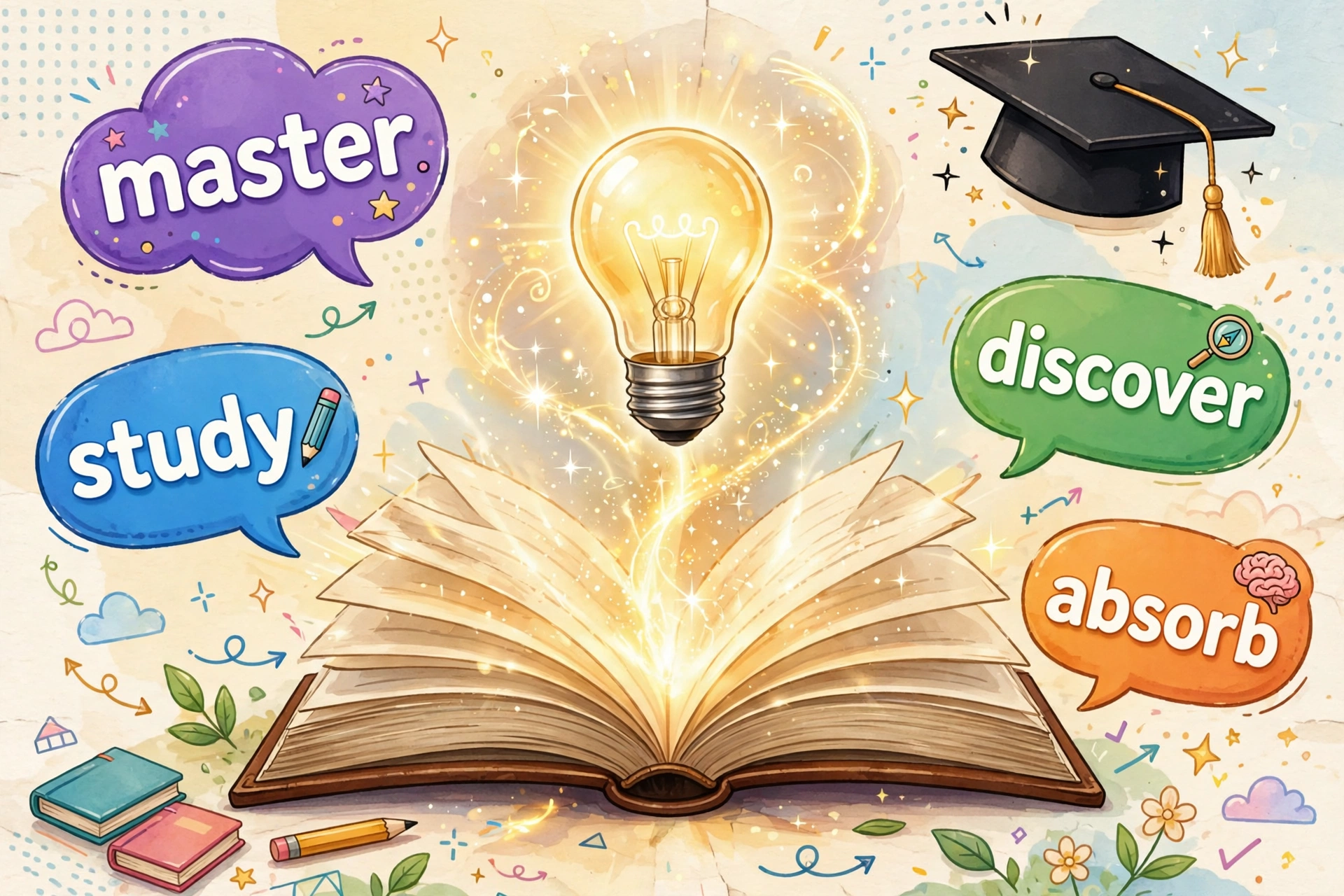
- Master — when you learn something completely and can do it well
- Study — when learning involves books, courses, or deliberate effort
- Acquire — the formal way to say you gained a skill or knowledge
- Discover — when learning happens by finding something out
- Pick up — casual way to say you learned quickly or naturally
- Absorb — when you take in information gradually, like a sponge
- Grasp — when you finally understand something tricky
- Comprehend — a formal word for deeply understanding
- Memorize — when learning means committing facts to memory
- Explore — when learning comes from curiosity and investigation
What Does “Learn” Mean?
To learn means to gain knowledge, understanding, or skill through study, experience, or being taught. It covers a wide range — from a child learning to tie shoelaces to a programmer learning a new framework. The word is neutral in tone and works in almost any context, which is exactly why writers reach for it so often.
It also covers finding something out — “I learned that the meeting was cancelled” — or memorizing by repetition — “She learned the poem by heart.” Because it stretches across so many meanings, a more precise synonym usually improves your sentence.
The Closest Alternatives to “Learn”
Here are the ten best substitutes for learn, each with notes on meaning, tone, and best use.
Master
Meaning: To learn something so thoroughly you can perform it at a high level.
Difference: “Learn” is the process; “master” is the finish line.
Tone: Confident, ambitious.
Best Use: Skills you worked hard to perfect, resumes, achievements.
Example: After six months of practice, she finally mastered the guitar solo.
Study
Meaning: To devote time and attention to gaining knowledge, usually from books or courses.
Difference: “Study” stresses effort and process; “learn” stresses the result.
Tone: Neutral, academic.
Best Use: School, university, exam preparation, research.
Example: He studies medicine at the university in Karachi.
Acquire
Meaning: To gain or obtain a skill, knowledge, or habit.
Difference: More formal than “learn”; it suggests gradual collection over time.
Tone: Formal, professional.
Best Use: Business writing, resumes, academic papers.
Example: The training program helped her acquire advanced data-analysis skills.
Discover
Meaning: To find out or become aware of something for the first time.
Difference: Fits learning that comes from exploration or accident, not from a lesson.
Tone: Curious, narrative.
Best Use: Stories, science writing, travel writing.
Example: While hiking, we discovered an old path that led to the waterfall.
Pick Up
Meaning: To learn something quickly, casually, or without formal teaching.
Difference: Informal and effortless-sounding; avoid it in formal reports.
Tone: Casual, conversational.
Best Use: Everyday speech, blogs, friendly advice.
Example: Living in Lahore, he picked up Punjabi within a year.
Absorb
Meaning: To take in information gradually and fully.
Difference: Suggests slow, deep soaking-in rather than active effort.
Tone: Descriptive, slightly literary.
Best Use: Immersive learning, reading, cultural experiences.
Example: She spent a summer in Paris, absorbing the language and the culture.
Grasp
Meaning: To fully understand something, especially a difficult idea.
Difference: About comprehension, not the whole learning process.
Tone: Neutral to slightly formal.
Best Use: Explaining breakthroughs, teaching, academic writing.
Example: It took three lessons before he grasped the concept of fractions.
Comprehend
Meaning: To understand something completely, especially complex material.
Difference: The most formal option here; heavier than “understand”.
Tone: Formal, serious.
Best Use: Legal, academic, or technical writing.
Example: The students struggled to comprehend the dense philosophical text.
Memorize
Meaning: To commit something to memory through repetition.
Difference: Only about remembering, not understanding.
Tone: Neutral.
Best Use: Exam prep, vocabulary lists, speeches, scripts.
Example: The actor memorized all forty pages of dialogue in a week.
Explore
Meaning: To investigate something in order to learn about it.
Difference: Active and curiosity-driven.
Tone: Adventurous, positive.
Best Use: Travel, science, self-improvement writing.
Example: They spent a year exploring traditional cooking techniques across Asia.
“Learn” Synonyms at a Glance
| Alternative | Main Meaning | Tone | Best Use |
|---|---|---|---|
| Master | Learn completely | Confident | Skills, achievements |
| Study | Learn through effort | Neutral, academic | School, exams |
| Acquire | Gain a skill or knowledge | Formal | Resumes, reports |
| Discover | Find something out | Curious | Stories, science |
| Pick up | Learn quickly or naturally | Casual | Conversation, blogs |
| Absorb | Take in gradually | Descriptive | Immersive experiences |
| Grasp | Understand a hard idea | Neutral | Teaching, explanations |
| Comprehend | Understand deeply | Formal | Academic, legal writing |
| Memorize | Commit to memory | Neutral | Exams, speeches |
| Explore | Learn by investigating | Adventurous | Travel, self-improvement |
| Familiarize yourself with | Get to know something new | Professional | Onboarding, manuals |
| Get the hang of | Become comfortable doing | Casual | Skills, tools, games |
Synonyms for “Learn” by Context
In School and Academic Writing
Formal, precise words work best here:
- Study — “She is studying chemistry this semester.”
- Comprehend — “The class comprehended the theorem after the demonstration.”
- Memorize — “We had to memorize twenty vocabulary words a day.”
- Research — “They researched the topic before writing the essay.”
In the Workplace
Professional language signals competence:
- Acquire — “New hires acquire these skills during onboarding.”
- Familiarize yourself with — “Please familiarize yourself with the company handbook.”
- Train in — “She trained in project management last year.”
- Master — “He mastered the new software in two weeks.”
In Everyday Conversation
Keep it relaxed and natural:
- Pick up — “I picked up some Italian from my coworkers.”
- Get the hang of — “You’ll get the hang of the new phone quickly.”
- Figure out — “I finally figured out how the printer works.”
- Discover — “I discovered a great bakery near my office.”
In Self-Improvement Writing
Growth-focused language keeps readers inspired — our list of synonyms for excited captures that feeling:
- Explore — “Explore what your mind is capable of.”
- Absorb — “Absorb new ideas every single day.”
- Grow — “Every challenge is a chance to grow.”
- Uncover — “Uncover hidden strengths you never knew you had.”
Grammar and Sentence Structure
Learn is a regular verb: the past tense is learned (American English) or learnt (common in British English). Both are correct — just stay consistent within one piece of writing.
It pairs with several useful structures:
- Learn + noun: “She wants to learn Spanish.”
- Learn + to + infinitive: “He learned to swim last summer.”
- Learn + that/whether/how clause: “We learned that practice matters more than talent.”
- Learn + about/from: “They learned about history from their grandmother.”
Remember: “learn” describes the result, while “study” describes the process — “I am studying for the test” (the activity) versus “I learned a lot from studying” (the outcome).
When Not to Use a Synonym for “Learn”
Precision matters. Here are three mistakes writers make with “learn” and its synonyms:
1. Confusing “learn” with “teach”
Wrong: “The course learned me a lot.”
Corrected: “The course taught me a lot.” — A teacher or course teaches; the student learns.
2. Using “learn” for the study process
Wrong: “She is learning her notes for the exam tomorrow.”
Corrected: “She is studying her notes for the exam tomorrow.” — “Study” is the effort; “learn” is what results from it.
3. Using “memorize” when you mean “understand”
Wrong: “Memorize how the engine works, and you will be able to fix it.”
Corrected: “Understand how the engine works, and you will be able to fix it.” — “Memorize” only means remembering words by heart; fixing an engine needs comprehension.
Frequently Asked Questions
What is the best synonym for “learn”?
It depends on the context. Use master for complete skill, study for academic effort, discover for finding things out, and pick up in casual conversation.
Is “learnt” a correct word?
Yes. “Learnt” is the standard past tense of “learn” in British English, while “learned” is preferred in American English. Both are grammatically correct.
What is the difference between “learn” and “study”?
“Study” is the process — devoting time and effort to gaining knowledge. “Learn” is the result — actually gaining it. You can study for hours without learning much, and you can learn something without ever studying it.
Can “learn” be used with an object, like “learn a skill”?
Yes, that is perfectly natural: “She learned a new skill.” For a more formal tone, especially in resumes or reports, acquire is a stronger choice: “She acquired new technical skills.” For more vocabulary lists like this one, browse our guide to 200+ common words and their synonyms.
Faizi is a content writer at AllAboutFacts (hotteamnames.com), covering vocabulary, language tips, and everyday explainers.


