Synonyms for Easy: 25+ Better Words and Examples
Last updated: October 6, 2026
Thank you for reading this post, don't forget to subscribe!“Easy” is one of the most overused words in everyday English. Saying a task is easy is fine, but repeating the same adjective makes your writing dull. If you are looking for synonyms for easy, this guide gives you 25+ better words — from formal picks like effortless to casual favorites like breezy — with examples so you use each one correctly. For even more vocabulary lists, browse the synonyms hub on AllAboutFacts, and check the Merriam-Webster Thesaurus for deeper word lists.
Table of Contents
- Quick Answer
- What Does “Easy” Mean?
- The Closest Alternatives to “Easy”
- “Easy” Synonyms at a Glance
- Synonyms for “Easy” by Context
- Grammar and Sentence Structure
- When Not to Use a Synonym for “Easy”
- Frequently Asked Questions
Quick Answer
- Simple — best all-round swap for anything uncomplicated
- Effortless — something done with no struggle or strain
- Straightforward — clear steps with nothing confusing
- Uncomplicated — formal pick for processes or problems
- Easygoing — describes a relaxed, calm person (not tasks)
- Painless — a process with no difficulty or trouble
- Elementary — so basic that a beginner can handle it
- Manageable — within your ability to handle
- Smooth — something that goes without bumps or delays
- Breezy — casual pick for something light and quick
What Does “Easy” Mean?
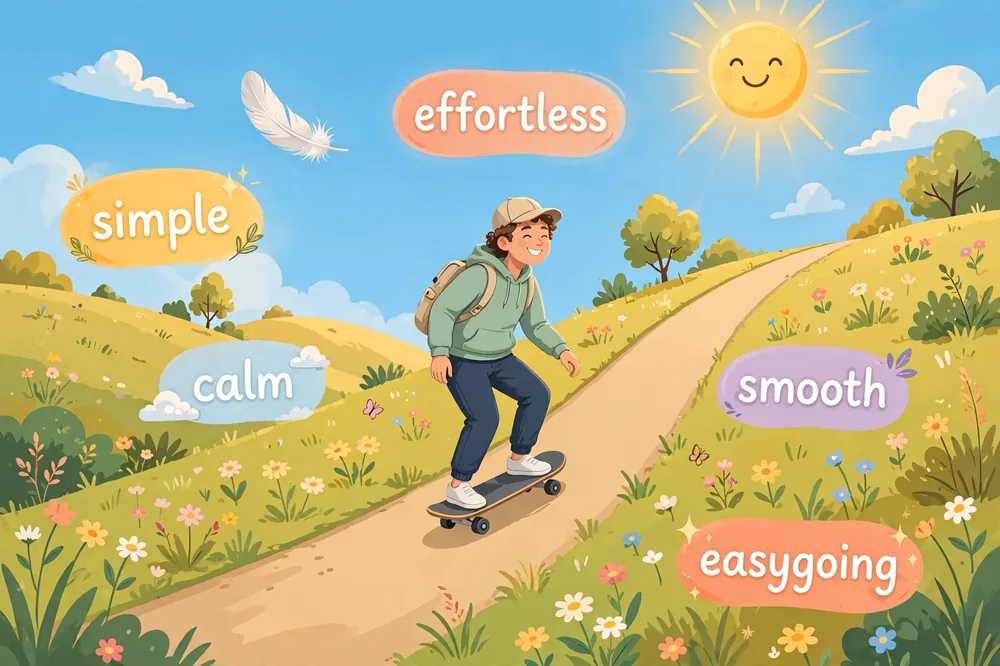
“Easy” is an adjective that means something requires little effort, difficulty, or skill. It can describe a task (“The test was easy”), a manner of doing something (“She made it look easy”), or even a relaxed state (“an easy weekend”). As an informal phrase, “Take it easy” means to relax or stay calm. Example: “The recipe was easy enough for a first-time cook.” Example: “After a long week, he just wanted an easy evening at home.”
The Closest Alternatives to “Easy”
1. Simple
Meaning: Not complicated; easy to understand or do.
Difference: “Simple” focuses on lack of complexity, while “easy” focuses on lack of effort.
Tone: Neutral.
Best Use: Instructions, explanations, everyday writing.
Example: “The app has a simple setup process that takes five minutes.”
If you want more options for this word, read our guide on synonyms for simple.
2. Effortless
Meaning: Done with no difficulty or visible strain.
Difference: Stronger than “easy” — it suggests grace, not just ease.
Tone: Elegant, positive.
Best Use: Describing skills, performances, style.
Example: “Her effortless piano playing amazed the whole audience.”
3. Straightforward
Meaning: Clear, direct, and easy to follow.
Difference: Implies logical steps rather than just low effort.
Tone: Professional.
Best Use: Business, instructions, problem-solving.
Example: “The refund policy is straightforward: no questions asked.”
4. Uncomplicated
Meaning: Free of complications.
Difference: More formal than “easy”; suits processes and plans.
Tone: Formal, measured.
Best Use: Reports, contracts, technical writing.
Example: “The migration to the new system was surprisingly uncomplicated.”
5. Painless
Meaning: Without difficulty or unpleasantness.
Difference: Works best for processes people usually dread.
Tone: Reassuring.
Best Use: Customer experience, healthcare, services.
Example: “Checking in online made the whole trip painless.”
6. Elementary
Meaning: Very basic; at a beginner’s level.
Difference: Slightly dismissive — use carefully.
Tone: Formal, sometimes condescending.
Best Use: Academic or educational contexts.
Example: “He solved the elementary math puzzle in seconds.”
7. Easygoing
Meaning: Relaxed, calm, and not easily upset.
Difference: Applies to people and attitudes, never to tasks.
Tone: Warm, casual.
Best Use: Describing personalities.
Example: “Our manager is easygoing, so the team atmosphere stays relaxed.”
8. Manageable
Meaning: Within your power to handle or control.
Difference: Suggests effort is possible rather than effortless.
Tone: Practical.
Best Use: Workload, projects, schedules.
Example: “Splitting the work into daily goals made the project manageable.”
9. Smooth
Meaning: Happening without problems or interruptions.
Difference: Describes how something progresses, not the effort itself.
Tone: Neutral, professional.
Best Use: Processes, transitions, operations.
Example: “The launch went smooth, with no major bugs reported.”
10. Breezy
Meaning: Light, quick, and pleasantly easy.
Difference: Casual and cheerful; avoid in serious writing.
Tone: Informal, friendly.
Best Use: Casual reviews, blogs, conversation.
Example: “It was a breezy twenty-minute commute, no traffic at all.”
“Easy” Synonyms at a Glance
| Alternative | Main Meaning | Tone | Best Use |
|---|---|---|---|
| Simple | Not complicated | Neutral | Instructions, everyday writing |
| Effortless | No strain at all | Elegant | Skills, performances |
| Straightforward | Clear and direct | Professional | Business, policies |
| Uncomplicated | Free of complications | Formal | Reports, technical writing |
| Painless | Without trouble | Reassuring | Services, processes |
| Elementary | Very basic | Formal | Education, academics |
| Easygoing | Relaxed and calm | Warm | People, personalities |
| Manageable | Possible to handle | Practical | Workload, projects |
| Smooth | Without problems | Neutral | Processes, launches |
| Breezy | Light and quick | Informal | Casual speech, reviews |
| Plain | Clear and simple | Neutral | Explanations, design |
| Facile | Superficially easy | Formal | Literary criticism |
Synonyms for “Easy” by Context
Formal Writing
- Uncomplicated — for processes and procedures
- Elementary — for basic concepts
- Facile — for literary or critical writing (implies shallow ease)
- Straightforward — for instructions and policies
Casual Conversation
- Breezy — “That was a breezy little quiz.”
- Painless — “The signup was totally painless.”
- Easy-peasy — playful, for kids or humor
- A piece of cake — idiom for a very easy task
Business and Work
- Straightforward — plans, guidelines, contracts
- Manageable — workloads and timelines
- Smooth — launches, transitions, handoffs
- Low-effort — tasks that take little time
Grammar and Sentence Structure
“Easy” is an adjective, so it describes nouns: an easy test, an easy recipe. Its comparative and superlative forms are easier and easiest (“This route is easier”). To describe how an action is done, use the adverb easily, not “easy” (“She passed easily”). You can also intensify it: very easy, incredibly easy, or dead easy (informal). One common idiom: “Easy does it” means to do something carefully and gently.
When Not to Use a Synonym for “Easy”
Mistake 1: Using an adjective as an adverb.
Wrong: “He finished the exam easy.”
Corrected: “He finished the exam easily.” — use “easily” when describing an action.
Mistake 2: Missing the article.
Wrong: “This is easy task for beginners.”
Corrected: “This is an easy task for beginners.” — “easy” starts with a vowel sound, so it needs “an.”
Mistake 3: Calling a person “easy” carelessly.
Wrong: “She is an easy person.”
Corrected: “She is an easygoing person.” — “easy” alone can sound insulting; “easygoing” clearly means relaxed and pleasant.
Frequently Asked Questions
What is the difference between “easy” and “simple”?
“Easy” means requiring little effort, while “simple” means not complicated. A simple recipe can still be hard work, and a complicated machine can be easy to use. The two overlap but focus on different things.
What is a more formal synonym for “easy”?
“Uncomplicated” and “straightforward” are the safest formal choices. “Effortless” works for skills and performance, while “elementary” suits academic writing — though it can sound dismissive.
Can “easy” describe a person?
Not directly — “He is easy” can sound insulting. Use “easygoing” for a relaxed personality, or describe what the person does: “He is easy to work with.”
What does “easy does it” mean?
It is a friendly idiom meaning “do it carefully and gently.” Example: “Easy does it with that vase — it is fragile.”
Faizi is a content writer at AllAboutFacts (hotteamnames.com), covering vocabulary, language tips, and everyday explainers.


