Synonyms for Time: 25+ Better Words and Examples
Last updated: October 6, 2026
Thank you for reading this post, don't forget to subscribe!“Time” is one of the most overused words in English. It shows up in essays, emails, speeches, and everyday conversation — yet it means something different every time. A time of crisis, spare time, runtime, and “have a good time” are not really the same word at all. When you replace it with something sharper — moment, period, era, spell — your writing gains precision and your ideas land harder. If you ever want to confirm how a thesaurus groups these options, the Merriam-Webster Thesaurus is a reliable place to check.
Table of Contents
- Quick Answer
- What Does “Time” Mean?
- The Closest Alternatives to “Time”
- “Time” Synonyms at a Glance
- Synonyms for “Time” by Context
- Grammar and Sentence Structure
- When Not to Use a Synonym for “Time”
- Frequently Asked Questions
Quick Answer
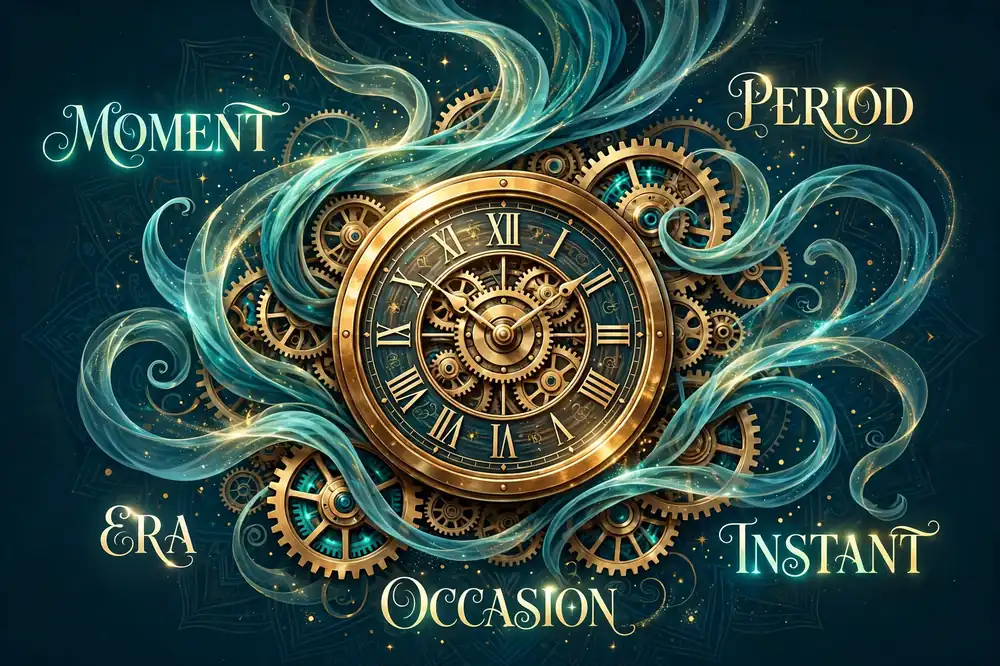
Here are the ten strongest alternatives to “time,” each suited to a slightly different situation:
- Moment — a brief, often significant point in time; use when seconds matter.
- Instant — an extremely short, near-instantaneous point; more technical than “moment.”
- Occasion — a special event or circumstance; use for celebrations and milestones.
- Period — a defined length of time, neutral and precise.
- Duration — how long something lasts; formal and measurement-focused.
- Era — a long, distinct span of history with a recognizable character.
- Phase — a stage in a process or development; implies progression.
- Spell — an indefinite, usually short stretch of time; slightly literary.
- Juncture — a critical point where decisions matter.
- Interval — a gap between two points; great for schedules and repetition.
What Does “Time” Mean?
“Time” is the continuous, irreversible progress of existence — the medium in which everything happens. In everyday use, though, it wears at least three different hats: a point (“at that time”), a duration (“in a short time”), and an occasion (“a fun time”). Each sense invites a different set of synonyms, which is why the generic word often feels flat.
For example: She arrived at exactly the right time to catch the announcement. And: They needed more time to finish the project. The first sentence means a point; the second means a duration. Precise synonyms remove that ambiguity.
The Closest Alternatives to “Time”
Moment
Meaning: A very brief point in time, often one that feels significant.
Difference: Shorter and more charged with meaning than “time.”
Tone: Emotional, reflective, sometimes dramatic.
Best Use: Memories, decisions, emotional turning points.
Example: The moment the results were announced, the whole room erupted in cheers.
Instant
Meaning: An almost indivisible point in time — a split second.
Difference: More precise and abrupt than “moment”; carries no emotion.
Tone: Technical, factual, immediate.
Best Use: Scientific writing, photography, computing, instructions.
Example: The flash froze the dancer in an instant of perfect balance.
Occasion
Meaning: A particular event, ceremony, or circumstance that happens at a specific time.
Difference: Describes the event itself, not the clock reading.
Tone: Formal, celebratory, dignified.
Best Use: Weddings, anniversaries, speeches, official events.
Example: Their fiftieth wedding anniversary was a truly joyful occasion.
Period
Meaning: A length of time with a beginning and an end.
Difference: Neutral and measurable; works in almost any register.
Tone: Plain, professional, academic.
Best Use: Essays, reports, history, science.
Example: The trial period lasts thirty days before the subscription renews.
Duration
Meaning: The total amount of time something continues or lasts.
Difference: Answers “how long,” not “when.”
Tone: Technical, administrative, precise.
Best Use: Contracts, schedules, travel itineraries, meeting notes.
Example: The flight’s duration is eleven hours, including the layover.
Era
Meaning: A long and distinct period of history marked by a particular character.
Difference: Much grander in scale than “period”; suggests a whole chapter.
Tone: Sweeping, historical, authoritative.
Best Use: History, culture, technology overviews, obituaries.
Example: The arrival of smartphones ended the era of the landline.
Phase
Meaning: A stage in a process or development.
Difference: Implies movement toward something — one step among several.
Tone: Analytical, orderly, professional.
Best Use: Project plans, childhood development, business cycles.
Example: The company is entering the final phase of its product launch.
Spell
Meaning: An indefinite, often short stretch of time.
Difference: More literary than “period”; pairs well with weather and moods.
Tone: Gentle, narrative, slightly old-fashioned.
Best Use: Storytelling, weather, illness, dry or cold runs.
Example: They endured a long dry spell before the rains finally returned.
Juncture
Meaning: A particular point in time, especially one where important decisions are made.
Difference: Carries gravity — it is a crossroads, not just a dot on a calendar.
Tone: Serious, formal, decisive.
Best Use: Strategy, politics, career turning points.
Example: At this critical juncture, the startup must choose between growth and profit.
Interval
Meaning: The space of time between two events or points.
Difference: Focuses on the gap rather than the endpoints.
Tone: Neutral, technical, rhythmic.
Best Use: Music, fitness, medication schedules, science.
Example: Take one tablet at regular intervals of eight hours.
“Time” Synonyms at a Glance
| Alternative | Main Meaning | Tone | Best Use |
|---|---|---|---|
| Moment | A brief, meaningful point | Emotional | Memories, decisions |
| Instant | A split-second point | Technical | Science, computing |
| Occasion | A special event or circumstance | Formal, celebratory | Ceremonies, milestones |
| Period | A defined length of time | Neutral | Essays, reports |
| Duration | How long something lasts | Formal, precise | Contracts, schedules |
| Era | A long, distinct historical span | Sweeping | History, culture |
| Phase | A stage in a process | Analytical | Projects, development |
| Spell | An indefinite short stretch | Literary | Storytelling, weather |
| Juncture | A critical decision point | Serious | Strategy, careers |
| Interval | The gap between two points | Technical | Music, fitness, medicine |
Synonyms for “Time” by Context
In Formal and Academic Writing
Formal writing rewards precision. Replace vague “time” with words that carry exact scope:
- Period — “the post-war period saw rapid growth.”
- Duration — “the duration of the experiment was six weeks.”
- Epoch — a larger unit than “era,” used in geology and deep history.
- Juncture — “at this critical juncture in the negotiations.”
In Casual Conversation
Everyday speech favors warm, concrete words over abstract ones:
- Moment — “give me a moment, I’ll be right with you.”
- While — “stay a while and have some tea.”
- Stretch — “for a long stretch, he lived abroad.”
- Spell — “we had a lovely warm spell in April.”
In Business and Professional Writing
Business prose needs words that are exact and easy to calendar:
- Quarter — “revenue rose this quarter.” (A business-specific time unit.)
- Phase — “we are moving into phase two of rollout.”
- Window — “the launch window is March to May.”
- Cycle — “the sales cycle runs about ninety days.”
Looking for more vocabulary upgrades? Browse our full collection of word guides, including our synonyms for journey, and start from the hub article covering synonyms for 200 common words to expand your vocabulary.
Grammar and Sentence Structure
“Time” is usually uncountable when it means the resource or the abstract flow: We don’t have much time. It becomes countable as “times” when it means occasions or experiences: I’ve visited Paris three times. Never write “three time” — the plural marker matters.
Watch the prepositions: “on time” means punctual (exactly when expected), while “in time” means early enough to act (“We arrived in time to stop the mistake”). Swapping them changes the meaning entirely.
“Time” also works as a verb meaning to measure or schedule: She timed her speech at four minutes. Its verb synonyms are schedule, clock, and measure — not the nouns listed above.
When Not to Use a Synonym for “Time”
1. Using “moment” for a long stretch. A “moment” is brief by definition, so it collapses when you stretch it.
Wrong: The company grew over a moment of ten years.
Corrected: The company grew over a period of ten years.
2. Using “period” for a single point. “Period” implies length; a point needs a point word.
Wrong: At that period, the phone rang.
Corrected: At that moment, the phone rang.
3. Using “era” for something brief or trivial. “Era” claims historical significance — small things sound absurd inside it.
Wrong: It was the era of my morning coffee.
Corrected: It was the time of my morning coffee. (Or simply: my morning coffee ritual.)
Frequently Asked Questions
What is the best formal synonym for “time”?
“Period” is the safest formal choice because it is neutral and measurable. Use “duration” when you mean how long something lasts, and “juncture” for decisive turning points.
Can “moment” and “instant” be used interchangeably?
Almost, but “instant” is shorter and more technical, while “moment” carries emotional weight. “In an instant, the glass shattered” sounds factual; “a moment I will never forget” sounds personal.
Is “times” the plural of “time”?
Yes, but only for the “occasion” sense — “three times” means three occasions. For the abstract resource, “time” stays uncountable: “we have little time.”
What is a good synonym for “time” as a verb?
When “time” means to measure, use clock or measure; when it means to arrange, use schedule. None of the noun synonyms above fit the verb use.
Faizi is a content writer at AllAboutFacts (hotteamnames.com), covering vocabulary, language tips, and everyday explainers.


