
Synonyms for Resilience: 25+ Better Words and Examples
Last updated: October 6, 2026
Thank you for reading this post, don't forget to subscribe!“Resilience” is a word we hear everywhere — in business meetings, self-help books, and news reports about communities rebuilding after disaster. But using it over and over can make your writing feel generic. The right synonym for “resilience” adds precision: toughness for physical strength, adaptability for flexibility, or perseverance for quiet determination. This guide walks through the best alternatives, each with its meaning, tone, and example sentences — plus a helpful list from the Merriam-Webster Thesaurus if you want to explore further.
Table of Contents
- Quick Answer
- What Does “Resilience” Mean?
- The Closest Alternatives to “Resilience”
- “Resilience” Synonyms at a Glance
- Synonyms for “Resilience” by Context
- Grammar and Sentence Structure
- When Not to Use a Synonym for “Resilience”
- Frequently Asked Questions
Quick Answer
- Toughness — when you mean raw physical or mental strength
- Perseverance — when resilience means refusing to give up
- Adaptability — when bouncing back means adjusting to change
- Fortitude — a formal word for brave endurance through hardship
- Grit — short and punchy, great for casual or motivational writing
- Endurance — when resilience is about lasting through a long struggle
- Flexibility — for bending without breaking, mentally or organizationally
- Hardiness — when describing people or things that withstand harsh conditions
- Determination — when resilience comes from firm resolve
- Recovery — when the focus is on bouncing back after a setback
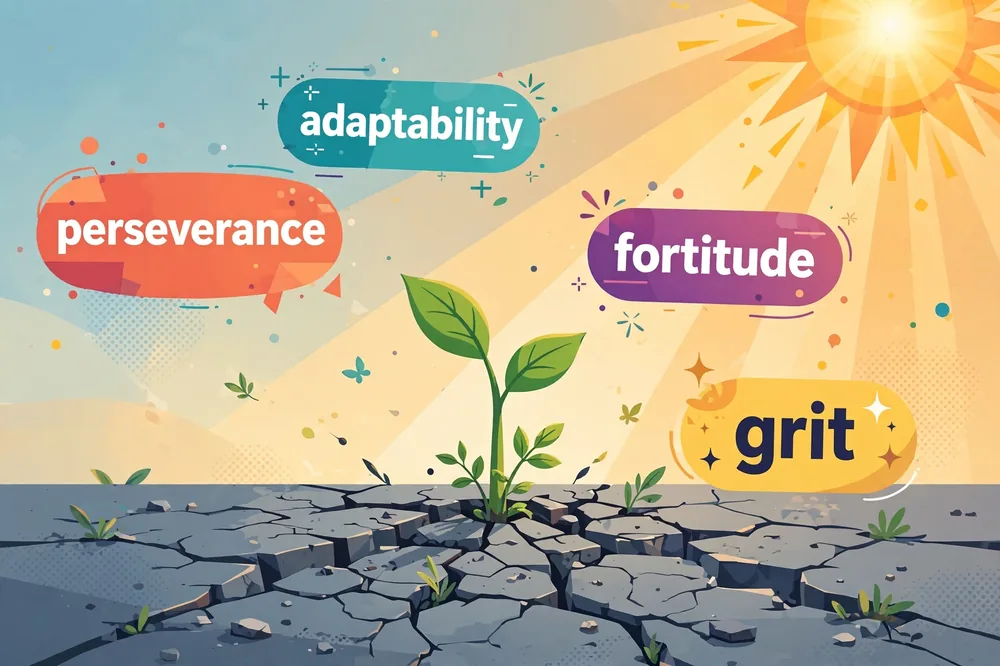
What Does “Resilience” Mean?
“Resilience” is a noun meaning the ability to recover quickly from difficulties, setbacks, or change. Originally it described materials that spring back into shape after being bent — for example, “The resilience of the rubber surprised the engineers.” Today it is used far more often for people, teams, economies, and ecosystems — for example, “Her resilience after losing her job inspired everyone around her.”
The word blends two ideas: toughness and recovery. A resilient person is not just strong enough to take a hit; they are able to return to normal (or even improve) afterward. Because it is so popular in modern writing, swapping in a more specific synonym can make your sentences sharper and less clichéd.
The Closest Alternatives to “Resilience”
1. Toughness
Meaning: The quality of being strong enough to handle difficulty or hardship.
Difference: Toughness emphasizes strength and endurance; resilience emphasizes the bounce-back.
Tone: Direct and no-nonsense.
Best Use: Sports writing, everyday speech, describing people.
Example: “His mental toughness carried him through two years of night shifts.”
2. Perseverance
Meaning: Continued effort despite difficulty, failure, or delay.
Difference: Perseverance focuses on persistence over time rather than recovery from a single blow.
Tone: Respectful and inspiring.
Best Use: Motivational writing, biographies, education.
Example: “Her perseverance through years of rejection finally paid off with a publishing deal.”
3. Adaptability
Meaning: The ability to adjust to new conditions or environments.
Difference: This is resilience through flexibility rather than sheer force — bending instead of breaking.
Tone: Modern and professional.
Best Use: Business writing, career advice, describing teams and companies.
Example: “Adaptability has become the most valued skill in a changing job market.”
4. Fortitude
Meaning: Courage and strength in facing pain, danger, or adversity.
Difference: More formal and weighty than resilience — it suggests noble, moral courage.
Tone: Formal and dignified.
Best Use: Speeches, obituaries, literary or historical writing.
Example: “She faced her illness with quiet fortitude.”
5. Grit
Meaning: Passion and perseverance combined with hard work.
Difference: Shorter, more casual, and trendier than resilience — popular in coaching and sports.
Tone: Energetic and informal.
Best Use: Motivational content, sports, casual advice.
Example: “Starting a business takes equal parts talent and grit.”
6. Endurance
Meaning: The ability to withstand prolonged hardship or strain.
Difference: Endurance is about lasting through something long; resilience is about recovering from it.
Tone: Serious and steady.
Best Use: Athletics, medical writing, descriptions of long struggles.
Example: “Marathon running builds endurance of both body and mind.”
7. Flexibility
Meaning: Willingness to change or compromise when circumstances demand it.
Difference: Flexibility is the mental side of resilience — it covers attitude, not strength.
Tone: Neutral and practical.
Best Use: Workplace communication, planning, parenting advice.
Example: “A little flexibility goes a long way when travel plans fall apart.”
8. Hardiness
Meaning: The capacity to survive harsh or difficult conditions.
Difference: Hardiness sounds physical and rugged — it suits bodies, plants, and communities.
Tone: Earthy and descriptive.
Best Use: Gardening, nature writing, describing populations or regions.
Example: “The hardiness of the local farmers impressed the visiting researchers.”
9. Determination
Meaning: Firmness of purpose; the decision to keep going no matter what.
Difference: Determination is the inner decision; resilience is the visible result.
Tone: Strong and focused.
Best Use: Career writing, profiles, goal-setting content.
Example: “With determination, she finished the degree she had abandoned ten years earlier.”
10. Recovery
Meaning: The process of returning to a normal state after difficulty.
Difference: Recovery is the process itself; resilience is the trait that enables it.
Tone: Neutral to hopeful.
Best Use: Health, economics, disaster reporting.
Example: “The town’s recovery after the flood took less than a year.”
“Resilience” Synonyms at a Glance
| Alternative | Main Meaning | Tone | Best Use |
|---|---|---|---|
| Toughness | Strength under pressure | Direct | Sports, everyday speech |
| Perseverance | Keeping going despite obstacles | Inspiring | Motivational and educational writing |
| Adaptability | Adjusting to new conditions | Professional | Business and career writing |
| Fortitude | Brave endurance | Formal | Speeches, literary writing |
| Grit | Determined effort | Energetic | Casual, sports, motivational |
| Endurance | Lasting through strain | Serious | Athletics, long struggles |
| Flexibility | Willingness to change | Neutral | Workplace, planning |
| Hardiness | Surviving harsh conditions | Earthy | Nature and community writing |
| Determination | Firm resolve | Strong | Profiles, goal setting |
| Recovery | Returning to normal | Hopeful | Health, economics, news |
Synonyms for “Resilience” by Context
Business and Professional
- Adaptability — “The company’s adaptability kept it profitable during the downturn.”
- Recovery — “Analysts expect a steady recovery in the third quarter.”
- Flexibility — “Our team values flexibility over rigid five-year plans.”
Casual Speech
- Grit — “You need real grit to finish a degree while working full time.”
- Toughness — “It takes toughness to move to a new city alone.”
- Determination — “She had the determination to learn coding from scratch.”
Formal and Literary Writing
- Fortitude — “He bore his losses with remarkable fortitude.”
- Perseverance — “The perseverance of the research team saved the project.”
- Endurance — “Their endurance through the long winter became legend.”
Health and Everyday Life
- Recovery — “Her recovery after surgery was faster than expected.”
- Flexibility — “Parenting small kids teaches you flexibility fast.”
- Toughness — “Mental toughness matters as much as talent in exams.”
Grammar and Sentence Structure
“Resilience” is an uncountable noun — do not pluralize it. Say “showing great resilience,” not “showing great resiliences.” It commonly appears in three patterns: resilience + preposition (“the resilience of local communities,” “resilience in the face of hardship,” “resilience to stress”), verb + resilience (“build resilience,” “show resilience,” “develop resilience”), and resilience as the subject (“Resilience matters more than talent in the long run”).
Note the adjective form is “resilient” (“a resilient economy”) and the adverb is “resiliently” (“she recovered resiliently”), though “resiliently” is rare in everyday writing. When replacing “resilience” with a synonym, check that the new word is also a noun and works with the same prepositions — “adaptability to change” and “flexibility in plans” both work naturally, just as “resilience to change” does.
Want to expand your vocabulary further? Browse our hub of synonyms for 200 common words, and see related emotional strength in our guides to synonyms for sad and synonyms for hope.
When Not to Use a Synonym for “Resilience”
1. “Recovery” is not always a substitute. Resilience is the trait; recovery is the process.
❌ Wrong: “The team’s recovery impressed the coach” (when you mean their ongoing character, not a comeback from one event).
✅ Corrected: “The team’s resilience impressed the coach.”
2. “Grit” is too casual for formal writing. Save it for blogs, speeches, and conversation.
❌ Wrong: “The committee demonstrated admirable grit during the audit.” (formal report)
✅ Corrected: “The committee demonstrated admirable fortitude during the audit.”
3. “Toughness” can sound harsh in emotional contexts. It implies enduring pain rather than healing.
❌ Wrong: “She needed toughness to grieve her father.”
✅ Corrected: “She needed resilience to grieve and heal after her father’s death.”
Frequently Asked Questions
Q: What is the closest single-word synonym for “resilience”?
A: “Toughness” is the closest everyday synonym, while “perseverance” best captures the keep-going aspect. For a formal option, use “fortitude.”
Q: Is “resilient” the adjective form of “resilience”?
A: Yes. “Resilience” is the noun (“showing great resilience”), and “resilient” is the adjective (“a resilient child,” “resilient supply chains”).
Q: Can “resilience” be used for non-human things?
A: Absolutely. It is commonly used for economies (“economic resilience”), ecosystems, materials, software systems, and organizations.
Q: What is the opposite of “resilience”?
A: “Fragility” and “vulnerability.” If you want the opposite quality, say someone “lacked resilience” or “was fragile under pressure.”
Faizi is a content writer at AllAboutFacts (hotteamnames.com), covering vocabulary, language tips, and everyday explainers.


