
Best Pastelitos de Guayaba Near Me: Find Them Fresh
Last updated: October 31, 2026
Thank you for reading this post, don't forget to subscribe!Typing “best pastelitos de guayaba near me” usually means you tasted a warm, flaky guava pastry once — at a Cuban bakery, a family gathering, or a Miami coffee window — and want that bite again, close to home. The good news: this pastry is easier to find than many regional specialties. The catch is that bakeries call it by several names. This guide explains what they are, where they hide on menus, and how to spot a fresh one.
Table of Contents
- Quick Answer
- What Are Pastelitos de Guayaba?
- Guayaba Only vs Guayaba y Queso
- Pastelitos, Pastelillos, and Other Names
- Where to Find Them Near You
- How to Search “Near Me” the Smart Way
- What to Ask Before You Order
- Signs of a Good One — and Red Flags
- If You Cannot Find One Nearby
- Make a Day of It
- Frequently Asked Questions
Quick Answer
Pastelitos de guayaba are flaky puff-pastry pockets filled with sweet guava paste, often paired with cream cheese or white cheese, baked until golden and usually finished with a sugar glaze or powdered sugar. Your best chance is a Cuban bakery or café, a Puerto Rican panadería, or a Latin grocery bakery — searched in both English and Spanish. Ask whether they were baked today, and order guava-and-cheese for the classic pairing, or guava-only if you prefer the fruit alone.
What Are Pastelitos de Guayaba?
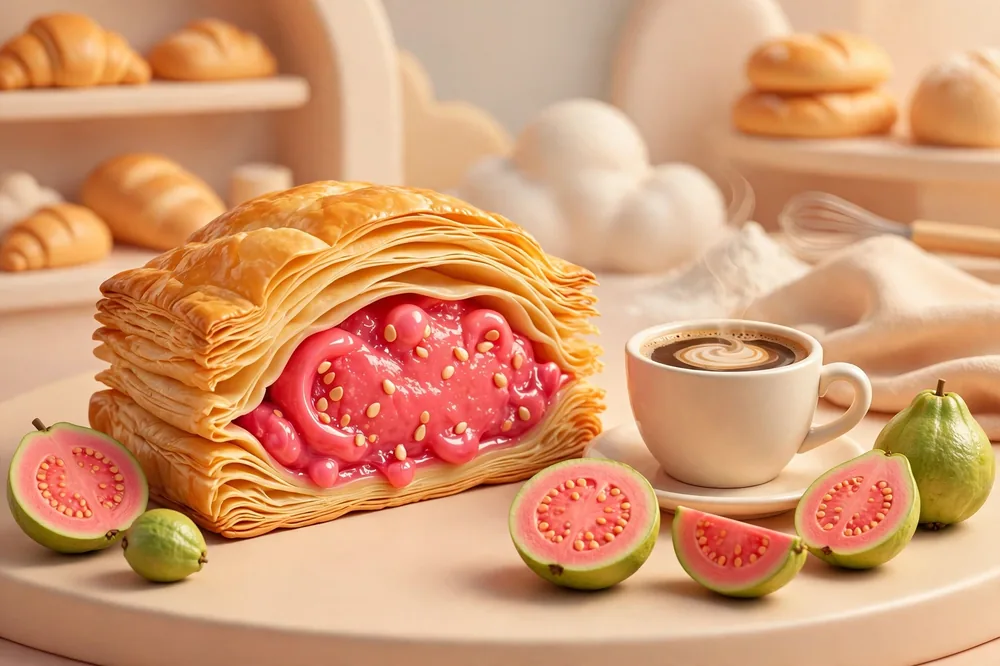
A pastelito de guayaba is a little pastry — pastelito means “little pie” in Spanish — made from puff pastry wrapped around guava paste. Guava paste, or pasta de guayaba, is a dense, sweet block of cooked guava and sugar, sold in Latin grocery stores. Baked inside puff pastry, it softens into a fragrant, tart-sweet center against buttery, shattering layers.
It is a Cuban bakery staple, equally beloved in Puerto Rico as a pastelillo de guayaba. Guava is one of the traditional sweet fillings for Cuban pastries, alongside cream cheese, pineapple, and coconut. For an overview of the whole family, see the Cuban pastry guide on Wikipedia.
Guayaba Only vs Guayaba y Queso
When you reach the bakery case, you will usually face two choices:
- Pastelito de guayaba (guava only): puff pastry and guava paste alone. The flavor is brighter, fruitier, and a little more tart — the purest version, and the one to choose if you want to judge a bakery on its guava alone.
- Pastelito de guayaba y queso (guava and cheese): guava paste plus cheese, most often sweetened cream cheese in Cuban bakeries, or queso blanco in some Caribbean versions. The cheese softens the sweetness and makes the pastry richer and more filling.
Neither choice is “correct.” Cheesecake lovers usually prefer guayaba y queso; guava purists go for guava only. Note that a quesito is cheese-only, not guava-and-cheese. If the case is unlabeled, ask what each pastry contains. Shape can hint — cheese versions are often triangles, guava-only ones squares — but bakeries differ, so ask.
Pastelitos, Pastelillos, and Other Names
The name travels, and the pastry changes slightly from place to place — which is why a “near me” search can miss good options. In Cuba and Cuban-American communities it is pastelito. In Puerto Rico the sweet guava version is usually a pastelillo de guayaba, finished with powdered sugar rather than syrup. In the Dominican Republic, pastelitos tend to be savory fried turnovers, so a Dominican bakery may not use the word for the sweet version at all.
That naming tangle matters when you search: a Puerto Rican panadería may list “pastelillos de guayaba,” a Cuban bakery “guava and cheese pastry,” and a supermarket “guava turnover” — all the same thing. The same lesson applies elsewhere: our guide to finding the best empanada de atún near you shows that Spanish spellings and menu photos beat one broad search.
Where to Find Them Near You
Pastelitos de guayaba have spread wherever Cuban and Puerto Rican communities have settled — and, through supermarkets, well beyond. Start here, in order:
- Cuban bakeries and cafés: the surest bet. Look for a glass case of pastelitos and a coffee window (ventanita) serving cortaditos and café con leche. Miami’s Little Havana is the home of the guava-and-cheese version, but strong Cuban bakeries exist across Florida, New Jersey, New York, Texas, and California.
- Puerto Rican panaderías: especially in Florida, New York, New Jersey, Pennsylvania, and Connecticut. Ask for pastelillos de guayaba — a bakery that makes good quesitos usually makes good guava pastries too.
- Latin American grocery bakeries: large Latin supermarkets often bake pastelitos fresh in-store. Check the bakery section near the bread and cakes, not just the packaged-pastry aisle.
- Supermarket bakery cases and food halls: in areas with large Hispanic populations, chains stock guava pastries, and Latin stalls at markets and festivals often sell them alongside empanadas and coffee.
Far from any Cuban or Puerto Rican community, frozen puff pastry and a block of guava paste from a Latin grocery let you bake a respectable version at home in under an hour.
How to Search “Near Me” the Smart Way
A plain “near me” search often returns generic bakeries that never stocked the pastry. Try this sequence instead:
- Search in Spanish too: try “pastelitos de guayaba cerca de mí,” “pastelillos de guayaba,” and “panadería cubana cerca de mí,” plus your city name. Many family-run bakeries describe food in Spanish first.
- Search the category, not just the dish: look for “Cuban bakery near me,” “Puerto Rican bakery near me,” and “Latin bakery near me,” then check menus or call about guava pastries.
- Check maps and photos: on Google Maps, search a promising bakery’s reviews and photos for “guava” or “pastelito.” A photo of the pastry in the case beats a menu listing.
- Try delivery apps separately: search “guava pastry,” “pastelito,” and “guava and cheese” there, since wording varies by app.
- Ask the community: local Latin American food groups on social media usually know which bakery bakes freshest, and on which days.
The same approach works elsewhere: our guide to finding humita en chala near you uses the same tricks, because search engines match exact menu words, not intentions.
What to Ask Before You Order
A quick call can save a wasted trip. Ask whether the pastelitos were baked fresh today; whether the bakery has guava-only, guava-and-cheese, or both; whether the cheese is cream cheese or queso blanco; and whether the finish is syrup or powdered sugar. Pastelitos reheat well in a hot oven the next morning.
If the bakery only has the cheese-only quesito, that is still a wonderful pastry — just a different one. Note the place anyway: it may add guava versions on weekends or by request.
Signs of a Good One — and Red Flags
A great pastelito announces itself before you taste it: deep golden color, visible flaky layers, a top that shatters lightly, and a generous filling — guava visible at the edges, soft and fragrant, with a tart edge under the sweetness. In a cheese version, the cheese should be creamy and mild.
Be cautious if the pastry is pale and soft rather than crisp, if the layers feel doughy in the middle, or if the filling is thin, grainy, or tastes only of sugar with no guava tang. A pastry that has sat in the case all day loses its shatter and turns leathery. Price is not a reliable guide — some of the best pastelitos come from small, inexpensive bakeries — but freshness always is.
If You Cannot Find One Nearby
If no bakery near you makes them, baking at home is easy. Thaw frozen puff pastry, cut it into squares, place a slice of guava paste (and sweetened cream cheese, for the classic pairing) in the center, seal with a fork, brush with egg, and bake until puffed and golden. Warm syrup after baking gives the Cuban shine; powdered sugar gives the Puerto Rican finish.
Make a Day of It
The best pastelitos live in small, family-run bakeries, so they suit a relaxed family outing: pick up a warm box in the morning and enjoy it with coffee at a nearby park. If children are coming along, see our guide to choosing a kids table and chair set for family meals at home. Afterwards, round the day out at an Urban Air trampoline and adventure park — pastries first, bouncing second.
Frequently Asked Questions
What exactly is a pastelito de guayaba?
A flaky puff-pastry pocket filled with sweet guava paste, often with cream cheese or white cheese, baked until golden and finished with syrup or powdered sugar — a Cuban staple and Puerto Rican favorite, where it is often called a pastelillo de guayaba.
Is it the same as a guava turnover?
Very close. “Guava turnover” is the English supermarket name for the same pastry. Bakery versions tend to be flakier and made with real guava paste rather than jam, so the flavor is more tart and tropical.
Are pastelitos de guayaba vegetarian?
Usually, yes — puff pastry, guava paste, and cheese contain no meat. Check ingredients if you are vegan, since most puff pastry contains butter and tops may be brushed with egg wash.
Why can I not find pastelitos de guayaba near me?
Because bakeries may list them under a different name — pastelillo de guayaba, guava pastry, or guava turnover — or bake them only on certain days. Searching in Spanish and calling ahead improves your odds a lot.
Faizi is a content writer at AllAboutFacts (hotteamnames.com), covering vocabulary, language tips, and everyday explainers.


