
As for Me and My House: The Verse on Every Christian Wall
Last updated: October 24, 2026
Thank you for reading this post, don't forget to subscribe!Table of Contents
- Quick Answer
- The Verse: Joshua 24:15
- Who Said It, and Why It Mattered
- What “As for Me and My House” Really Means
- How Christians Use the Verse Today
- The Verse in Home Décor and Wall Signs
- Frequently Asked Questions
Quick Answer
“As for me and my house, we will serve the Lord” comes from Joshua 24:15, spoken by Joshua near the end of his life. It is a public declaration that he — and everyone under his roof — had chosen to serve God alone instead of the false gods around them. Today it is one of the best-known mottos of Christian family life, and one of the most common Bible quotes on home décor signs and wall art.
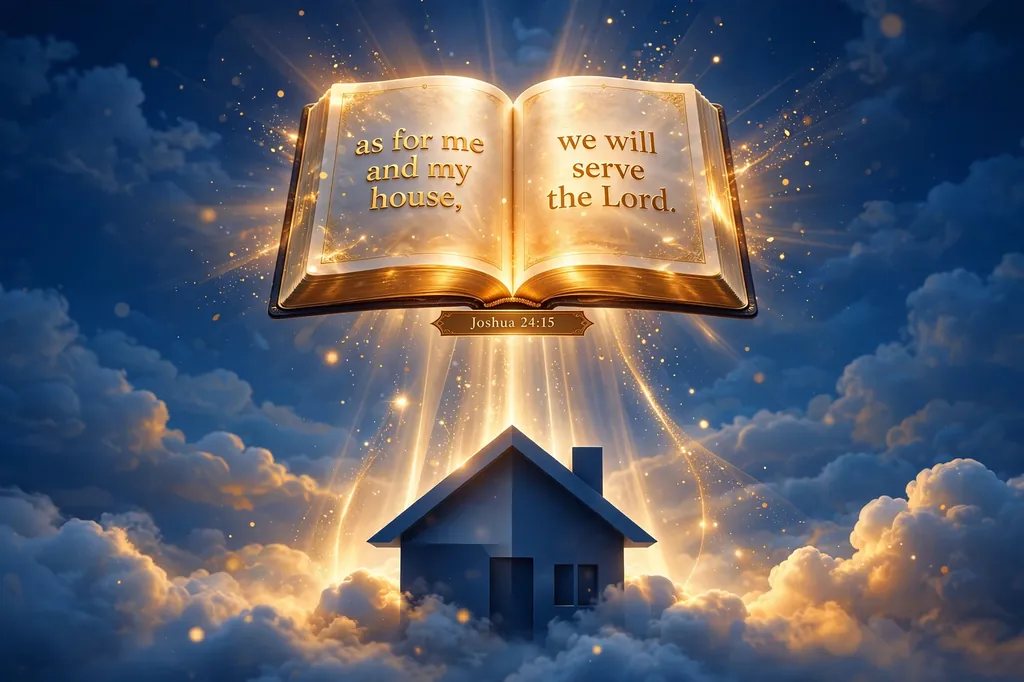
The Verse: Joshua 24:15
The full verse (King James Version) reads:
“And if it seem evil unto you to serve the LORD, choose you this day whom ye will serve; whether the gods which your fathers served that were on the other side of the flood, or the gods of the Amorites, in whose land ye dwell: but as for me and my house, we will serve the LORD.”
The New King James Version renders the famous closing line as most people know it: “But as for me and my house, we will serve the Lord.” You can compare translations and read the surrounding speech on BibleGateway.
Who Said It, and Why It Mattered
The speaker is Joshua, the leader who brought Israel into the land of Canaan after Moses’ death. Joshua 24 is his farewell address — his final major public act as an old man. He gathers all the tribes at Shechem, a place loaded with spiritual history: it is where God first promised the land to Abraham, and where Abraham built an altar (Genesis 12:6–7). He chose the ground on purpose.
The speech follows a deliberate pattern. First, Joshua recites what God has actually done: calling Abraham, delivering Israel from slavery in Egypt, preserving the people through the wilderness, driving out their enemies, and giving them a land they did not earn. Then he demands a decision: put away the foreign gods of their ancestors and of the Amorites, and “choose this day whom you will serve.” His own position is stated without hedging: whatever anyone else decides, his house will serve the Lord.
The scene does not end there. The people answer that they too will serve the Lord, Joshua warns them not to answer lightly since God is holy and will not tolerate divided loyalty, they confirm their choice, and Joshua makes a covenant with them that day — setting up a large stone under the oak by the sanctuary as a witness.
What “As for Me and My House” Really Means
First, “choose this day.” Joshua frames faith as a deliberate, present-tense decision — not an inherited habit or a vague intention for someday. The choice is urgent because the danger is drift: surrounded by other gods, the people would absorb their neighbors’ worship by default.
Second, “my house.” In the ancient world, a house meant the whole household — family members, servants, and everyone living under the head of the home. Joshua is not only declaring his personal faith; he is committing the people he leads. His own devotion sets the example, and the household follows. That is why the verse is so often quoted about spiritual leadership in the family: the parent’s choice sets the direction of the home.
Third, the declaration is public. Joshua stakes his own reputation on it before asking anyone else to decide. And its substance echoes the first commandment — “you shall have no other gods before Me” (Exodus 20:3): exclusive loyalty to the Lord, renouncing every rival for the heart.
How Christians Use the Verse Today
For many Christian families, Joshua 24:15 functions as a household mission statement — read at house blessings and move-in prayers, quoted in sermons on spiritual leadership, and taught to children as a memory verse. It pairs naturally with other well-loved household verses, like our explainer on Psalm 46:10, Be Still and Know That I Am God: Psalm 46:10 Meaning, which many families display as a companion piece.
The verse also shapes how believers see the home itself: not merely as a building but as the first place where faith is taught. Parents educating their children in a Christian framework often build their daily rhythm around exactly this household commitment — our guide to The Good and the Beautiful, the Christian homeschool curriculum, explores one popular way families do that. Readers drawn to the verse’s call for a clear decision often continue with I Am the Way, the Truth, and the Life: John 14:6 Meaning, another passage that demands a personal answer.
The Verse in Home Décor and Wall Signs
Walk into enough Christian homes and you will notice a pattern: this verse shows up on walls more than almost any other, in a wide range of styles. Farmhouse-style wooden signs with painted or vinyl lettering are the most familiar look — rustic boards that suit entryways and living rooms. Canvas prints present the verse on parchment-style backgrounds, sometimes with floral illustrations or vintage scroll borders. Laser-cut metal wall art gives it a bolder feel, vinyl wall decals place the verse directly on the wall without nails, and framed prints work well on mantels and shelves.
Placement carries meaning: the entryway is the classic spot, so the verse greets everyone who walks in and quietly announces the household’s values. The signs are also popular housewarming and wedding gifts. Like the verse in May the Lord Bless You and Keep You: Meaning, Origin & Use, another favorite for house-blessing wall art, it works as décor precisely because it is more than decoration: it is a commitment the household reads every single day.
Frequently Asked Questions
What book of the Bible contains the verse “as for me and my house”?
It is Joshua 24:15, in the Old Testament — the climax of Joshua’s farewell speech to the tribes of Israel.
What did Joshua mean by “my house”?
His household — family and everyone living under his authority — not the physical building. The “house” in ancient Israel included relatives, servants, and dependents, so the verse commits his whole circle of influence, not just himself.
Why do so many Christians hang this verse on their walls?
Because it works as a daily, public declaration. On an entryway sign it tells guests what the household stands for; for the family itself it is a constant reminder of a choice they keep making — to serve God, not drift with everything competing for their loyalty.
What happened right after Joshua spoke these words?
The people answered that they too would serve the Lord. Joshua warned them not to answer lightly, since God is holy and will not tolerate divided loyalty. They confirmed their choice, Joshua made a formal covenant with them that day, and he set up a large stone under an oak tree as a witness to everything said.
Faizi is a content writer at AllAboutFacts (hotteamnames.com), covering vocabulary, language tips, and everyday explainers.


