
Synonyms for Understanding: 25+ Better Words and Examples
Last updated: October 6, 2026
Thank you for reading this post, don't forget to subscribe!“Understanding” is one of the most overused words in English — it can mean grasping an idea, feeling empathy, or even reaching an agreement. But repeating it makes your writing flat, so building a richer vocabulary is a smart move. Browse the Merriam-Webster Thesaurus and you will find dozens of sharper options, and this guide puts the best 25 of them in one place with clear examples.
- Quick Answer
- What Does “Understanding” Mean?
- The Closest Alternatives to “Understanding”
- “Understanding” Synonyms at a Glance
- Synonyms for “Understanding” by Context
- Grammar and Sentence Structure
- When Not to Use a Synonym for “Understanding”
- Frequently Asked Questions
Quick Answer
If you need a fast replacement for “understanding,” start with these:
- Comprehension — use it for intellectual grasp of a subject, especially in school or study.
- Grasp — a casual, punchy word for getting the main idea.
- Insight — deep, original seeing into a problem or situation.
- Awareness — knowing that something exists and matters.
- Discernment — careful judgment that separates what is true from what is not.
- Empathy — emotionally understanding how another person feels.
- Sympathy — caring support when someone is going through hardship.
- Knowledge — stored information and learned facts.
- Perception — the way you see or interpret things.
- Appreciation — full recognition of the value or complexity of something.
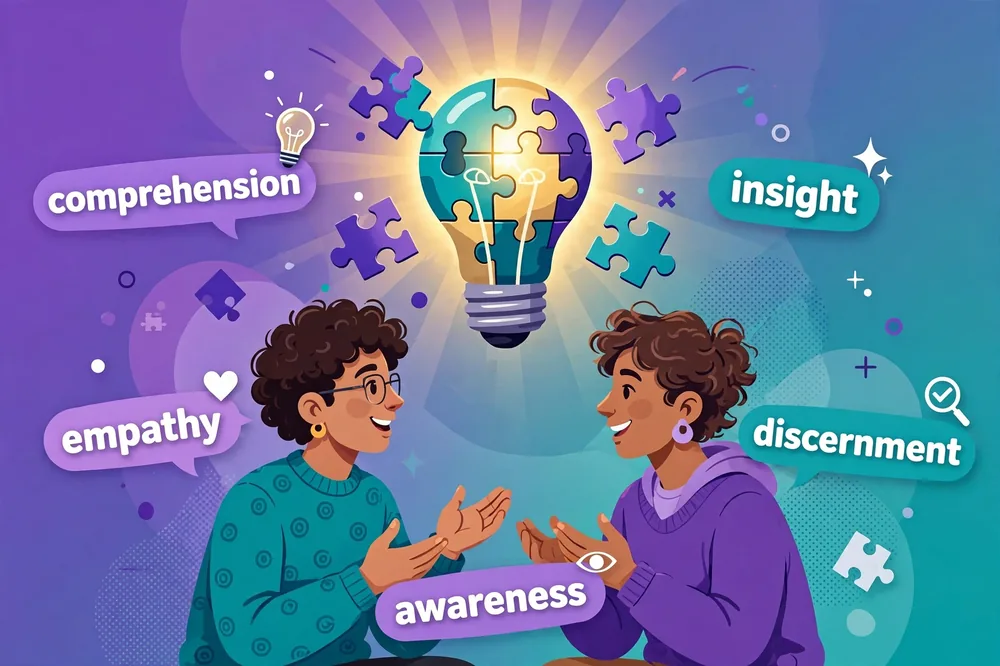
What Does “Understanding” Mean?
“Understanding” works in three main ways in English. As a noun, it means the ability to grasp the meaning of something: “She has a deep understanding of mathematics.” It can also mean an informal agreement between people: “We reached an understanding about the deadline.” As an adjective, it describes someone compassionate and forgiving: “He was very understanding when I explained the delay.”
Because it covers mental grasp, emotional compassion, and mutual agreement, swapping in a precise synonym often makes your sentence stronger. “She has a firm grasp of mathematics” sounds more active, while “an empathetic teacher” says more than “an understanding teacher.”
The Closest Alternatives to “Understanding”
Here are the ten best replacements, each explained so you can pick the exact right one. For more word choices, also see our guide on synonyms for 200 common words to expand your vocabulary.
1. Comprehension
Meaning: The mental act of fully grasping information or a subject.
Difference: More formal and academic than “understanding” — it implies tested, complete grasp.
Tone: Formal, educational.
Best Use: School, exams, reading skills, research writing.
Example: “The test measures reading comprehension, not just speed.”
2. Grasp
Meaning: A firm hold on an idea, fact, or situation.
Difference: Shorter and more energetic; suggests active control of the topic.
Tone: Neutral to casual.
Best Use: Everyday speech, résumés, casual essays.
Example: “He has a solid grasp of the basics already.”
3. Insight
Meaning: Deep, clear, sometimes sudden understanding of something complex.
Difference: Goes beyond plain comprehension — it suggests seeing what others missed.
Tone: Thoughtful, professional.
Best Use: Business analysis, psychology, self-reflection.
Example: “Her insight into the data revealed the real cause of the drop.”
4. Awareness
Meaning: Knowing that something exists and being conscious of it.
Difference: Broader and lighter — it does not require full comprehension.
Tone: Neutral.
Best Use: Health, social issues, safety campaigns.
Example: “Awareness of the risks has grown since last year.”
5. Discernment
Meaning: The mental act of fully grasping information or a subject.
Difference: Emphasizes wisdom and careful judgment, not just knowledge.
Tone: Formal, mature.
Best Use: Leadership writing, reviews, advice columns.
Example: “A good editor needs strong discernment about tone.”
6. Empathy
Meaning: The ability to feel and share another person’s emotions.
Difference: Emotional, not intellectual — it is about hearts, not facts.
Tone: Warm, compassionate.
Best Use: Relationships, counseling, customer service.
Example: “Show empathy when a customer describes the problem.”
7. Sympathy
Meaning: Feelings of care and support for someone’s hardship.
Difference: Unlike empathy, you do not have to feel the same emotion — just care.
Tone: Kind, supportive.
Best Use: Condolences, apologies, comforting messages.
Example: “Please accept my sympathy during this difficult time.”
8. Knowledge
Meaning: Information, facts, and skills gained through learning.
Difference: Refers to what is stored, while understanding refers to how well you use it.
Tone: Neutral, academic.
Best Use: Résumés, reports, reference material.
Example: “Her knowledge of history is impressive.”
9. Perception
Meaning: The way you interpret or see something.
Difference: Subjective — two people can have different perceptions of the same event.
Tone: Neutral to formal.
Best Use: Psychology, marketing, opinion writing.
Example: “Public perception of the brand improved after the relaunch.”
10. Appreciation
Meaning: Full recognition and valuing of something’s worth or complexity.
Difference: Adds gratitude or admiration to understanding.
Tone: Positive, respectful.
Best Use: Art, music, culture, thank-you notes.
Example: “Travel gave me a deeper appreciation of other cultures.”
“Understanding” Synonyms at a Glance
| Alternative | Main Meaning | Tone | Best Use |
|---|---|---|---|
| Comprehension | Full mental grasp | Formal | Academics, exams |
| Grasp | Firm hold on an idea | Casual | Everyday speech, résumés |
| Insight | Deep seeing into something | Thoughtful | Analysis, reflection |
| Awareness | Consciousness of something | Neutral | Campaigns, health |
| Discernment | Careful judgment | Formal | Leadership, reviews |
| Empathy | Sharing another’s feelings | Warm | Relationships, service |
| Sympathy | Caring support in hardship | Kind | Condolences, comfort |
| Knowledge | Stored facts and skills | Neutral | Reports, résumés |
| Perception | How you interpret things | Formal | Psychology, marketing |
| Appreciation | Recognition of value | Positive | Art, culture, thanks |
Synonyms for “Understanding” by Context
In Formal and Academic Writing
- Comprehension — reading comprehension, listening comprehension.
- Cognizance — formal awareness, often used in legal writing (“take cognizance of”).
- Discernment — wise judgment in essays and critiques.
- Apprehension — the mental grasping of an idea (formal, not the “fear” sense).
In Business and Professional Settings
- Insight — data-driven discoveries shared in reports.
- Awareness — market awareness, risk awareness.
- Alignment — shared understanding of goals between teams.
- Consensus — an agreement everyone supports (“we reached a consensus”).
In Casual Everyday Speech
- Grasp — “Do you have a grasp of the plan?”
- Get the picture — “Ah, now I get the picture.”
- Familiarity — casual knowledge from experience (“familiarity with the software”).
- Feel for — an intuitive sense (“she has a feel for design”).
For Emotional or Compassionate Contexts
- Empathy — feeling what another feels.
- Sympathy — caring support in hard times.
- Compassion — deep care paired with a wish to help.
- Tolerance — accepting differences without judgment.
- Sensitivity — being tuned in to others’ feelings.
Grammar and Sentence Structure
“Understanding” appears as a noun, an adjective, and in the verb form “understand.” Each form needs different grammar, and each takes different synonyms.
- As a noun of: use “understanding of” — “an understanding of the rules.” Synonyms like comprehension and grasp follow the same pattern: “a comprehension of the rules,” “a grasp of the rules.”
- As a noun meaning agreement: “We came to an understanding.” Alternatives: “We reached an agreement / a consensus.”
- As an adjective: “an understanding friend.” Adjective synonyms must match: “an empathetic friend,” “a compassionate friend,” “a tolerant friend.”
- Common mistake: don’t pair noun synonyms with adjective positions. “An insightful friend” means a clever friend, not necessarily a kind one — context decides.
When Not to Use a Synonym for “Understanding”
1. Swapping empathy for intellectual grasp.
Wrong: “His empathy of the tax code is strong.”
Correct: “His grasp of the tax code is strong.” (Empathy is for feelings, not facts.)
2. Using “sympathy” when you mean “agreement.”
Wrong: “We reached a sympathy about the price.”
Correct: “We reached an understanding about the price.” (Or “an agreement.”)
3. Replacing “knowledge” with “comprehension” on a résumé.
Wrong: “Comprehension of Microsoft Excel.”
Correct: “Knowledge of Microsoft Excel.” (Knowledge names the skill; comprehension sounds like a test result.)
Frequently Asked Questions
What is the best synonym for “understanding” in an essay?
Use comprehension for learning contexts and insight when you mean deep analysis. Both sound academic and precise.
What is a kind word for an “understanding person”?
Empathetic, compassionate, and tolerant all describe a caring, understanding person — pick based on the situation.
Can “understanding” mean agreement?
Yes. “We have an understanding” means an informal agreement. Good synonyms for this sense are agreement, accord, and consensus.
Is “understanding” formal or informal?
It is neutral and fits everywhere, which is why writers overuse it. Replacing it with a precise synonym like discernment or grasp sharpens your tone. If you liked this guide, you may also enjoy our article on synonyms for sad.
Faizi is a content writer at AllAboutFacts (hotteamnames.com), covering vocabulary, language tips, and everyday explainers.


