Synonyms for Problem: 25+ Better Words and Examples
Last updated: October 6, 2026
Thank you for reading this post, don't forget to subscribe!“Problem” is one of the most overused words in English — and that makes it one of the least precise. The right synonym can turn a flat sentence into one with real tone, whether you are writing a business report, an essay, or a casual text. For a full word reference, the Merriam-Webster Thesaurus is a reliable place to check shades of meaning. Below you will find more than 25 alternatives for “problem,” with examples and tips for using each one correctly.
Table of Contents
- Quick Answer
- What Does “Problem” Mean?
- The Closest Alternatives to “Problem”
- “Problem” Synonyms at a Glance
- Synonyms for “Problem” by Context
- Grammar and Sentence Structure
- When Not to Use a Synonym for “Problem”
- Frequently Asked Questions
Quick Answer
- Issue — the neutral, professional choice for formal writing and business.
- Challenge — a problem framed positively, as something to overcome.
- Dilemma — a problem involving a difficult choice between two options.
- Obstacle — something standing in the way of a goal.
- Hurdle — a smaller, surmountable obstacle, often in plans or careers.
- Complication — a problem that makes an existing situation worse.
- Predicament — an awkward or unpleasant situation you are stuck in.
- Setback — a problem that delays progress toward a goal.
- Quandary — a confusing situation with no obvious solution.
- Snag — a small, unexpected problem, common in casual speech.
What Does “Problem” Mean?
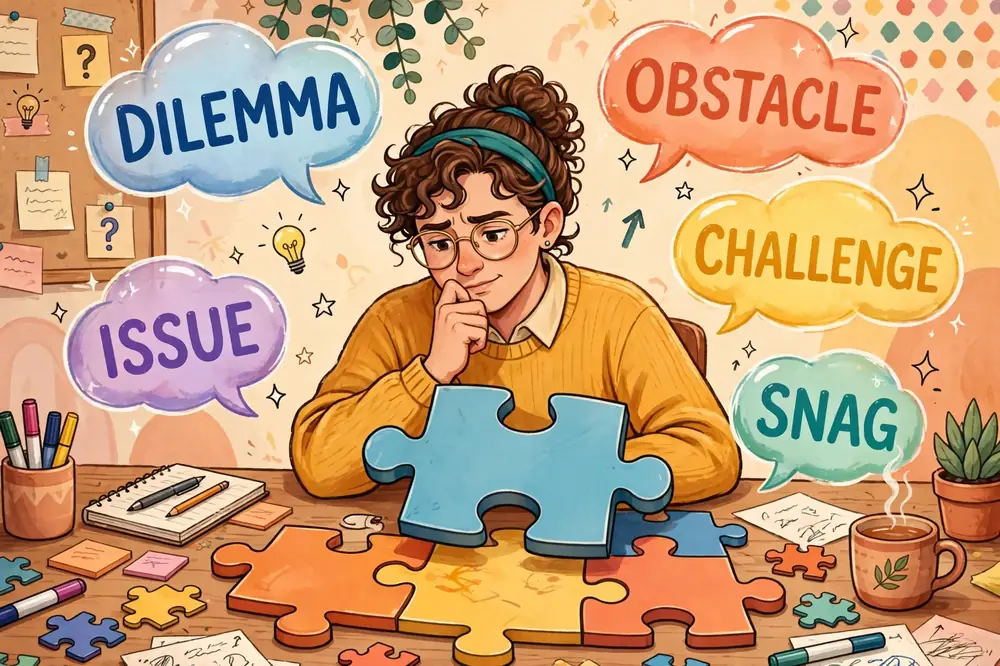
“Problem” is a noun meaning a matter or situation that is unwelcome, harmful, or difficult to deal with — something that needs a solution. It is extremely broad: a broken appliance, a math puzzle, a relationship conflict, and a global crisis can all be called problems.
Example: “The factory’s main problem was its outdated machinery.”
Example: “We need to solve this problem before Friday’s deadline.”
The Closest Alternatives to “Problem”
Issue
Meaning: A point of concern or dispute; a problem in neutral, professional terms.
Difference: Softer and more formal than “problem” — it does not suggest blame.
Tone: Neutral, professional.
Best Use: Business emails, reports, customer service.
Example: “We are aware of the login issue and our team is fixing it.”
Challenge
Meaning: A difficult task or situation that tests someone’s abilities.
Difference: Reframes the problem positively — something to rise to, not just suffer.
Tone: Motivating, optimistic.
Best Use: Resumes, speeches, self-help and team contexts.
Example: “Starting the company at nineteen was a challenge, but it taught him everything.”
Dilemma
Meaning: A situation requiring a choice between two equally difficult options.
Difference: Specifically involves a tough decision, not just any difficulty.
Tone: Serious, thoughtful.
Best Use: Essays, ethics discussions, storytelling.
Example: “She faced the dilemma of choosing between her dream job and staying close to family.”
Obstacle
Meaning: Something that blocks progress or achievement.
Difference: Emphasizes blocking rather than general difficulty.
Tone: Determined, narrative.
Best Use: Motivational writing, sports, biographies.
Example: “Despite every obstacle, she became the first doctor in her village.”
Complication
Meaning: An additional difficulty that makes things worse.
Difference: Implies something went wrong on top of an existing situation.
Tone: Clinical, matter-of-fact.
Best Use: Medical, legal, and project contexts.
Example: “A complication during surgery delayed her recovery by two weeks.”
Predicament
Meaning: An unpleasant, awkward, or difficult situation.
Difference: Focuses on the situation itself, often with a sense of being trapped.
Tone: Dramatic, literary.
Best Use: Creative writing, journalism.
Example: “Locked out in the rain with no phone, he found himself in quite a predicament.”
Quandary
Meaning: A state of confusion or uncertainty over what to do.
Difference: Stresses confusion and indecision more than hardship.
Tone: Formal, reflective.
Best Use: Academic writing, opinion pieces.
Example: “The committee was in a quandary over how to spend the limited budget.”
Hurdle
Meaning: An obstacle that must be overcome, usually temporary.
Difference: Smaller and more specific than “problem” — one step in a longer process.
Tone: Upbeat, sports-like.
Best Use: Career advice, project updates.
Example: “The visa delay was just one hurdle in her journey to study abroad.”
Setback
Meaning: A reversal or delay in progress.
Difference: Implies you were moving forward and got pushed back — time-focused.
Tone: Resilient, honest.
Best Use: Progress reports, personal stories.
Example: “The injury was a major setback, but she returned to training within months.”
Snag
Meaning: A small, unexpected difficulty.
Difference: Minor and informal — the opposite of a crisis.
Tone: Casual, light.
Best Use: Everyday conversation, informal messages.
Example: “We hit a snag with the booking, so the trip is delayed by a day.”
“Problem” Synonyms at a Glance
| Alternative | Main Meaning | Tone | Best Use |
|---|---|---|---|
| Issue | A matter of concern | Neutral, professional | Business, customer service |
| Challenge | A difficult task to overcome | Optimistic, motivating | Speeches, resumes |
| Dilemma | A difficult choice | Serious, thoughtful | Essays, storytelling |
| Obstacle | Something blocking the way | Determined | Narratives, sports |
| Complication | An added difficulty | Clinical, factual | Medical, legal, projects |
| Predicament | An awkward situation | Dramatic | Creative writing, journalism |
| Quandary | Confusion over what to do | Formal, reflective | Academic writing |
| Hurdle | A temporary obstacle | Upbeat | Career, project updates |
| Setback | A delay in progress | Resilient, honest | Reports, personal stories |
| Snag | A small unexpected difficulty | Casual, light | Everyday conversation |
| Trouble | Difficulty or distress | General, conversational | Daily speech |
| Difficulty | The state of being hard to do | Neutral, formal | Academic, official writing |
| Conundrum | A confusing puzzle-like problem | Intellectual, formal | Science, philosophy |
| Crisis | A time of intense danger or difficulty | Urgent, grave | News, emergencies |
| Hiccup | A minor temporary problem | Light, informal | Business updates, chat |
Synonyms for “Problem” by Context
Formal and Business Writing
- Issue — “Please report any technical issues to the IT desk.”
- Matter — “This is a matter the board must address urgently.”
- Concern — “The main concern is the rising cost of raw materials.”
- Difficulty — “The company faced financial difficulties last quarter.”
Casual Speech and Everyday Conversation
- Snag — “We ran into a snag with the delivery.”
- Hiccup — “There was a small hiccup during the presentation.”
- Pickle — “He got himself into a real pickle with that bet.”
- Trouble — “The car is giving us trouble again.”
Academic and Analytical Writing
- Conundrum — “The study presents a conundrum for economists.”
- Quandary — “Researchers remain in a quandary about the cause.”
- Question — “The question of climate adaptation remains open.”
- Enigma — “The manuscript’s origin is still an enigma.”
Emotional and Personal Contexts
- Struggle — “He opened up about his struggle with anxiety.”
- Burden — “She carried the burden of the family’s debts alone.”
- Plight — “The documentary highlights the plight of displaced workers.”
If you are writing about feelings, our article on synonyms for sad and our list of synonyms for excited can help you name emotions more precisely. For more vocabulary, see our guide to synonyms for 200+ common words.
Grammar and Sentence Structure
“Problem” is a countable noun: you can have one problem or many problems. It commonly appears in these patterns:
- “The problem is…” — followed by a clause: “The problem is that nobody told us.”
- “Have a problem with…” — followed by a noun or gerund: “I have a problem with the new schedule.”
- “No problem” — informal response meaning “you’re welcome” or “it’s fine”: “No problem, happy to help.”
- “Problems with” + noun — plural for ongoing issues: “There are problems with the water supply.”
Most synonyms follow the same countable-noun pattern (“an issue,” “a dilemma,” “several obstacles”), but a few behave differently: trouble is usually uncountable (“We’re in trouble,” not “a trouble”), and difficulty is uncountable when it means the general quality of being hard (“She solved it with difficulty”).
When Not to Use a Synonym for “Problem”
Mistake 1 — Using “dilemma” for any problem. A dilemma requires a choice between two options.
❌ Wrong: “The dilemma is that the printer is broken.”
✅ Corrected: “The problem is that the printer is broken.”
Mistake 2 — Saying “no problem” in formal settings. It sounds dismissive in professional emails.
❌ Wrong: “Thanks for your patience. No problem.”
✅ Corrected: “Thanks for your patience. You’re welcome — the issue is resolved.”
Mistake 3 — Using “issue” when you mean a real crisis. “Issue” softens too much when urgency matters.
❌ Wrong: “We have a small issue with the fire in the kitchen.”
✅ Corrected: “We have a serious problem with the fire in the kitchen.”
Frequently Asked Questions
What is the difference between a “problem” and an “issue”?
“Issue” is the neutral, professional version of “problem.” It carries no blame and sounds more formal, which is why businesses prefer it. “Problem” can sound harsher and more personal.
What is the most formal synonym for “problem”?
“Difficulty” and “matter” are the most formal options. In business, “issue” is the standard; in academic writing, “question,” “conundrum,” or “dilemma” fit better.
Is “dilemma” a direct synonym for “problem”?
Only partly. A dilemma is a specific kind of problem — one that involves choosing between two difficult options. Using it for any problem is a common mistake.
What is a positive-sounding alternative to “problem”?
“Challenge” and “opportunity” reframe difficulty in an upbeat way. “Hurdle” and “setback” also suggest the problem is temporary and beatable.
Faizi is a content writer at AllAboutFacts (hotteamnames.com), covering vocabulary, language tips, and everyday explainers.


