Synonyms for Similar: 25+ Better Words and Examples
Last updated: October 6, 2026
Thank you for reading this post, don't forget to subscribe!“Similar” is one of those words we reach for without thinking — but it can sound flat and vague when a more precise word would do the job better. Whether you are writing an essay, a business email, or a story, the right synonym for similar can sharpen your meaning instantly. In this guide, you will find 25+ better words and examples to replace “similar” in any situation. For even more word options, you can also browse the Merriam-Webster Thesaurus.
Table of Contents
- Quick Answer
- What Does “Similar” Mean?
- The Closest Alternatives to “Similar”
- “Similar” Synonyms at a Glance
- Synonyms for “Similar” by Context
- Grammar and Sentence Structure
- When Not to Use a Synonym for “Similar”
- Frequently Asked Questions
Quick Answer
- Comparable — use when two things can be fairly measured against each other.
- Analogous — use for a comparison between situations or ideas, not physical things.
- Akin — use for a literary or slightly formal way to say “of the same kind.”
- Alike — use when two or more things share a look or quality.
- Parallel — use when two paths, stories, or careers develop in the same way.
- Corresponding — use when each item in one set matches an item in another.
- Equivalent — use when two things are equal in value, amount, or effect.
- Matching — use for pairs or sets designed to go together.
- Identical — use when there is no difference at all, not just resemblance.
- Close — use in casual speech when things are nearly alike.
What Does “Similar” Mean?
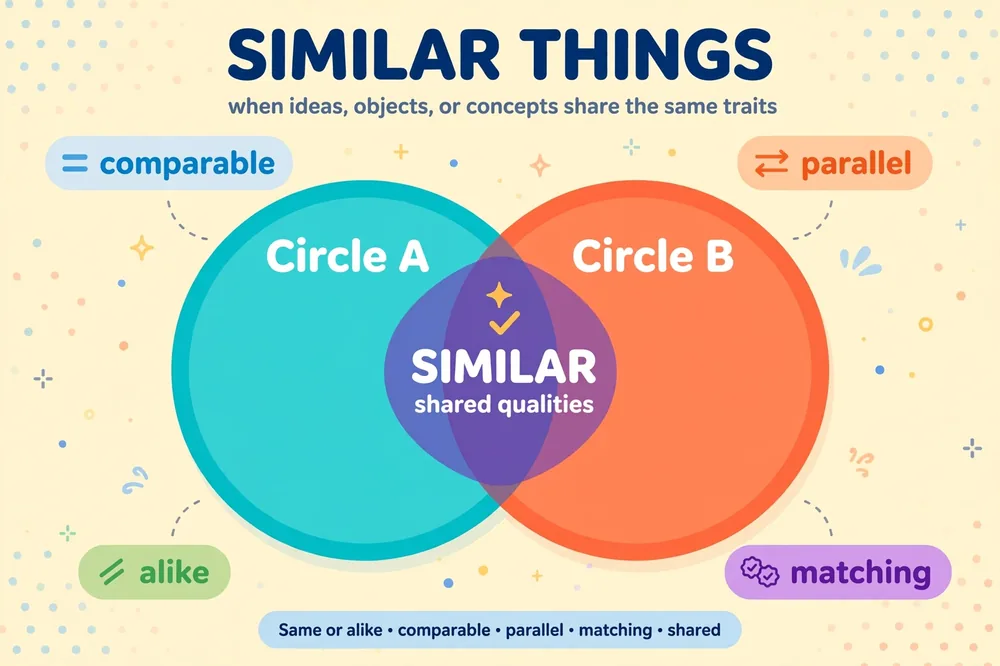
Similar is an adjective that means “having qualities, characteristics, or appearance that resemble something else, without being exactly the same.”
For example: “Her new novel has a similar plot to her last one.” Or: “Our tastes in music are surprisingly similar.”
The Closest Alternatives to “Similar”
1. Comparable
Meaning: able to be compared; alike enough that a fair comparison is possible.
Difference: “Comparable” stresses measurability — two things similar enough to weigh against each other.
Tone: Neutral to formal.
Best use: Reviews, reports, and essays. Example: “This year’s harvest is comparable to the record year of 2021.”
2. Analogous
Meaning: similar in a way that makes comparison useful, usually between ideas or situations.
Difference: “Analogous” is for relationships and patterns, not physical likeness.
Tone: Formal, academic.
Best use: Philosophy, science, and law. Example: “The human brain is often described as analogous to a computer.”
3. Akin
Meaning: of a similar character or kind; closely related in nature.
Difference: “Akin” feels more literary and pairs with “to,” suggesting a family-like closeness.
Tone: Formal, slightly poetic.
Best use: Essays and creative writing. Example: “His quiet anger was akin to a storm gathering offshore.”
4. Alike
Meaning: similar in appearance or character; resembling one another.
Difference: “Alike” almost always describes two or more things compared with each other, not one thing compared to another.
Tone: Neutral.
Best use: Everyday writing and speech. Example: “The twins are so alike that their teachers mix them up.”
5. Parallel
Meaning: similar in the way two things develop in step with each other.
Difference: “Parallel” highlights shared direction or timing, like two lines that never meet but never drift apart.
Tone: Neutral to formal.
Best use: History, biographies, and commentary. Example: “Her career followed a path parallel to her mentor’s.”
6. Equivalent
Meaning: equal in value, amount, meaning, or importance.
Difference: “Equivalent” is stronger than “similar” — it claims sameness of worth or effect, not just likeness.
Tone: Formal, precise.
Best use: Business, finance, and academic writing. Example: “Two years of work experience is considered equivalent to a degree for this role.”
7. Corresponding
Meaning: matching or relating to something else in a one-to-one way.
Difference: “Corresponding” implies an exact pairing — item A in one set goes with item B in the other.
Tone: Formal, technical.
Best use: Data, instructions, and documentation. Example: “Click the corresponding button to confirm your selection.”
8. Matching
Meaning: the same as, or designed to go with, something else.
Difference: “Matching” often describes pairs or sets that belong together, especially clothing or furniture.
Tone: Casual to neutral.
Best use: Everyday descriptions and shopping. Example: “They arrived in matching jackets, looking like a team.”
9. Resembling
Meaning: having a likeness or appearance like something else.
Difference: “Resembling” is usually about looks and is followed by the thing being copied.
Tone: Neutral.
Best use: Describing appearance. Example: “The cloud resembled a giant bird gliding across the sky.”
10. Identical
Meaning: exactly the same; with no difference at all.
Difference: “Identical” is the endpoint of similarity — total sameness. Use it only when you mean zero difference.
Tone: Neutral to formal.
Best use: Precise statements. Example: “The two reports contained identical figures.”
“Similar” Synonyms at a Glance
| Alternative | Main Meaning | Tone | Best Use |
|---|---|---|---|
| Comparable | Alike enough to compare fairly | Neutral–formal | Reviews and essays |
| Analogous | Similar in pattern or relationship | Formal | Academic and scientific writing |
| Akin | Of the same kind | Literary | Essays and creative writing |
| Alike | Resembling one another | Neutral | Everyday writing |
| Parallel | Developing in the same way | Neutral–formal | History and biographies |
| Equivalent | Equal in value or effect | Formal | Business and finance |
| Corresponding | Matching one-to-one | Formal | Instructions and data |
| Matching | Designed to go together | Casual | Everyday descriptions |
| Resembling | Looking like something else | Neutral | Describing appearance |
| Identical | Exactly the same | Neutral–formal | Precise statements |
| Close | Nearly alike | Casual | Conversation |
| Kindred | Sharing a spirit or nature | Literary | Describing people and ideas |
Synonyms for “Similar” by Context
Formal and Academic Writing
In academic writing, “similar” can feel too plain. Stronger options include:
- Analogous — for comparing situations, systems, or arguments.
- Comparable — for studies, statistics, and data sets.
- Corresponding — for elements that pair across two groups.
- Parallel — for historical events or trends that echo each other.
- Homologous — for biology and anatomy, where structures share an origin.
Business and Professional Communication
Workplace writing rewards precision. Try these instead of repeating “similar”:
- Equivalent — for equal value or qualifications.
- Corresponding — for matching entries, figures, or documents.
- Parallel — for careers, projects, or market trends.
- Along the same lines — for ideas that point in the same direction.
- In the same vein — for proposals or styles consistent with earlier ones.
Casual Speech and Everyday Writing
When you are talking with friends or writing casually, simpler choices feel natural:
- Alike — “We think alike on most things.”
- Close — “His version is pretty close to mine.”
- Kind of the same — relaxed and friendly.
- Pretty much the same — for rough similarity.
- Like — as in “a result like this one.”
Just as knowing the right feeling word matters — see our guide to synonyms for sad — picking the right word for likeness keeps your writing fresh. The same applies to our list of synonyms for excited, which shows how tone changes with each option.
Grammar and Sentence Structure
Similar is an adjective, so it describes nouns: “a similar design,” “similar results.” The standard pattern is “similar to” followed by a noun: “My answer is similar to yours.”
A common error is saying “similar with” — English almost always uses “to.” In British English, “similar as” also appears (“do it similar as before”), but “similar to” is the safest choice everywhere.
Do not confuse similar with similarly: “similar” is the adjective (“They have similar views”), while “similarly” is the adverb (“They think similarly”). For a fuller vocabulary-building routine, browse our hub of synonyms for 200 common words to expand your word bank one keyword at a time.
When Not to Use a Synonym for “Similar”
Mistake 1: Using the wrong preposition. Wrong: “Her style is similar with her sister’s.” Corrected: “Her style is similar to her sister’s.”
Mistake 2: Saying “similar” when you mean “the same.” Wrong: “The two keys are similar — either one opens the door.” (If both keys work, they are functionally the same.) Corrected: “The two keys are identical — either one opens the door.”
Mistake 3: Double comparatives. Wrong: “This version is more similarer to the original.” Corrected: “This version is more similar to the original.”
Frequently Asked Questions
What is the difference between “similar” and “same”?
“Similar” means alike in some ways but not in all; “same” means no difference at all. Two houses can be similar in design but never the same house.
What is the opposite of “similar”?
The direct opposites are “different,” “dissimilar,” “unlike,” and “contrasting.” For a stronger contrast, “opposite” itself works: “Our approaches are complete opposites.”
What is a more formal synonym for “similar”?
“Analogous,” “comparable,” and “corresponding” are the most formal options. “Analogous” suits arguments and ideas; “comparable” suits measurable things; “corresponding” suits paired items.
Can “similar” describe people?
Yes. You can say two people have “similar personalities,” “similar taste,” or “similar goals.” For deeper closeness of character, “kindred” or “alike” can sound warmer.
Faizi is a content writer at AllAboutFacts (hotteamnames.com), covering vocabulary, language tips, and everyday explainers.


