
Synonyms for Also: 25+ Better Words and Examples
Last updated: October 6, 2026
Thank you for reading this post, don't forget to subscribe!“Also” is one of the hardest-working little words in English — we use it every time we want to add an idea, fact, or detail to what we just said. The trouble is that it shows up so often that sentences start to blur together. In this guide, you’ll find 25+ synonyms for “also” with examples, so you can vary your writing and make every added point land with more weight. For even more options, the Merriam-Webster Thesaurus is a great place to keep exploring.
Table of Contents
- Quick Answer
- What Does “Also” Mean?
- The Closest Alternatives to “Also”
- “Also” Synonyms at a Glance
- Synonyms for “Also” by Context
- How to Use “Also” Correctly
- When Not to Use a Synonym for “Also”
- Frequently Asked Questions
Quick Answer
- Too — the casual go-to; best at the end of a sentence
- As well — like “too,” but a touch more polished
- Additionally — the top pick for formal and academic writing
- In addition — starts a sentence gracefully in essays and reports
- Besides — adds a point, sometimes with a hint of “and that’s not all”
- Furthermore — formal; introduces a stronger supporting point
- Moreover — like “furthermore,” but slightly more emphatic
- Likewise — signals that the same thing applies to another case
- Similarly — works when the added point is comparable to the last
- Further — compact formal option; common in reports and legal writing
- Plus — conversational and punchy; great for lists and benefits
- What’s more — adds emphasis, as if saying “and it’s even better”
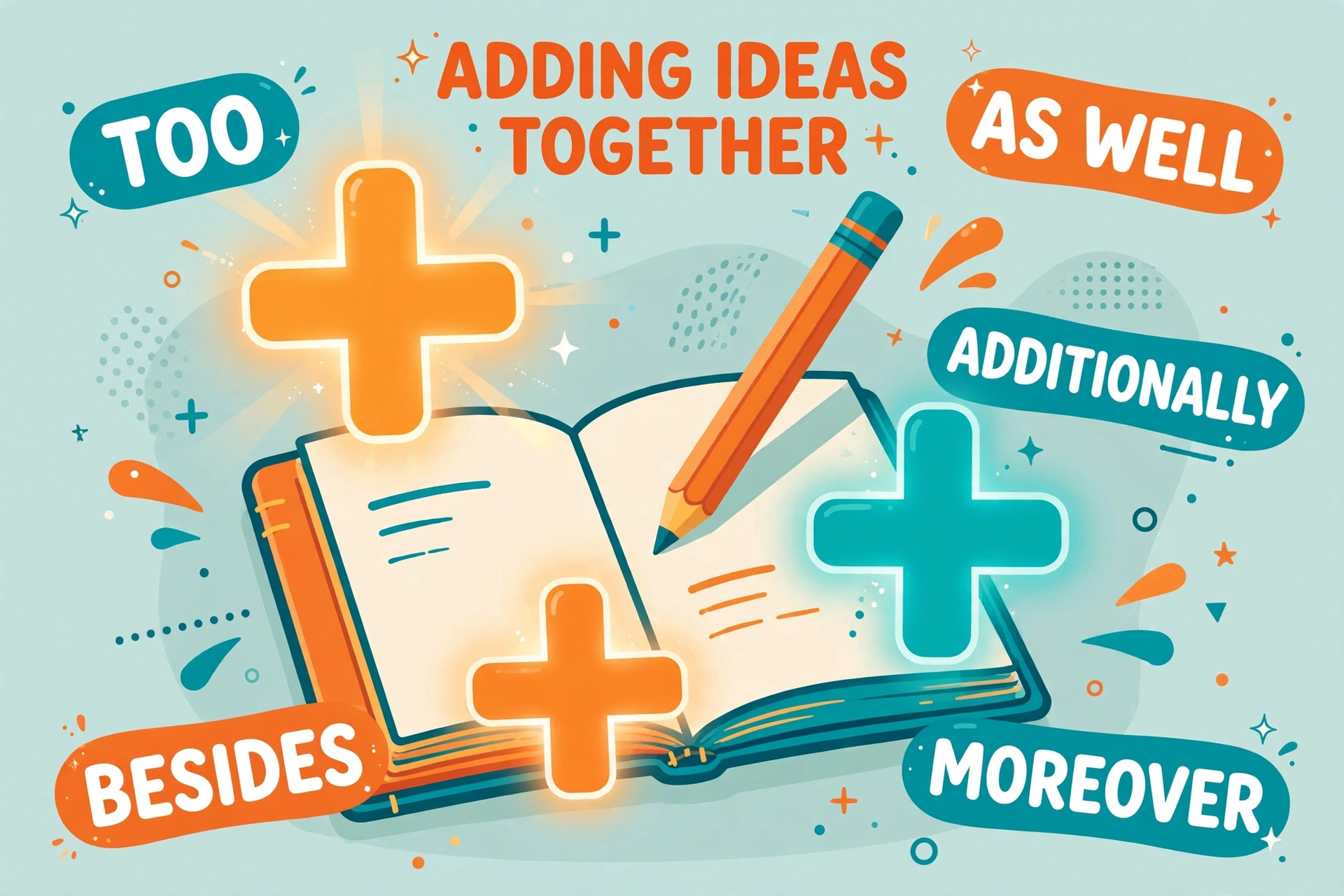
What Does “Also” Mean?
“Also” is an adverb of addition — it tells the reader “in addition to what I just said, this is true too.” Unlike conjunctions such as “and” or “but,” it doesn’t glue two clauses together; it adds extra weight to the point it sits near.
For example: “She speaks three languages. She also plays the piano.” The second sentence adds a brand-new fact. “Also” is perfect for everyday speech, but repeating it in essays makes writing feel flat.
The Closest Alternatives to “Also”
Too
Meaning: Adds something extra, usually at the end of a sentence.
Difference: More casual than “also”; sounds friendlier in speech.
Tone: Conversational, light.
Best Use: Everyday talk, texts, casual emails.
Example: “I loved the movie. My brother enjoyed it too.”
As Well
Meaning: Signals that something is true in addition to the last point.
Difference: Slightly more refined than “too.”
Tone: Neutral, smooth.
Best Use: Presentations, semi-formal writing, polite conversation.
Example: “The course covers grammar as well as vocabulary.”
Additionally
Meaning: Introduces a further point in a deliberate, structured way.
Difference: Much more formal; usually starts a sentence.
Tone: Professional, academic.
Best Use: Essays, research papers, business reports.
Example: “The hotel offers free parking. Additionally, breakfast is included in the price.”
In Addition
Meaning: Opens a sentence that adds another supporting fact.
Difference: More elegant than “also”; pairs naturally with “to.”
Tone: Formal, graceful.
Best Use: Academic writing, cover letters, official documents.
Example: “In addition to her teaching duties, she leads the debate club.”
Besides
Meaning: Adds an extra point, often one that strengthens the argument.
Difference: Can carry a hint of “and there’s more where that came from.”
Tone: Casual to neutral.
Best Use: Persuasive writing, conversations, debates.
Example: “The restaurant is cheap. Besides, the food is excellent.”
Furthermore
Meaning: Introduces a further, usually stronger, supporting point.
Difference: Implies the new point goes beyond the last one.
Tone: Formal, persuasive.
Best Use: Argumentative essays, speeches.
Example: “The policy saves money. Furthermore, it reduces waste across the company.”
Moreover
Meaning: Adds a point with emphasis, like “and on top of that.”
Difference: Slightly stronger and more deliberate than “furthermore.”
Tone: Formal, confident.
Best Use: Academic essays, legal and professional writing.
Example: “The course is affordable; moreover, it comes with a job guarantee.”
Likewise
Meaning: Shows that the same thing applies to another person or case.
Difference: Connects two matching situations, not just a new fact.
Tone: Neutral, slightly formal.
Best Use: Comparisons, instructions, formal correspondence.
Example: “Guests should silence their phones; likewise, staff should avoid calls in the lobby.”
Similarly
Meaning: Adds a point that resembles the previous one.
Difference: Highlights a parallel point.
Tone: Neutral, academic.
Best Use: Essays, data comparisons, explanations.
Example: “Tokyo has excellent public transport. Similarly, Osaka’s network is fast and reliable.”
Further
Meaning: Introduces extra information in a compact, formal way.
Difference: More clipped; common in business prose.
Tone: Formal, concise.
Best Use: Reports, contracts, official statements.
Example: “The package includes installation. Further details are available on our website.”
Plus
Meaning: Tacks on an extra benefit or item, often enthusiastically.
Difference: Very informal and punchy.
Tone: Casual, energetic.
Best Use: Marketing copy, lists, friendly conversation.
Example: “The job pays well, plus you get to work from home.”
What’s More
Meaning: Adds a point while stressing that it makes things even better.
Difference: Carries built-in emphasis.
Tone: Conversational, emphatic.
Best Use: Opinion pieces, blogs, persuasive speech.
Example: “The phone is cheap. What’s more, its battery lasts two full days.”
“Also” Synonyms at a Glance
| Alternative | Main Meaning | Tone | Best Use |
|---|---|---|---|
| Too | In addition, at the end of a sentence | Casual | Everyday speech |
| As well | Something is true in addition | Neutral | Presentations, polite talk |
| Additionally | A further point, stated formally | Formal | Essays, reports |
| In addition | Opens a sentence with a new fact | Formal | Academic and official writing |
| Besides | An extra point that strengthens the case | Casual–neutral | Debates, persuasion |
| Furthermore | A stronger supporting point | Formal | Argumentative essays |
| Moreover | An emphatic extra point | Formal | Academic, legal writing |
| Likewise | The same applies to another case | Neutral–formal | Comparisons, instructions |
| Similarly | A parallel, comparable point | Neutral | Essays, explanations |
| Further | Extra information, stated compactly | Formal | Reports, official statements |
| Plus | An extra benefit, announced with energy | Casual | Marketing, friendly talk |
| What’s more | An added point that tops the last one | Conversational | Blogs, opinion pieces |
Synonyms for “Also” by Context
Formal and Academic Writing
- Additionally — “Additionally, the study surveyed 2,000 participants.”
- Furthermore — “Furthermore, the results held across all age groups.”
- Moreover — “Moreover, the effect increased over time.”
- In addition — “In addition to the survey, interviews were conducted.”
- Further — “Further, the appendix contains the raw data.”
Casual Conversation and Messages
- Too — “I loved it too.”
- As well — “Bring your sister as well.”
- Plus — “It’s sunny, plus there’s a breeze.”
- Besides — “Come along. Besides, you’ll love the music.”
Business and Professional Writing
- In addition — “In addition, the team completed the audit early.”
- Additionally — “Additionally, quarterly targets were exceeded.”
- As well — “The proposal covers costs as well as timelines.”
- Further — “Further updates will follow tomorrow.”
How to Use “Also” Correctly
“Also” is an adverb, not a conjunction, so where you place it changes the meaning. Put it before the main verb (“She also sings”), after the verb “be” (“He is also a chef”), or between a helping verb and the main verb (“They have also finished”). Avoid starting formal sentences with “Also,” — it reads as abrupt in essays and reports, so use “Additionally” or “In addition” there instead. Never pair “also” with “too” in the same clause — “She also sings too” is redundant.
If you’re mastering the small words that shape sentences, our guide to synonyms for but covers the contrast side of the same coin.
When Not to Use a Synonym for “Also”
Mistake 1 — Using a formal word in a casual chat. Saying “Furthermore, I like pizza” at dinner sounds stiff and odd. Better: “I like pizza too.” Save “furthermore” and “moreover” for essays and professional writing.
Mistake 2 — Doubling up additives. Wrong: “I also went there too.” Corrected: “I went there too.” One word already carries the “in addition” meaning — using two is redundant.
Mistake 3 — Starting sentences with “Also,” in formal writing. Wrong: “Also, the budget was approved.” Corrected: “Additionally, the budget was approved.” Sentence-initial “also” is fine in texts and blogs but looks informal in reports and academic work.
Frequently Asked Questions
Can I start a sentence with “also”?
Yes, in casual writing and speech — “Also, don’t forget your keys.” In formal writing, though, prefer “Additionally,” or “In addition,” to sound polished.
What’s the difference between “also,” “too,” and “as well”?
All three add information. “Also” usually sits in the middle of the sentence, “too” goes at the end, and “as well” is the more polished version of “too” that can sit mid-sentence or at the end.
Is “also” too informal for essays?
Not always — mid-sentence “also” is fine in most essays. Just avoid repeating it every few sentences or starting paragraphs with it; mix in “additionally,” “furthermore,” or “moreover” for variety.
Want more vocabulary upgrades like this?
Browse our hub of synonyms for 200 common words to expand your vocabulary — one dedicated guide per word, each with examples and usage tips.
Faizi is a content writer at AllAboutFacts (hotteamnames.com), covering vocabulary, language tips, and everyday explainers.


