
Synonyms for While: 25+ Better Words and Examples
Last updated: October 6, 2026
Thank you for reading this post, don't forget to subscribe!“While” is one of the hardest-working words in English, but repeating it in every sentence makes your writing sound flat. Whether you mean “during the time that” or “although,” there is almost always a sharper alternative. This guide breaks down 25+ synonyms for “while,” with each word’s meaning, tone, and real examples, so you can pick the right one every time. For quick lookups, bookmark the Merriam-Webster Thesaurus.
Table of Contents
- Quick Answer
- What Does “While” Mean?
- The Closest Alternatives to “While”
- “While” Synonyms at a Glance
- Synonyms for “While” by Context
- How to Use “While” Correctly
- When Not to Use a Synonym for “While”
- Frequently Asked Questions
Quick Answer
The best synonyms for “while” depend on which meaning you need. Here are the top picks:
- During — for events that happen inside a time period
- Throughout — for something that continues the whole time
- As — for two things happening at the same moment
- When — for a general time reference
- Whereas — for direct contrast between two ideas
- Although — for concession and “despite the fact that”
- Though — a slightly less formal version of although
- Whilst — the formal or British equivalent of while
- Meanwhile — for “at the same time” as a separate clause
- Even though — for stronger emphasis on the contrast
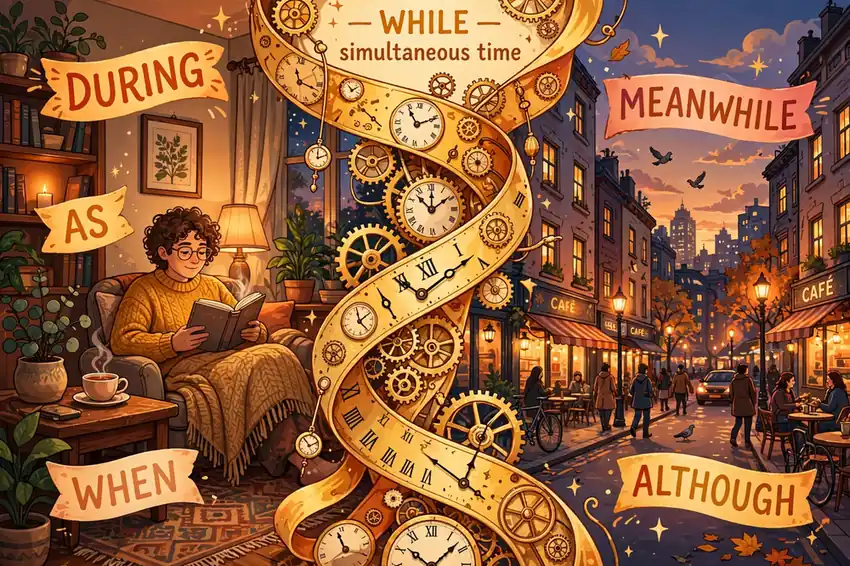
What Does “While” Mean?
“While” is a conjunction, preposition, and noun, so its meaning shifts with its job in the sentence:
- Conjunction (time): it joins two clauses to show that two things happen at the same time. Example: “I read while she cooked dinner.”
- Conjunction (contrast): it introduces an idea that contrasts with the main clause. Example: “While I like tea, my brother prefers coffee.”
- Preposition (British/poetic): in older or literary English it can mean “until,” as in “rest a while.” Example: “Wait a while before you reply.”
- Noun: “a while” means a period of time. Example: “It took a while to finish the project.”
Because it wears so many hats, swapping in the right synonym means first asking: am I talking about time, or about contrast?
The Closest Alternatives to “While”
1. During
Meaning: within the period of an event or activity.
Difference: “During” is a preposition, so it is followed by a noun phrase, not a full clause.
Tone: neutral and widely used.
Best use: when the second idea is a simple noun phrase.
Example: “The lights flickered during the storm.”
2. Throughout
Meaning: in every part of a period of time or space.
Difference: stronger than “during” — it stresses that something continued the whole time, not just at some point.
Tone: neutral, slightly formal.
Best use: when the action lasts the entire period.
Example: “She stayed calm throughout the interview.”
3. As
Meaning: at the same time that something else happens.
Difference: “as” emphasizes two actions overlapping at the exact same moment.
Tone: neutral, everyday.
Best use: short, simultaneous actions.
Example: “As I opened the door, the phone rang.”
4. When
Meaning: at or during the time that.
Difference: “when” is broader and looser than “while”; it does not stress that both things lasted equally long.
Tone: neutral and casual.
Best use: general time references, especially in spoken English.
Example: “Call me when you reach the station.”
5. Whilst
Meaning: exactly the same as “while” in both its time and contrast senses.
Difference: mostly a style choice — it is formal and chiefly British, so it can sound stiff in American writing.
Tone: formal, literary.
Best use: formal or academic British English.
Example: “The committee deliberated whilst the press waited outside.”
6. Whereas
Meaning: in contrast or comparison with the fact that.
Difference: “whereas” only replaces the contrast meaning of “while,” never the time meaning.
Tone: formal, precise.
Best use: comparisons and academic or legal writing.
Example: “The north saw record rainfall, whereas the south stayed dry.”
7. Although
Meaning: in spite of the fact that.
Difference: like “whereas,” it covers only the contrast sense, and it admits a surprising or opposing fact.
Tone: neutral to formal.
Best use: conceding a point before making your main one.
Example: “Although it was raining, the match continued.”
8. Though
Meaning: the same as “although,” with a slightly more conversational feel.
Difference: “though” is more flexible in placement and tone than “although.”
Tone: neutral, conversational.
Best use: everyday writing and speech.
Example: “Though tired, she kept working on the report.”
9. Meanwhile
Meaning: at the same time as something else is happening.
Difference: an adverb that starts its own clause or sentence, rather than joining two clauses.
Tone: neutral, narrative.
Best use: storytelling and switching between two simultaneous scenes.
Example: “I packed my bag; meanwhile, the taxi waited outside.”
10. Even Though
Meaning: despite the fact that; a stronger version of “although.”
Difference: adds extra emphasis to the contrast, making the opposition feel sharper.
Tone: neutral, emphatic.
Best use: when you want the reader to feel the tension between the two ideas.
Example: “Even though the road was closed, they found a way through.”
“While” Synonyms at a Glance
| Alternative | Main Meaning | Tone | Best Use |
|---|---|---|---|
| During | within a time period | Neutral | Noun phrases (“during the meeting”) |
| Throughout | for the whole time | Neutral-formal | Continuous actions |
| As | at the same moment | Neutral | Two overlapping actions |
| When | at the time that | Neutral-casual | General time references |
| Whilst | identical to “while” | Formal | Formal British writing |
| Whereas | in contrast to | Formal | Comparisons |
| Although | despite the fact that | Neutral-formal | Concessions |
| Though | despite the fact that | Neutral | Everyday writing |
| Meanwhile | at the same time | Neutral | Narrative scene-switching |
| Even though | despite the fact that | Emphatic | Strong contrast |
Synonyms for “While” by Context
Formal and Academic Writing
- Whereas — for precise contrasts in essays and reports.
- Although — for concessions that keep an academic tone.
- Throughout — for describing sustained conditions or periods.
- Whilst — acceptable in British academic prose.
Casual Speech and Everyday Writing
- When — the most natural time word in conversation.
- Though — a friendly way to admit a contrast.
- As — quick and easy for simultaneous actions (“as I left”).
Business and Professional Writing
- During — crisp and professional (“during the review period”).
- Meanwhile — useful for updates on parallel workstreams.
- Although — polite concession in emails and reports.
Storytelling and Narrative
- As — keeps action tight and immediate.
- Meanwhile — perfect for cutting between two scenes.
- All the while — a vivid phrase for something happening in the background.
How to Use “While” Correctly
“While” is a subordinating conjunction, which means the clause it introduces cannot stand alone. Place a comma before “while” when it means “although” or “whereas,” but not always when it means “during the time that.”
- Time: “She sang while she cooked.” (no comma needed)
- Contrast: “I prefer mornings, while my sister is a night owl.” (comma helps signal contrast)
After “while,” use the continuous tense for ongoing background actions: “While I was waiting, I read a book.” With contrast “while,” the simple tense is fine: “While some people love crowds, others avoid them.”
Common pairings: while + clause (“while the meeting was running”), a while as a noun (“in a while,” “for a while”), and while away as a phrasal verb meaning to pass time pleasantly (“we whiled away the afternoon”).
If you are building a strong vocabulary toolkit, you may also enjoy our guide to synonyms for 200 common words to expand your vocabulary, which covers many of the small connector words writers overuse.
When Not to Use a Synonym for “While”
Mistake 1: Using a time synonym for a contrast meaning.
- Wrong: “During I like coffee, she likes tea.” (“During” needs a noun, not a clause.)
- Corrected: “While I like coffee, she likes tea.” / “Whereas I like coffee, she likes tea.”
Mistake 2: Dropping the comma that signals contrast.
- Confusing: “I stayed inside while it rained.” (Was it raining at the same time, or despite the rain?)
- Clearer: “I stayed inside while it rained.” (time) vs. “I stayed inside, although it had stopped raining.” (contrast)
Mistake 3: Overusing “while” for every simultaneous action.
- Weak: “While I was eating, while the TV was on, while the dog barked…”
- Corrected: “As I ate, the TV played in the background and the dog barked.” (vary the connectors)
Frequently Asked Questions
Is “whilst” the same as “while”?
Yes, in meaning. “Whilst” is simply the formal, mostly British variant. In American English it can sound pretentious, so “while” is usually the safer pick. If you enjoy contrast words like this, see our article on synonyms for furthermore for more formal connectors.
Can “while” mean “although”?
Yes. “While” has a well-established contrast sense: “While I understand your point, I disagree.” Use “although” or “whereas” when you want that meaning to be unmistakable.
What is the difference between “while” and “during”?
“While” is followed by a clause with a subject and verb (“while we waited”), while “during” is followed by a noun phrase (“during the wait”). They are not interchangeable without restructuring the sentence.
Is “a while” one word or two?
As a noun phrase meaning “a period of time,” it is two words: “a while.” The one-word “awhile” is an adverb: “Stay awhile.” Mixing them up is one of the most common errors with this word family.
Faizi is a content writer at AllAboutFacts (hotteamnames.com), covering vocabulary, language tips, and everyday explainers.


