
Race vs Ethnicity: What’s the Difference? Explained
Last updated: October 24, 2026
Thank you for reading this post, don't forget to subscribe!Table of Contents
- Quick Answer
- What Is Race?
- What Is Ethnicity?
- Race vs Ethnicity: The Key Differences
- Can You Have More Than One Race or Ethnicity?
- Real-World Examples
- Common Misconceptions
- Why the Distinction Actually Matters
- Frequently Asked Questions
Quick Answer
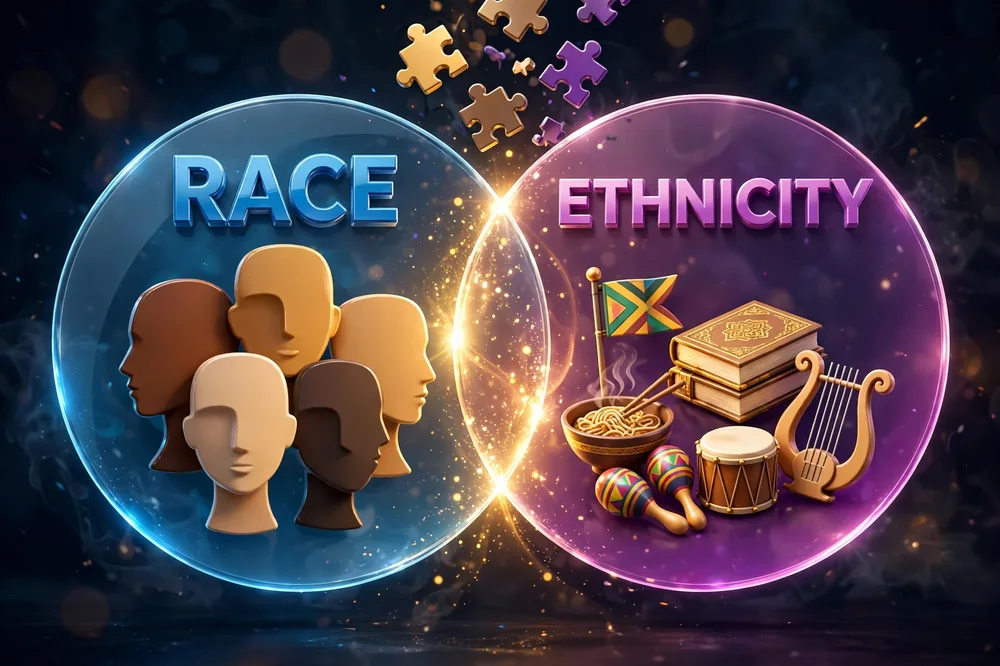
Race describes how society classifies people based on physical traits — mainly skin color, facial features, and hair texture — and is widely understood by sociologists as a social construct rather than a biological fact. Ethnicity describes a shared culture: language, ancestry, religion, traditions, and a sense of belonging to a group. In short: race is how you are categorized by visible traits, while ethnicity is the culture and heritage you identify with.
What Is Race?
Race is a social classification system that groups people according to physical characteristics that a society treats as important — most often skin color, but also facial features and hair texture. The sociology of race and ethnic relations treats race as a social construct: racial categories were created by societies, not discovered in biology.
History backs this up: Irish and Italian immigrants were once treated as separate, lesser races in the United States before being absorbed into the broader “white” category, and census categories keep changing across the decades.
Genetics backs this up: there is more genetic variation within any single racial group than between racial groups. Yet race remains a powerful social reality that shapes how people are perceived and treated.
What Is Ethnicity?
Ethnicity is about culture, not appearance. An ethnic group is a community of people who share a sense of identity built from things like language, ancestry, religion, food, traditions, and a common history. The word comes from the Greek ethnos, meaning “people” or “nation.”
Examples make it concrete. Someone’s ethnicity might be Irish, Korean, Nigerian, Mexican, Jewish, or Cherokee. Unlike race — which is usually assigned by how you look — ethnicity is far more personal. People often choose how strongly to embrace their ethnic heritage, celebrate its holidays, cook its food, and pass its traditions to their children.
Ethnic identity can also blend — Irish-American or British-Pakistani identities combine a heritage culture with the culture of the country someone lives in.
Race vs Ethnicity: The Key Differences
Put side by side, the two concepts work very differently:
| Race | Ethnicity | |
|---|---|---|
| Based on | Physical traits: skin color, facial features, hair texture | Culture: language, ancestry, religion, traditions |
| How it forms | Largely assigned by society based on appearance | Often self-identified through family and culture |
| Can it change? | Generally fixed; you cannot simply opt into another race | Can shift with migration, marriage, and assimilation |
| Scope | Broad categories (Black, White, Asian) | Narrower groups (Cuban, Polish, Navajo) |
| Example | Two people racially classified as Asian | …may be ethnically Chinese, Korean, or Filipino |
Can You Have More Than One Race or Ethnicity?
Yes — and increasingly, many people do. Mixed-race and multiracial identities are among the fastest-growing categories on census forms, and multiracial people may identify with one background more strongly than another.
Multiple ethnicities are even more common. A person raised by an Italian mother and a Mexican father, speaking both languages, belongs to two ethnic traditions at once. People tend to be more comfortable claiming mixed ethnicity than mixed race — ethnicity feels like a story you tell about yourself, while race feels like a label others apply.
Real-World Examples
Real life makes the distinction easier to grasp than any definition:
- Latino is an ethnicity, not a race. People who identify as Hispanic or Latino can be of any race — White, Black, Indigenous, or mixed. This is why the U.S. Census asks about Hispanic origin separately from race.
- Brazil is the classic case. “Brazilian” is an ethnicity and a nationality, yet Brazilians belong to many different racial groups, from White to Black to multiracial to Indigenous. Coverage of international stars often touches on exactly this — our article on Gisele Bündchen And Rian Johnson: Any Real Connection? looks at the Brazilian supermodel alongside the American director, a pairing that shows how nationality and ethnicity get discussed very differently from race.
- Same country, different ethnicities. Sports coverage is full of examples — our piece on Chloe Kim And Myles Garrett: Are They Engaged? follows two American athletes from very different cultural backgrounds, a reminder that sharing a nationality does not mean sharing an ethnicity.
- Black communities are not one ethnicity. In the United States, the racial category “Black” includes African Americans, Afro-Caribbean communities, and recent African immigrants — groups with distinct languages, histories, and traditions.
Common Misconceptions
1. “Race and ethnicity mean the same thing.” They overlap in everyday speech, but they measure different things — appearance versus culture.
2. “Nationality is the same as ethnicity or race.” Nationality tells you which country someone belongs to, not their race or ethnicity. Business coverage illustrates the difference well — our article on Carlos Slim And Donald Trump: Are They Friends Or Foes? profiles a Mexican billionaire whose background is described in terms of nationality and heritage, which are two different ideas.
3. “Race is purely biological.” Physical traits like skin color are real and inherited, but the way humans sort those traits into a handful of racial categories — and which traits count — is decided by society. That is why the categories differ between countries.
4. “You can tell someone’s ethnicity by looking at them.” You cannot. Two people of the same race may belong to completely different ethnic groups, and two people of different races may share an ethnicity.
5. “Ethnicity never changes.” It can. Immigrants and their children often blend the culture of their heritage with the culture around them, creating hyphenated identities over a generation or two.
Why the Distinction Actually Matters
This is not just an academic exercise. Race and ethnicity appear on job applications, school forms, medical records, and census surveys. Researchers also study the two separately, because grouping people by culture can reveal patterns that grouping by appearance hides.
On a personal level, the distinction gives people better language for their own identity — race for how society categorizes you, ethnicity for the culture you belong to.
Frequently Asked Questions
Is Hispanic a race or an ethnicity?
Hispanic (or Latino) is an ethnicity, not a race. It refers to people with cultural ties to Spanish-speaking countries, and Hispanic people can be of any race — White, Black, Indigenous, Asian, or mixed.
What is the difference between race, ethnicity, and nationality?
Race is a social category based on physical traits. Ethnicity is a shared culture and heritage. Nationality is the country you are a citizen of. A person can be racially Black, ethnically Haitian, and French by nationality — all at once.
Can my ethnicity change over time?
Yes, more easily than race. Migration, intermarriage, language adoption, and cultural blending can all reshape ethnic identity across a lifetime or between generations.
Why do forms ask about race and ethnicity separately?
Because they capture different information. Separating them — as the U.S. Census does — recognizes that one racial group can contain many ethnicities, and that culture and appearance do not always line up.
Faizi is a content writer at AllAboutFacts (hotteamnames.com), covering vocabulary, language tips, and everyday explainers.