Synonyms for Proud: 25+ Better Words and Examples
Last updated: October 6, 2026
Thank you for reading this post, don't forget to subscribe!Proud is one of those words that carries two very different moods: it can glow with earned satisfaction — “I’m so proud of my daughter” — or sting with arrogance, as in “he’s too proud to admit he was wrong.” Because it covers both celebration and conceit, synonyms for proud let you pick exactly the shade you mean. Swapping in a word like triumphant, gratified, or self-assured makes your writing sharper and your praise more specific. According to the Merriam-Webster Thesaurus, the right alternative depends on whether you mean joy in an achievement, quiet dignity, or excessive self-importance — and this guide walks through all three. Our guide to synonyms for confident is a useful companion, since confidence and pride often overlap.
Table of Contents
- Quick Answer
- What Does “Proud” Mean?
- The Closest Alternatives to “Proud”
- “Proud” Synonyms at a Glance
- Synonyms for “Proud” by Context
- Grammar and Sentence Structure
- When Not to Use a Synonym for “Proud”
- Frequently Asked Questions
Quick Answer
- Triumphant — pride after winning or overcoming something big
- Gratified — quiet satisfaction when something turns out well
- Self-assured — calm, steady pride in your own abilities
- Elated — proud plus joyful, a high-energy celebration
- Satisfied — content pride in a job done properly
- Pleased — light, friendly pride in a good result
- Honored — humble pride in being chosen or recognized
- Dignified — proud with composure and self-respect
- Boastful — pride that shows off, often annoying to others
- Arrogant — the negative extreme: pride that looks down on people
What Does “Proud” Mean?
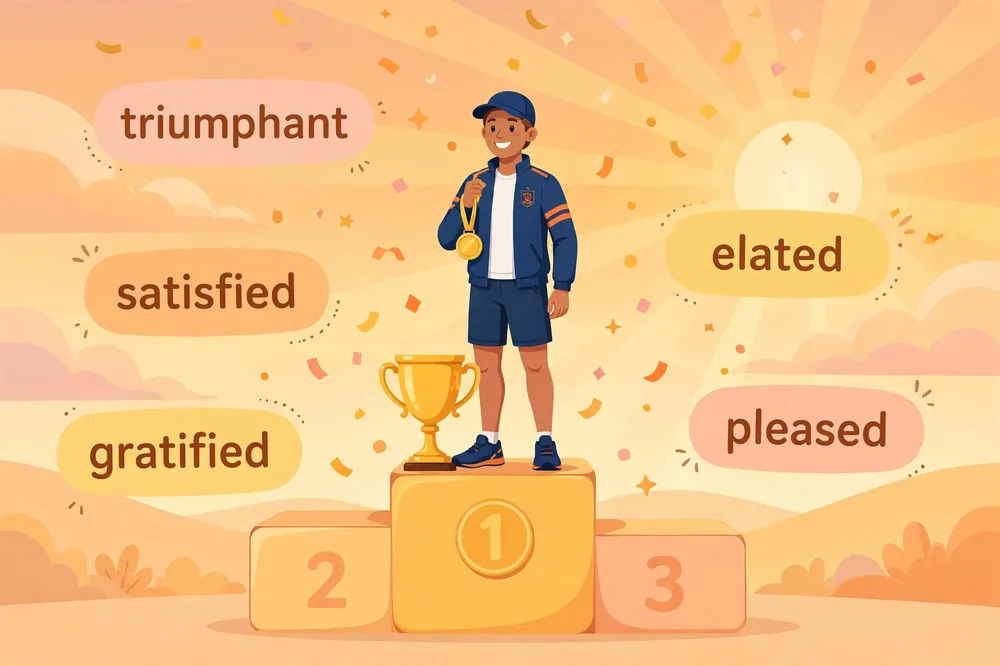
Proud describes the feeling of deep satisfaction that comes from your own achievements, qualities, or associations — the things you are happy to call yours. A parent is proud of a child’s graduation, a team is proud of a hard-fought win, a craftsman is proud of work done well. In these senses, pride is a warm, positive emotion tied to effort and identity.
But proud has a darker edge. It can also mean having an excessively high opinion of yourself: “too proud to apologize” or “proud people rarely ask for help.” In this sense it sits close to arrogant and conceited. Context tells you which pride you are dealing with — “proud of my team” glows, while “proud and unyielding” warns.
Examples: She felt a surge of pride as her name was called on stage. He was too proud to admit the mistake, so it cost him the deal.
The Closest Alternatives to “Proud”
Triumphant
Meaning: Feeling or showing joy after a victory or major success.
Difference: Stronger than “proud” — it implies you beat real odds or competition.
Tone: Energetic, celebratory.
Best Use: Sports, elections, competitions, and any hard-won achievement.
Example: The triumphant team lifted the trophy as the crowd roared.
Gratified
Meaning: Quietly pleased that something has turned out well or been appreciated.
Difference: Softer and more inward than “proud”; less about ego, more about relief and contentment.
Tone: Calm, modest.
Best Use: Thank-you notes, reviews, and professional praise.
Example: She was gratified to hear that readers loved her first novel.
Self-assured
Meaning: Confident in your own abilities, without needing to prove it.
Difference: Pride as steady confidence rather than an emotional high; it is about trust in yourself.
Tone: Composed, mature.
Best Use: Job interviews, leadership writing, and character descriptions.
Example: He walked into the interview calm and self-assured.
Elated
Meaning: Very happy and excited, often after good news or success.
Difference: Adds joy on top of pride — it is the feeling, not the self-regard.
Tone: Bright, enthusiastic.
Best Use: Celebrations, personal milestones, and joyful announcements.
Example: She was elated when she learned she had won the scholarship.
Satisfied
Meaning: Content because expectations or standards were met.
Difference: Quieter than “proud” — it signals a job done right rather than a chest-thumping win.
Tone: Neutral, settled.
Best Use: Work reviews, customer feedback, and everyday results.
Example: He looked at the finished garden with a satisfied smile.
Pleased
Meaning: Mildly happy about something good that happened.
Difference: Lighter and friendlier than “proud”; works for small wins and compliments.
Tone: Warm, gentle.
Best Use: Emails, compliments, and polite conversation.
Example: The teacher was pleased with how quickly the class improved.
Honored
Meaning: Feeling privileged and grateful to be recognized or chosen.
Difference: Pride turned humble — the spotlight is on the recognition, not the self.
Tone: Modest, gracious.
Best Use: Award speeches, thank-yous, and invitations.
Example: I am honored to accept this award on behalf of our team.
Dignified
Meaning: Showing pride through composure, self-respect, and good conduct.
Difference: Pride as behavior rather than feeling — how you carry yourself.
Tone: Serious, respectful.
Best Use: Obituaries, formal speeches, and descriptions of character.
Example: Even in defeat, she remained dignified and gracious.
Boastful
Meaning: Showing pride by talking too much about your achievements.
Difference: This is pride performed for an audience — and it usually annoys people.
Tone: Negative, showy.
Best Use: Describing someone who brags, or warning against it.
Example: His boastful stories about his salary made everyone uncomfortable.
Arrogant
Meaning: Pride that looks down on others; believing you are better than everyone.
Difference: The negative extreme of “proud” — it insults rather than celebrates.
Tone: Strong, negative.
Best Use: Criticism, villain descriptions, and cautionary writing.
Example: The arrogant manager never listened to anyone else’s ideas.
“Proud” Synonyms at a Glance
| Alternative | Main Meaning | Tone | Best Use |
|---|---|---|---|
| Triumphant | Joy after a big win | Celebratory | Sports, competitions |
| Gratified | Quiet, modest satisfaction | Calm | Reviews, praise |
| Self-assured | Steady self-confidence | Composed | Interviews, leadership |
| Elated | Proud plus joyful | Enthusiastic | Celebrations, milestones |
| Satisfied | Content with the result | Neutral | Work, feedback |
| Pleased | Lightly happy | Warm | Emails, compliments |
| Honored | Grateful to be recognized | Gracious | Awards, speeches |
| Dignified | Proud through composure | Respectful | Formal writing |
| Boastful | Pride that belittles others | Negative | Describing braggarts |
| Arrogant | Pride that belittles others | Negative | Criticism, villains |
Synonyms for “Proud” by Context
Celebrating Achievements
- Triumphant — for wins over real competition or hardship
- Elated — when the pride is bursting with joy
- Satisfied — for a hard job done properly and quietly
Formal Writing
- Dignified — pride expressed through conduct and composure
- Gratified — modest satisfaction, safe for essays and reports
- Honored — the go-to word for awards and formal recognition
Workplace Praise
- Self-assured — describing confident, capable colleagues
- Pleased — light, professional praise in emails and reviews
- Satisfied — acknowledging good work without overstatement
The Negative Shade (Arrogance)
- Boastful — when pride becomes loud bragging
- Arrogant — pride that looks down on others
- Conceited — pride focused on looks, status, or talent
Grammar and Sentence Structure
Proud is an adjective, and its most common partner is the preposition of: “proud of my son,” “proud of the results,” “proud of yourself.” It can also pair with to + verb (“proud to serve,” “proud to announce”) and with that clauses (“I’m proud that we finished on time”). Most synonyms follow similar patterns — you can be pleased with results, satisfied with progress, gratified by feedback, or honored to accept an award — but triumphant and elated usually stand alone (“a triumphant return,” “she was elated”).
Our pillar guide on synonyms for 200+ common words to expand your vocabulary covers more adjective-and-preposition pairings like these. One rule of thumb: if the word describes a feeling about something, use “of” or “with”; if it describes the feeling itself, no preposition is needed.
When Not to Use a Synonym for “Proud”
Mistake 1: Using “arrogant” as a positive.
Wrong: The coach was arrogant of his players.
Corrected: The coach was proud of his players. (“Arrogant” is always negative — it means looking down on others.)
Mistake 2: Swapping “pleased” into serious achievements.
Wrong: After ten years of research, the scientist was pleased.
Corrected: After ten years of research, the scientist was triumphant. (“Pleased” is too light for a decade of work.)
Mistake 3: Using “honored” for your own solo effort.
Wrong: I’m honored that I scored the winning goal.
Corrected: I’m proud that I scored the winning goal. (“Honored” fits recognition given by others, not your own achievement.)
Frequently Asked Questions
What is the best synonym for proud in a positive sense?
Gratified or satisfied work well for quiet, healthy pride, while triumphant suits big wins and honored fits formal recognition. Pick the one that matches the size of the achievement.
Is “proud” a positive or negative word?
Both. “Proud of” someone or something is positive — it means earned satisfaction. But “proud” alone, especially in phrases like “too proud,” can mean stubborn self-importance. Check which meaning your sentence needs, then choose a synonym accordingly.
What is the difference between proud and arrogant?
“Pride” is satisfaction in real achievement or identity, while “arrogance” adds a belief that you are better than everyone else. You can be proud of your team without insulting anyone — arrogance needs a target.
What preposition goes with “proud”?
“Proud of” is the standard pairing: “proud of my parents,” “proud of our work.” Use “proud to” with verbs (“proud to serve”) and “proud that” with clauses (“proud that she passed”).
Faizi is a content writer at AllAboutFacts (hotteamnames.com), covering vocabulary, language tips, and everyday explainers.


