
Synonyms for Hot: 25+ Better Words and Examples
Last updated: October 6, 2026
Thank you for reading this post, don't forget to subscribe!Looking for better synonyms for “hot”? This everyday word does a lot of heavy lifting — from weather and food to trends and tempers — so choosing a sharper replacement can make your writing far more vivid. Below you will find over 25 alternatives with meanings, examples, and tips, based on careful research of the Merriam-Webster Thesaurus. If you are building a stronger vocabulary overall, browse our pillar guide to synonyms for 200 common words next.
Table of Contents
- Quick Answer
- What Does “Hot” Mean?
- The Closest Alternatives to “Hot”
- Hot Synonyms at a Glance
- Synonyms for “Hot” by Context
- Grammar and Sentence Structure
- When Not to Use a Synonym for “Hot”
- Frequently Asked Questions
Quick Answer
The best all-purpose synonyms for “hot” include:
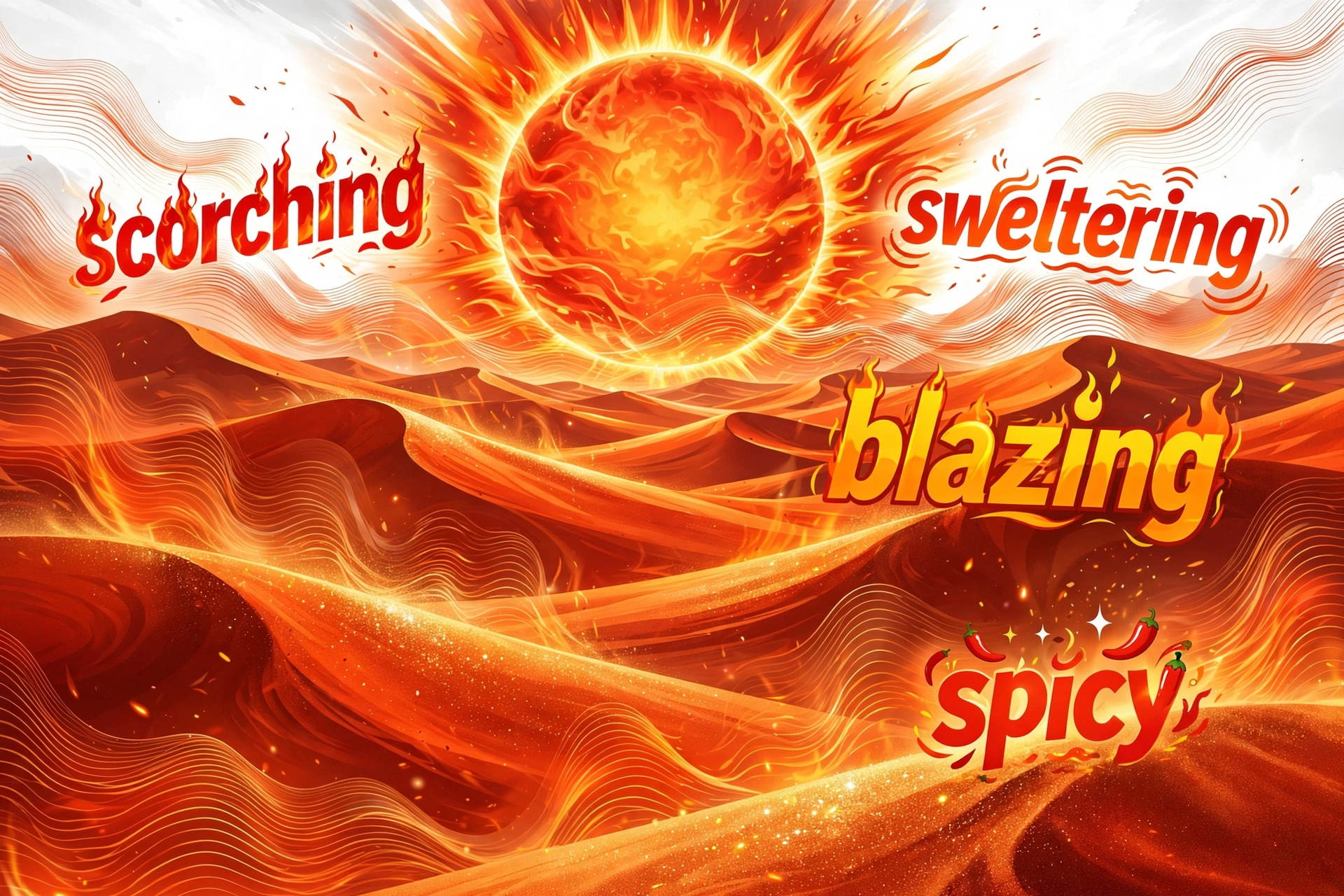
- Scorching — for extreme, blazing heat, especially weather or surfaces.
- Blazing — for intense heat that feels fast-moving or dramatic.
- Sweltering — for hot, humid, uncomfortable air.
- Boiling — for liquids or moments at peak temperature.
- Spicy — for food with heat from chili or pepper.
- Trendy — for something popular and fashionable right now.
- In demand — for products, skills, or people everyone wants.
- Attractive — for a good-looking person or appealing offer.
- Fiery — for strong passion, temper, or flavor.
- Heated — for arguments or debates full of strong feelings.
What Does “Hot” Mean?
“Hot” is one of the most flexible words in English. At its core, it describes something with a high temperature — the opposite of cold. From there it branches out: food can be hot (spicy or temperature), a person can be hot (attractive), a topic can be hot (trendy or controversial), a tip can be hot (fresh and urgent), and stolen goods are famously called hot in slang.
Example: “The soup was too hot to eat right away.” — Here it means high temperature. “That new phone is the hot product this year.” — Here it means trendy and in demand.
The Closest Alternatives to “Hot”
1. Scorching
Meaning: Extremely hot; hot enough to burn.
Difference: Stronger than “hot” — it implies damaging intensity.
Tone: Dramatic, descriptive.
Best Use: Weather reports, travel writing, descriptions of deserts or engines.
Example: “We crossed the desert at noon under scorching heat.”
2. Blazing
Meaning: Burning fiercely and brightly.
Difference: Suggests visible fire or fierce energy, more dynamic than “hot.”
Tone: Energetic, vivid.
Best Use: Creative writing, news about fires, describing intense sunlight.
Example: “The blazing sun made the beach sand too warm to walk on.”
3. Sweltering
Meaning: Uncomfortably hot and humid.
Difference: Focuses on how the heat feels on the body, not the temperature itself.
Tone: Slightly negative, weary.
Best Use: Describing summer weather, crowded places, tropical climates.
Example: “The sweltering afternoon sent everyone running for shade.”
4. Boiling
Meaning: At or near the temperature where liquid turns to steam.
Difference: Precise — tied to water’s boiling point, so it sounds more scientific.
Tone: Direct, sometimes exaggerated for effect.
Best Use: Cooking instructions, literal descriptions, dramatic exaggeration (“boiling mad”).
Example: “Drop the pasta into a pot of boiling water.”
5. Spicy
Meaning: Having a sharp, burning flavor from chili, pepper, or ginger.
Difference: Applies to flavor heat, not temperature heat.
Tone: Neutral to enthusiastic.
Best Use: Food reviews, recipes, restaurant menus.
Example: “The spicy curry left a pleasant warmth in my mouth.”
6. Trendy
Meaning: Fashionable and popular at the moment.
Difference: Captures the “hot topic” sense with none of the temperature meaning.
Tone: Casual, modern.
Best Use: Lifestyle writing, marketing, social media.
Example: “Oversized jackets are the trendy pick this season.”
7. In Demand
Meaning: Wanted by many people; highly sought after.
Difference: Describes market value rather than popularity vibes.
Tone: Professional, businesslike.
Best Use: Job postings, business articles, real estate.
Example: “Skilled electricians are in demand across the city.”
8. Attractive
Meaning: Pleasing to look at or appealing in general.
Difference: Polite and versatile; “hot” for a person can sound crude, while “attractive” is respectful.
Tone: Neutral, courteous.
Best Use: Formal writing, professional descriptions, compliments.
Example: “The job offer was attractive because of its flexible hours.”
9. Fiery
Meaning: Full of intense passion, anger, or flavor.
Difference: Emphasizes emotional or sensory intensity rather than temperature alone.
Tone: Passionate, literary.
Best Use: Describing personalities, speeches, flavors, sunsets.
Example: “She gave a fiery speech that moved the whole audience.”
10. Heated
Meaning: Full of strong feeling; made hot, especially a debate or argument.
Difference: Almost always describes conflict or discussion, not temperature.
Tone: Serious, journalistic.
Best Use: News writing, essays about debates or negotiations.
Example: “The council meeting turned into a heated argument about taxes.”
“Hot” Synonyms at a Glance
| Alternative | Main Meaning | Tone | Best Use |
|---|---|---|---|
| Scorching | Extremely hot weather or surfaces | Dramatic | Weather, travel writing |
| Blazing | Fiercely burning or sunny | Energetic | Creative writing, news |
| Sweltering | Hot and humid air | Weary | Summer descriptions |
| Boiling | At peak temperature | Direct | Cooking, science |
| Spicy | Burning food flavor | Neutral | Recipes, food reviews |
| Trendy | Fashionable right now | Casual | Lifestyle, marketing |
| In demand | Highly sought after | Professional | Business, jobs |
| Attractive | Pleasing or appealing | Courteous | Formal writing |
| Fiery | Passionate, intense | Literary | Speeches, descriptions |
| Heated | Full of strong feeling | Serious | News, debates |
Synonyms for “Hot” by Context
Weather and Climate
Use precise weather words: scorching, sweltering, blistering, tropical, torrid.
- “A blistering heatwave hit the city in July.”
- “The torrid climate makes afternoon naps a necessity.”
Food and Cooking
Separate temperature from flavor: steaming, piping hot, spicy, peppery, zesty.
- “Serve the soup steaming with fresh bread.”
- “The zesty salsa balanced the rich tacos.”
Business and Trends
Sound professional instead of slangy: trending, in demand, sought-after, popular, up-and-coming.
- “Cybersecurity skills are highly sought-after this year.”
- “The up-and-coming neighborhood drew young buyers.”
Emotions and Conflict
Describe intensity accurately: heated, fiery, passionate, intense, explosive. (Compare with our guide to synonyms for sad when you need the opposite end of the emotional spectrum.)
- “The debate grew heated after the second question.”
- “He had an explosive temper as a young man.”
Grammar and Sentence Structure
“Hot” is an adjective with comparatives hotter and hottest. Note the doubled t — a common spelling rule for short adjectives ending in a consonant after a short vowel. It works both before nouns (“a hot day”) and after linking verbs (“the day is hot”).
Longer synonyms cannot take “-er” and need “more”: say “Today is hotter than yesterday” but “Today is more sweltering than yesterday”. Also watch the “stolen goods” slang sense: “hot” meaning stolen (as in “a hot car”) has no true synonym that sounds natural — “stolen” itself is the only safe replacement.
When Not to Use a Synonym for “Hot”
Mistake 1: Using “spicy” for temperature.
Wrong: “The tea was too spicy to drink.”
Corrected: “The tea was too hot to drink.” — Spicy describes flavor from chili or pepper, not temperature.
Mistake 2: Using “heated” for literal temperature.
Wrong: “The heated soup burned my tongue.”
Corrected: “The hot soup burned my tongue.” — Heated usually describes arguments or emotions; for food it sounds like the soup was reheated.
Mistake 3: Using “attractive” when you mean trendy.
Wrong: “That app is very attractive right now.”
Corrected: “That app is very trendy right now.” — Attractive describes appeal, not popularity.
Frequently Asked Questions
What is the best formal synonym for “hot”?
For temperature, “scorching” or “sweltering” work well in formal writing. For popularity, use “in demand” or “sought-after” — they sound professional without slang.
What is a polite way to say someone is hot?
Use “attractive,” “good-looking,” or “striking.” They are respectful and work in any setting where “hot” might sound crude.
Can “hot” mean something other than temperature?
Yes — it can mean trendy (“a hot topic”), attractive (“a hot actor”), urgent (“a hot lead”), spicy (“hot sauce”), or even stolen (“hot goods”). Always match your synonym to the intended sense.
What is the difference between “hot” and “spicy”?
“Hot” can mean high temperature or burning flavor. “Spicy” only means burning flavor from spices — it never describes temperature. “Hot soup” is about temperature; “spicy soup” is about chili heat.
Faizi is a content writer at AllAboutFacts (hotteamnames.com), covering vocabulary, language tips, and everyday explainers.


